Voted one of the "World's Best Bars", New York's Dante has its first pop-up in London at Madison Rooftop Bar (from September 29 to October 4). Between 4pm and 9pm it will be hosting an "aperitivo happy hour".
During its residency at Madison, the Dante team are serving some of their greatest hits such as the Garibaldi, the Italian sour and the chocolate negroni. In addition, they have created two new cocktails inspired by Madison’s rooftop scene – Endless Summer and Rooftop Life.
The category of aperitifs is a broad one and there are many ingredients and products that can fit under its umbrella. It could include classic cocktails like the martini and the entire negroni family.
It could be the spritz, which we promote heavily at Dante through our Summer of Spritz campaign which was very successful for us this year. It could also be a beautifully garnished gin and tonic. Dry sherry, vermouth, Pimms or even a crisp IPA beer or a high acid wine like champagne all make for admirable aperitif options.
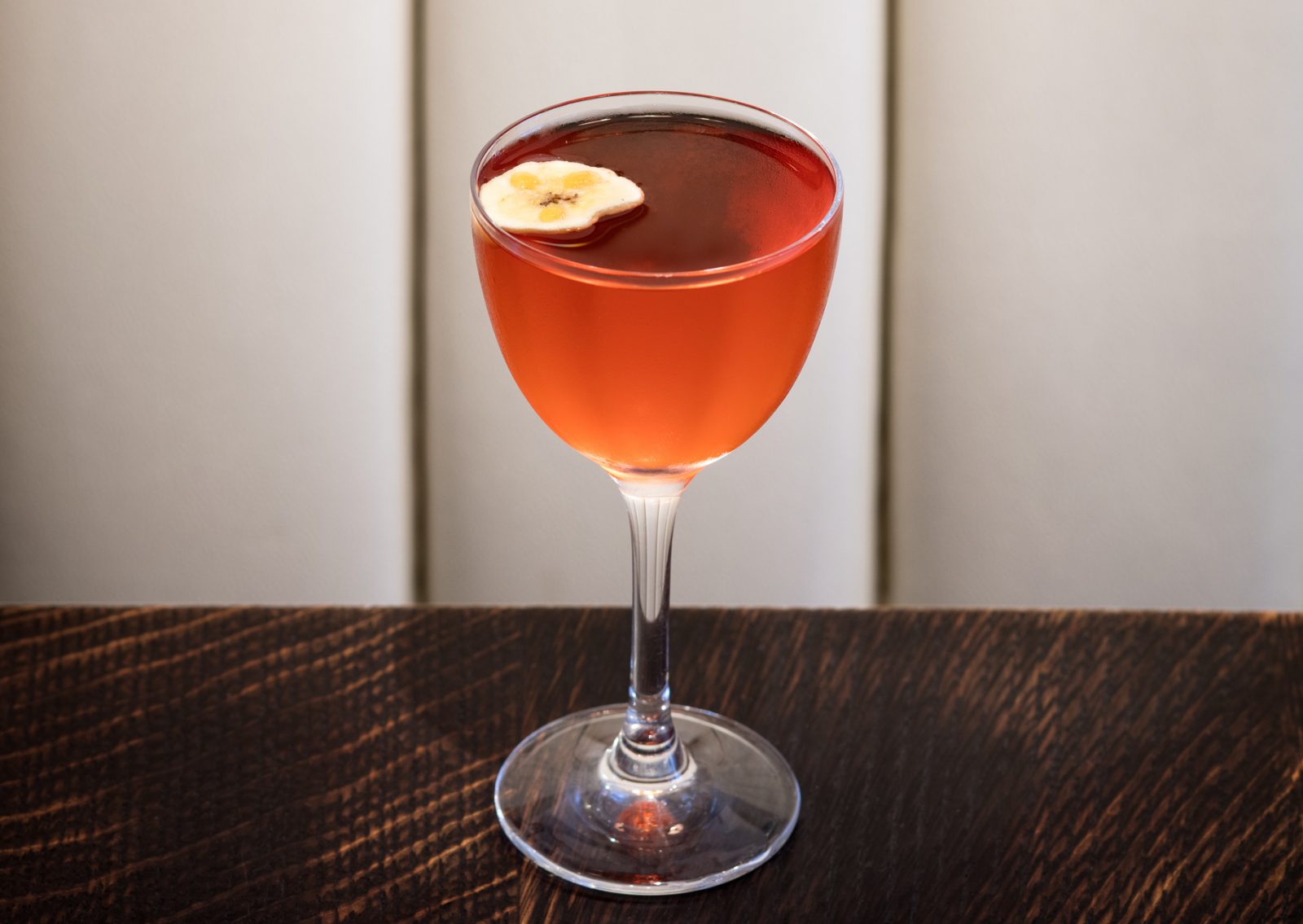 The negroni is no longer a niche drink and is part of pop culture. Seeing more and more people of all legal ages drinking negronis and appreciating its polarising bitter flavour profile has been an amazing thing to watch.
The Aperol spritz is a bona fide global phenomenon now and has set off a craze for spritzes in many guises. The Spanish-style G&T is also permeating its way around the world because of its stunning presentation in a large wine goblet with generous garnishes.
The amari family of spirits is also growing in popularity [Fernet Branca is a good example – and was the star drink of the Life is Beautiful festival in Las Vegas this summer], as is the influx of new vermouths [such as Regal Rogue] and red Italian bitters, such as the new Martini & Rossi Bitter.
Globetrender notes, at its launch this year, Beppe Musso, Martini master blender, said: “The art of the bitter aperitivo is to create a complete and rounded sensation of bitterness in the mouth.
"This is achieved by our incredible master herbalist Ivano Tonutti slowly building up layers of different styles of bitter botanicals, one by one for a more complex profile, until all are beautifully playing together like in an orchestra creating an uplifting melody.”
We've definitely seen a shift in the way people drink in recent years. There was a boom a few years back (mostly led by bartenders) that drinks needed to be boozy and intense to garner any sort of respect.
That philosophy has shifted remarkably as more and more people are not only enjoying more low alcohol, refreshing aperitivo-style drinks such as the ones we promote at Dante, but they're actively seeking them out.
Europeans have been drinking in this way for over 150 years and it is this leisurely, elegant and relaxed style of drinking that informs everything we do at Dante and helps to drive home our message that imbibing in this way is a lifestyle not a means of getting inebriated.
The Garibaldi is our signature cocktail, which is Campari and what we call "fluffy" orange juice. It has this very unique and captivating texture by being squeezed immediately for each drink through a very high speed juice extractor. This essentially puts air into the juice so it achieves a texture that makes this drink so special and is being copied around the world.
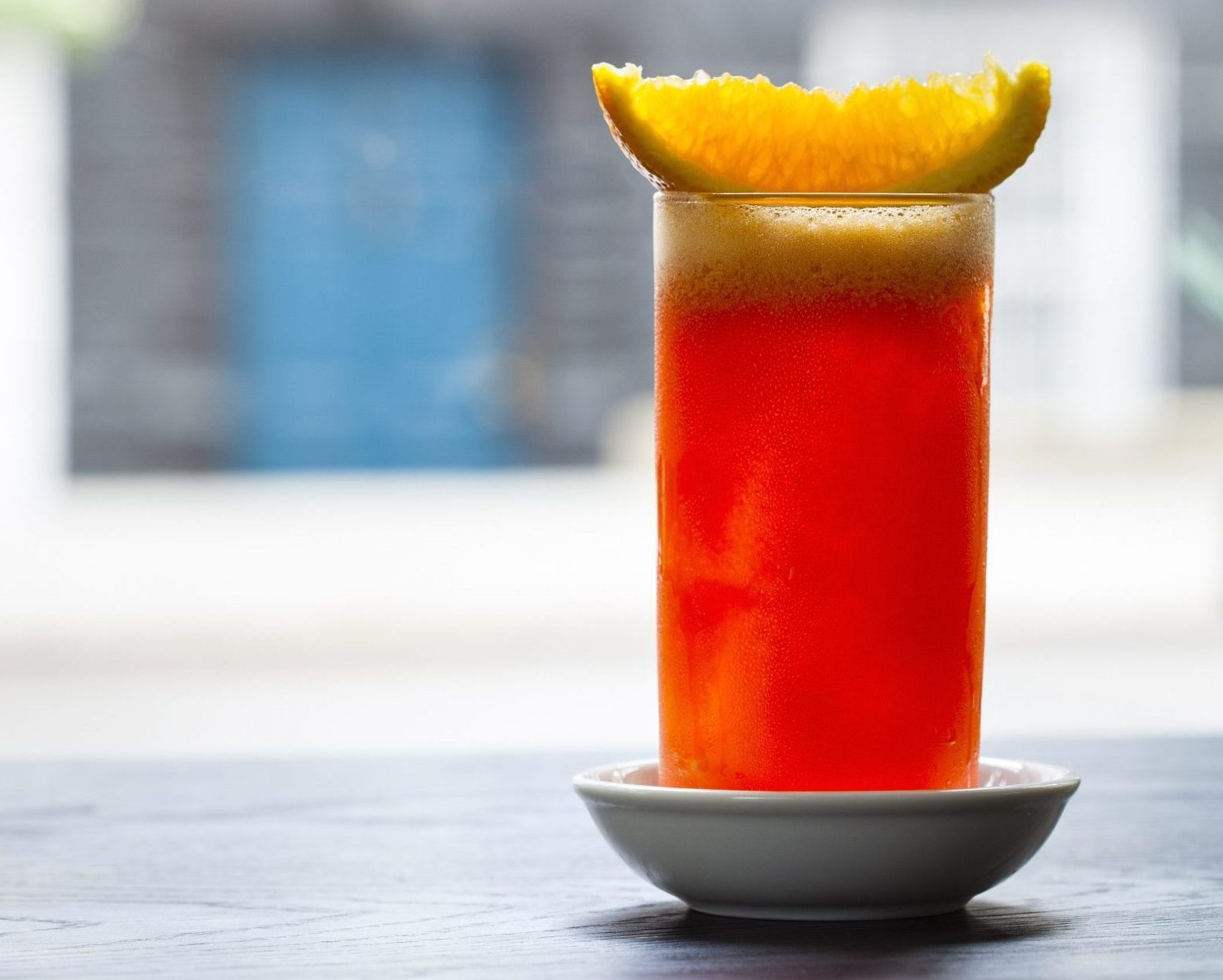 GARIBALDI
1.5 oz. Campari
Fresh orange juice
METHOD: Add 2 ice cubes to glass
Add Campari & a little OJ. Stir well to combine
Add 1 ice cube and fill glass with OJ
GLASS: Garibaldi
GARNISH: Orange wedge and plastic stirrer
Serve on small plate
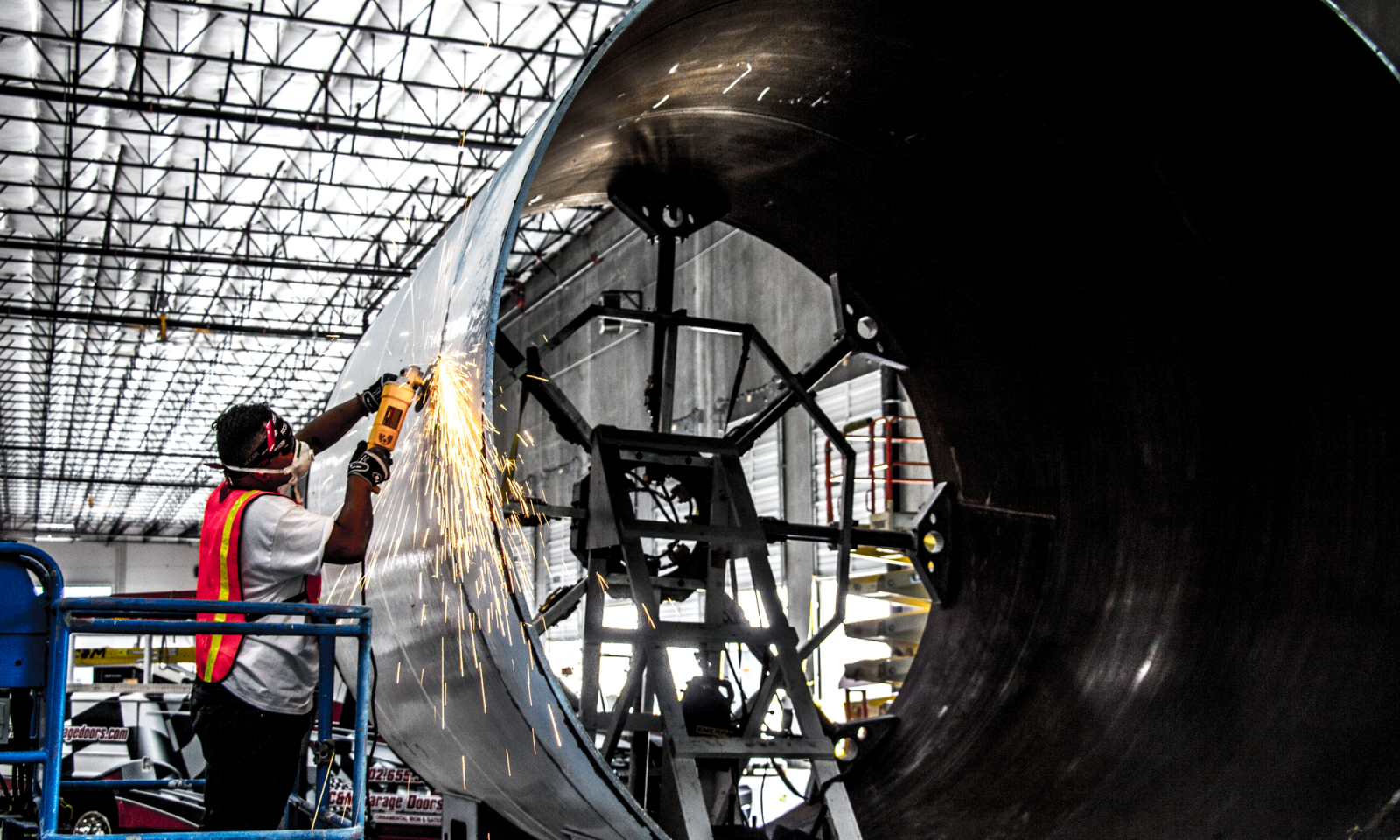
[dropcap size=big]L[/dropcap]ast year, billionaire entrepreneur Elon Musk announced a global competition in which countries could put forward potential routes for his ultra-high-speed Hyperloop One network, a futuristic train that is propelled through tubes at up to 670 mph.
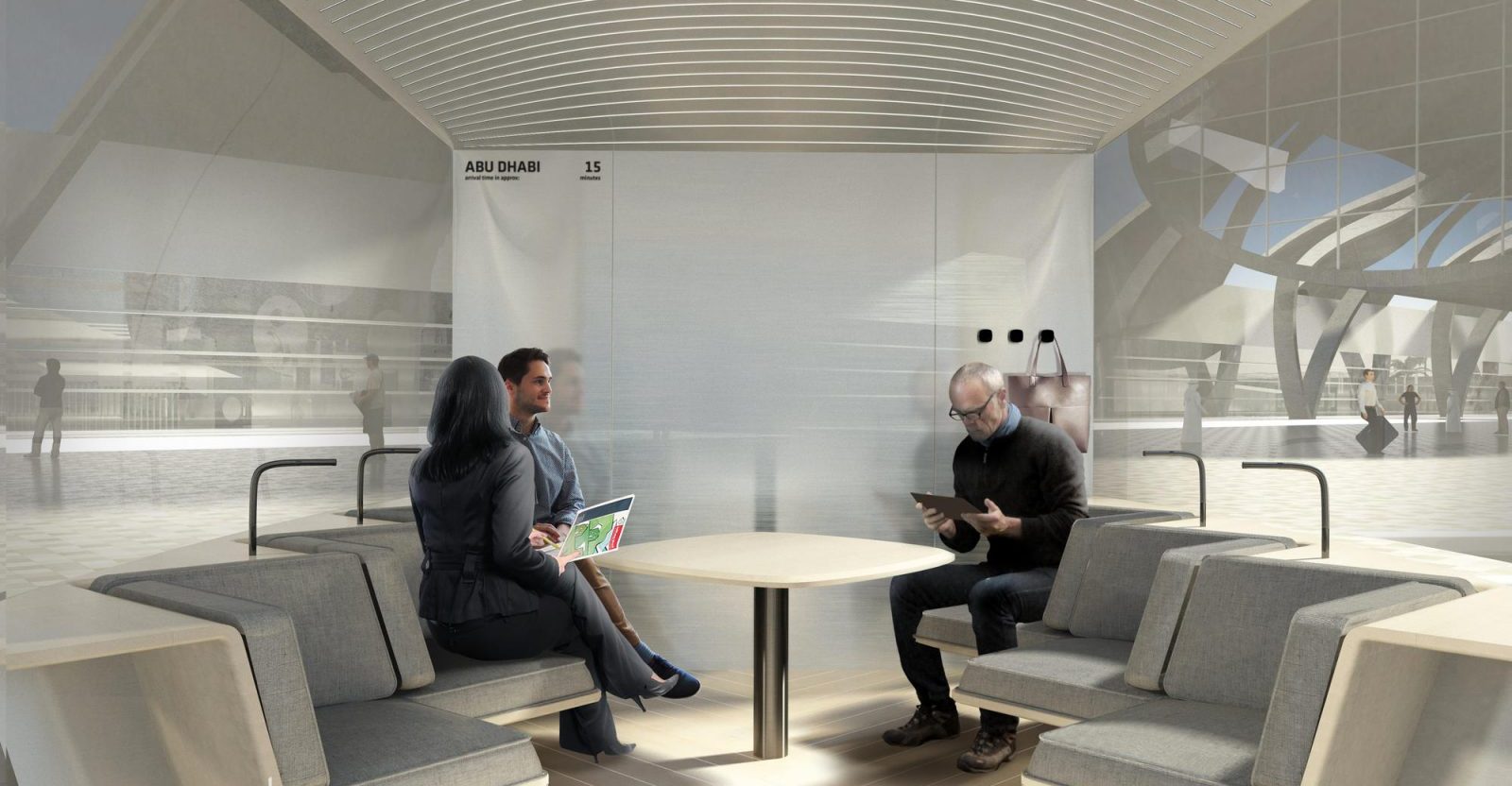
The first new kind of public transportation to be developed in over 100 years – instead of wheels, it uses magnetic levitation to hover above the tracks – it has already undergone a series of successful test phases (a prototype has been built in the Nevada desert outside of Las Vegas), bringing it ever closer to its 2021 launch goal. The passengers are loaded into pods, which then accelerate gradually via electric propulsion through a low-pressure tube. It means cities can be connected in a matter of minutes rather than hours. For example, the journey time between Glasgow and Liverpool could be reduced from 3.5 hours to 30 minutes.
  The shortlisted routes cover five countries – the UK, US, Canada, India and Mexico – with teams from each presenting their vision for how to tackle all the associated logistical challenges. A statement said that Hyperloop One will "commit meaningful business and engineering resources and work closely with each of the winning teams/routes to determine their commercial viability".
Shervin Pishevar, co-founder and executive chairman of Hyperloop One, says: “The Hyperloop One Global Challenge started as a call to action for innovators, engineers, trailblazers and dreamers around the world who shared our vision of creating a new mode of transportation.
"It became a movement of thousands of people from more than 100 countries over six continents. Like us, they believe that Hyperloop will not only solve transportation and urban development challenges within communities, it will unlock vast economic potential and transform how our cities operate and how we live. Our successful test this summer made Hyperloop a reality, and now we’re ready to bring our Hyperloop system to the world.”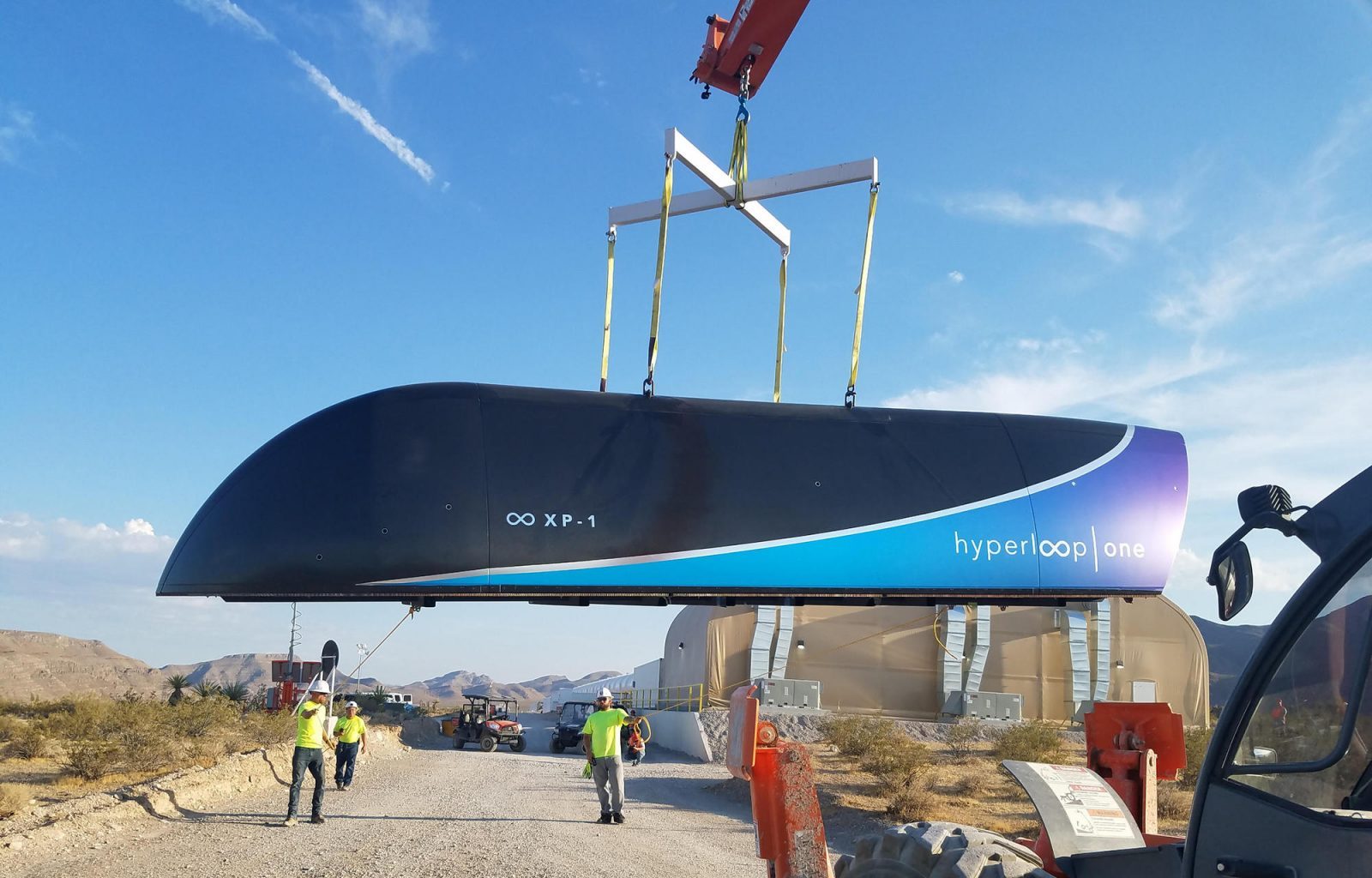 Hyperloop One will now work with each winning team to explore their proposals further, provide ridership forecasts, business plans and technical analyses of the routes.
Rob Lloyd, CEO of Hyperloop One, says: “The results of the Hyperloop One Global Challenge far exceeded our expectations. We had tremendous interest in this competition, and these ten teams each had their unique strengths in showcasing how they will alleviate serious transportation issues in their regions.
Hyperloop One has also forged a private-public partnership with the Colorado Department of Transportation and engineering firm AECOM to begin a feasibility study.
The winning routes connect 53 urban centers and almost 150 million people. Their combined distance spans 4,121 miles.
| Route | Miles | Cities | Population | |
| US Chicago-Columbus-Pittsburgh Team: Midwest Connect |
488 | 3 | 13,800,000 | |
| US Dallas-Laredo-Houston
Team: Texas Triangle |
640 | 5 | 18,771,000 | |
| US Cheyenne-Denver-Pueblo
Team: Rocky Mountain Hyperloop |
360 | 10 | 4,831,000 | |
| US Miami-Orlando
Team: Miami/Orlando Hyperloop |
257 | 2 | 8,500,000 | |
| India Bengaluru-Chennai
Team: AECOM India |
208 | 6 | 17,710,000 | |
| India Mumbai-Chennai
Team: Hyperloop India |
685 | 10 | 43,190,000 | |
| UK Edinburgh-London
Team: HypED |
414 | 4 | 19,151,514 | |
| UK Glasgow-Liverpool
Team: Northern Arc |
339 | 6 | 9,715,488 | |
| Mexico Mexico City-Guadalajara
Team: Mexloop |
330 | 4 | 33,530,000 | |
| Canada Toronto-Montreal
Team: HyperCan |
400 | 3 | 13,326,000 |
 Josh Giegel, co-founder and president of engineering at Hyperloop One, says: “The winning teams of the Hyperloop One Global Challenge represent the best innovation and creativity from government agencies, engineering firms, academics, infrastructure experts and more.
"We’re encouraged by these compelling projects that aim to increase passenger mobility, connect urban centers, reimagine trade and cargo and enhance quality of life."
Under the direction of Air France, Joon looks to capitalise on young travellers who prioritise low-cost fares and digital technology. But, apparently, it is not a budget airline. Instead, it's being advertised as a "lifestyle brand" that will resonate with millennials – a generation that now travels more than any other.
Joon will specifically target those aged between 18-35 by creating a “brand that means something to them”. The planes will feature Joon’s "youthful" branding and livery (although the logo looks more like "Joony" than Joon). Flight attendants will wear "basic, chic" uniforms in electric blue. Men will dress in combinations of blazers, polo shirts and gilets, while women will be in block-print shift dresses or navy trousers. Shoes will be pumps, Oxfords or Stan Smith-style white trainers.
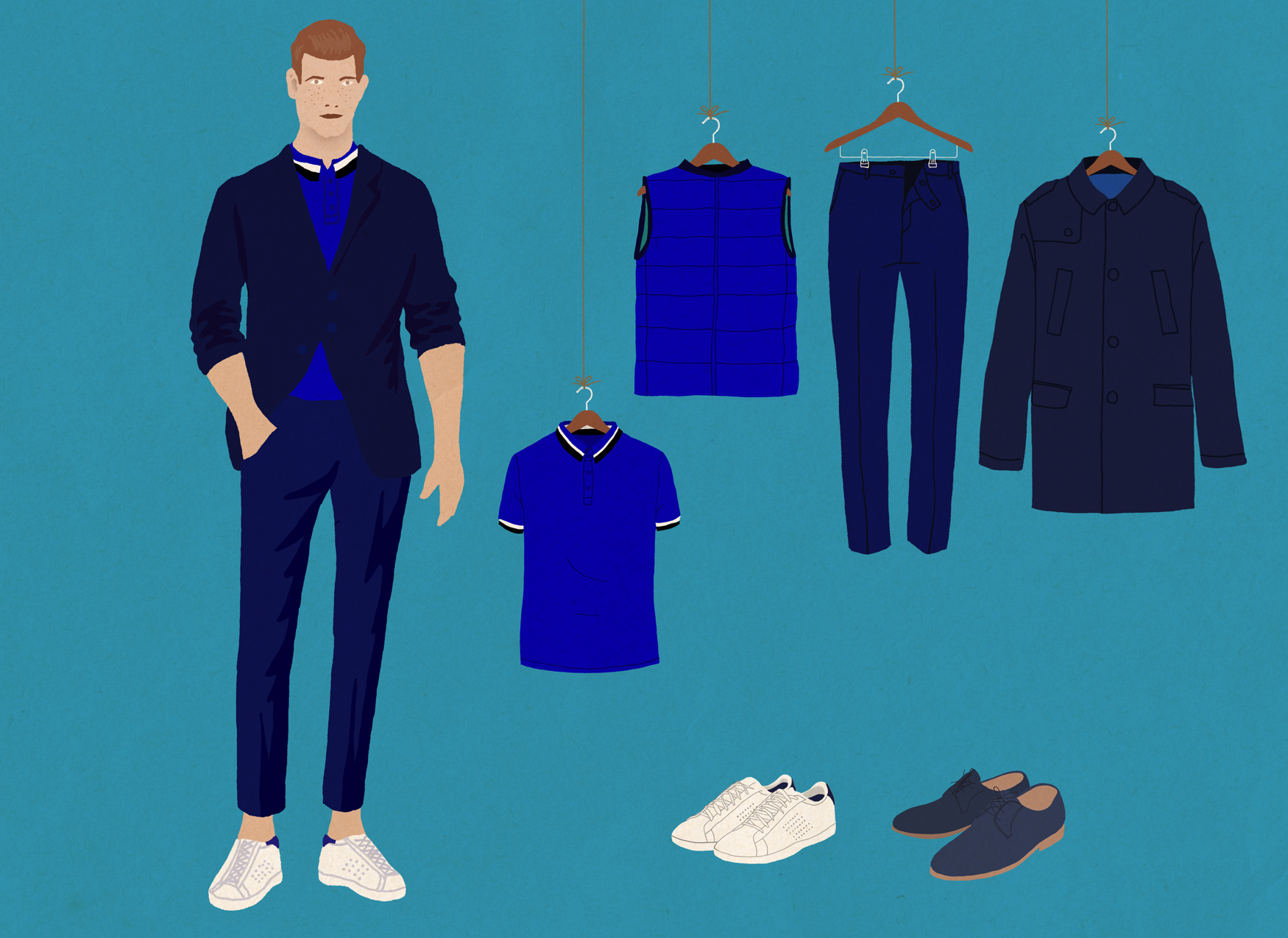 What does Lotte Jeffs, deputy editor of fashion magazine Elle (which originated in France), think of the concept? "What Air France call 'basic' is a nod to the utility trend, which refers to clothes that are as functional as they are stylish. There are also nods to the 'athleisure' trend, with the white sneakers.
"I think the new uniform reflects the way fashion is changing generally – a more pared down 'casual' look is no longer associated with a lack of style or formality. Indeed it's the fashion editor's uniform – flat shoes, the perfect cut of jean, and a crisp white shirt."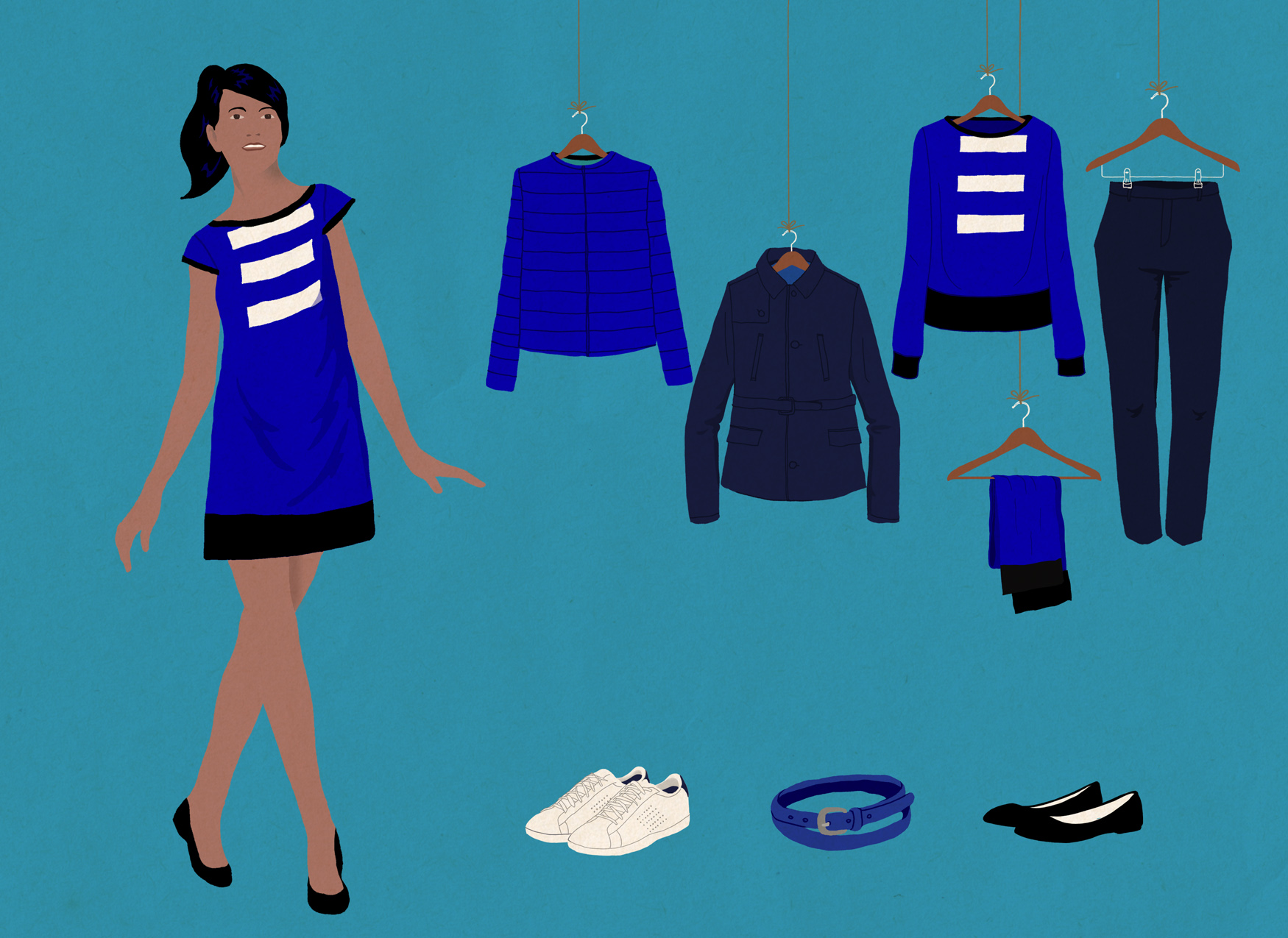 She adds: "It's also nice to see an airline that doesn't equate the height of its female crew's heels with the quality of its service. I for one would be more comfortable working on a long-haul flight in flat shoes."
Joon will also be a "digital-first" airline, presumably harnessing the power of mobile apps, location-specific services and gaming on the ground and in the air. (More details on Joon’s digital service will be revealed in September.)
Caroline Fontaine, vice-president of brand at Air France, says: "We started with our target customer segment, the millennials, to create this new brand that means something to them. Our brief was simple: to find a name to illustrate a positive state of mind.
"This generation has inspired us a lot: epicurean and connected, they are opportunistic in a positive sense of the word as they know how to enjoy every moment and are in search of quality experiences that they want to share with others. Joon is a brand that carries these values."
It remains to be seen whether millennials will flock to Joon because of it lifestyle branding and digital promise. Recent studies show that as many as 80 per cent of younger travellers still prioritise deals and budget when travelling, so, ultimately, it may simply come down to cost.
Luckily, Joon aims to compete in that department too. The airline will launch transatlantic flights and even Asian routes, similar to those offered at affordable prices by Norwegian.
Joon will kick off with six medium-haul planes, followed by a further four long-distance aircraft. The medium-haul routes will launch in September 2017 from Air France’s base at Paris Charles de Gaulle, with long-distance routes following in 2018.
The CEO of Air France, Franck Terner, said: “The creation of a new airline is a historic moment in many ways… Its creation will improve the profitability of the Air France Group, enabling it to reduce its costs and ensure the sustainability of its business model.”
It's a tough market, though, and new brands should be cautious about trying to embody what young people think is cool. As Jeffs says: "Millennials are interested in authenticity so if Joon has substance then I think they will be convinced. But as the reaction to the recent Pepsi advert shows, they won't respond well to vacuous maketing campaigns."
[dropcap size=big]H[/dropcap]ilton has taken the innovative step of installing gym equipment in individual hotel rooms so guests can workout in privacy. The new room category, which will be rolled out across existing properties, is called Five Feet to Fitness.
The concept launched in May at Parc 55 in San Francisco and Hilton McLean Tysons Corner, near the Hilton Worldwide HQ in Washington DC. Over the coming months it will also begin appearing in Hilton hotels across Atlanta, Austin, Chicago, Las Vegas, New York and San Diego.
Far from being a half-baked attempt at tapping into the trend for staying fit and healthy on the road, Globetrender is impressed to see that the Five Feet to Fitness provides people with a comprehensive range of state-of-the-art gym gear. It doesn't take up too much space either.
Hilton says the introduction of the workout room is the biggest change in the fitness hospitality space since it became the first major hotel company to standardise hotel gyms 20 years ago. We are inclined to agree.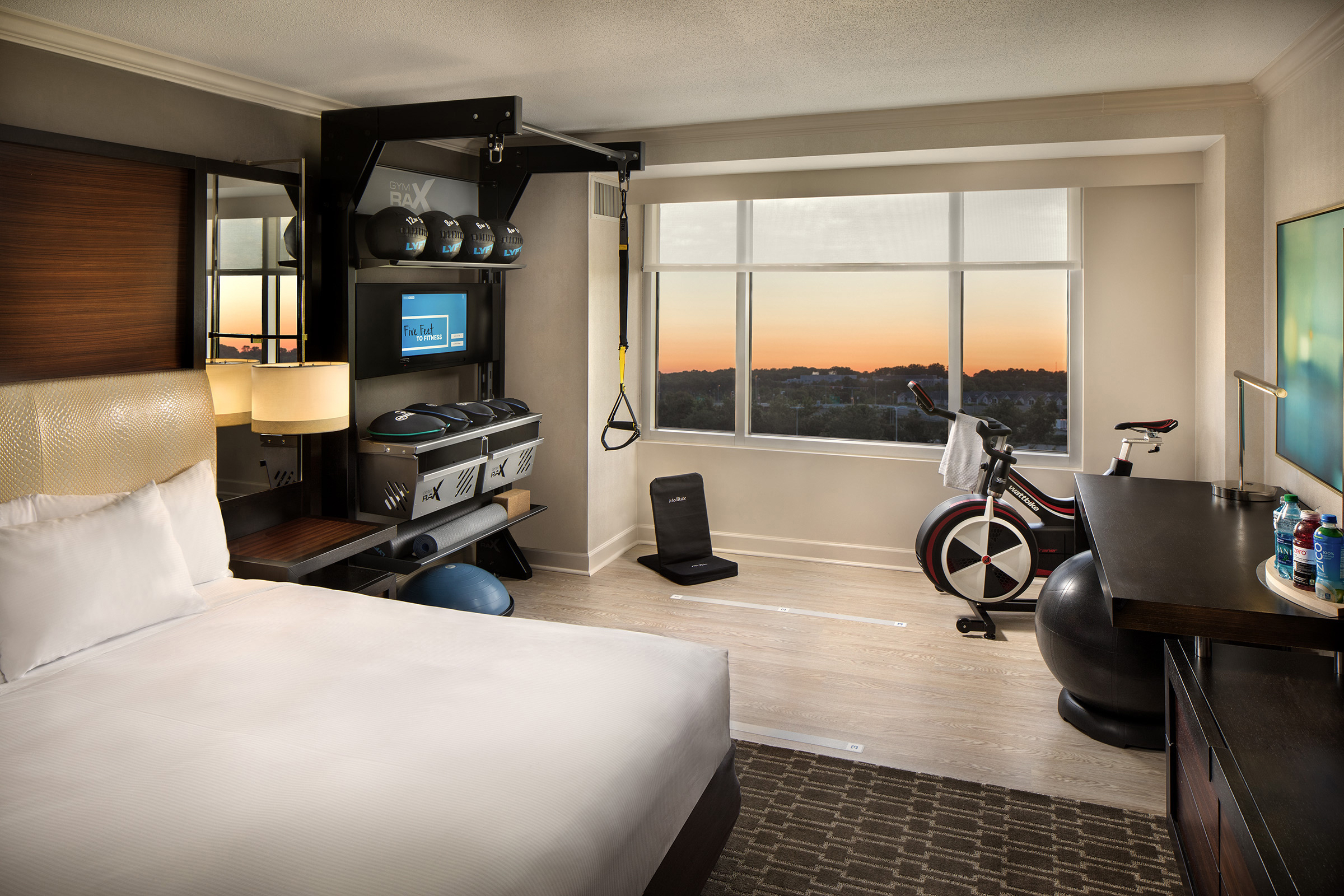
There is an indoor exercise bike from British brand Wattbike that is used for both longer endurance sessions or focused interval-training.
Gym Rax is a built-in station that displays apparatus and accessories such as weighted medicine balls from Lyft, resistance bands, Hyperwear Sandbells and TRX suspension straps for strength, core, suspension and High Intensity Interval Training (HIIT) workouts.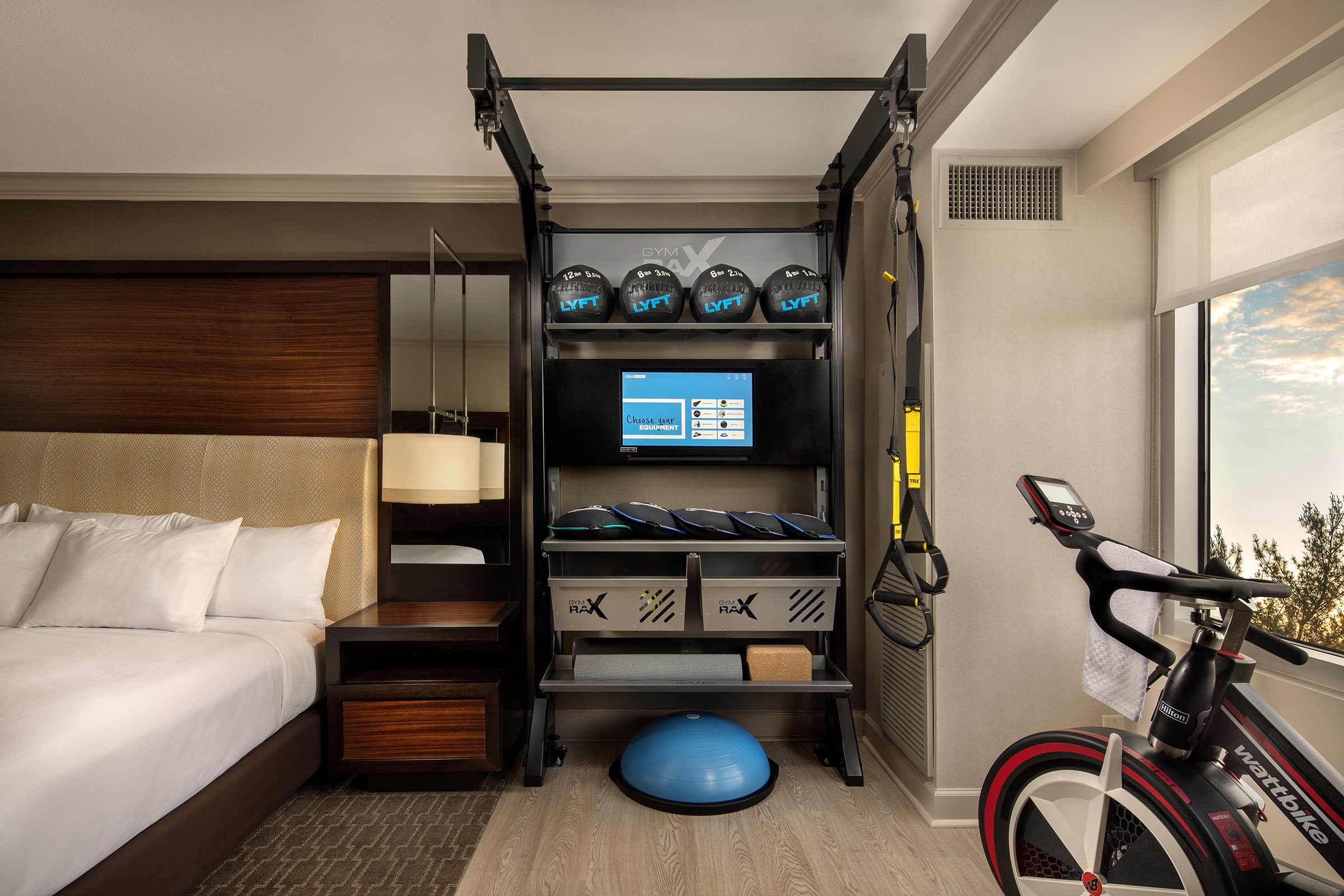 At the heart of it is the Fitness Kiosk, a touchscreen display embedded within the Gym Rax system where guests view tutorials and guided workout routines.
In partnership with Aktiv Solutions, Hilton has created more than 200 bespoke fitness videos for Cardio, Cycling, Endurance, Strength, HIIT, Yoga, Stretch and Recovery. This means you don't need a personal trainer.
Guests will also find a yoga mat, balance ball, massage ball from Trigger Point, and meditation seat. There are blackout blinds to help you sleep more deeply, Biofreeze pain relief gel for aching muscles, and a selection of protein and hydration drinks (Vitamin Water, Zico coconut water, Dasani water, Core Power shake and Powerade Zero).
Ryan Crabbe, senior director of global wellness at Hilton, says: "A guest room that combines a sleep and fully integrated fitness experience delivers an impressive new dimension of convenience and personalisation – an industry first.
"Five Feet to Fitness has been thoughtfully engineered to serve as a guest's personal wellness stage, complete with sports performance materials and best-in-class gym accessories. Guests will quickly realise we have gone much further than simply placing a piece of equipment in a room.
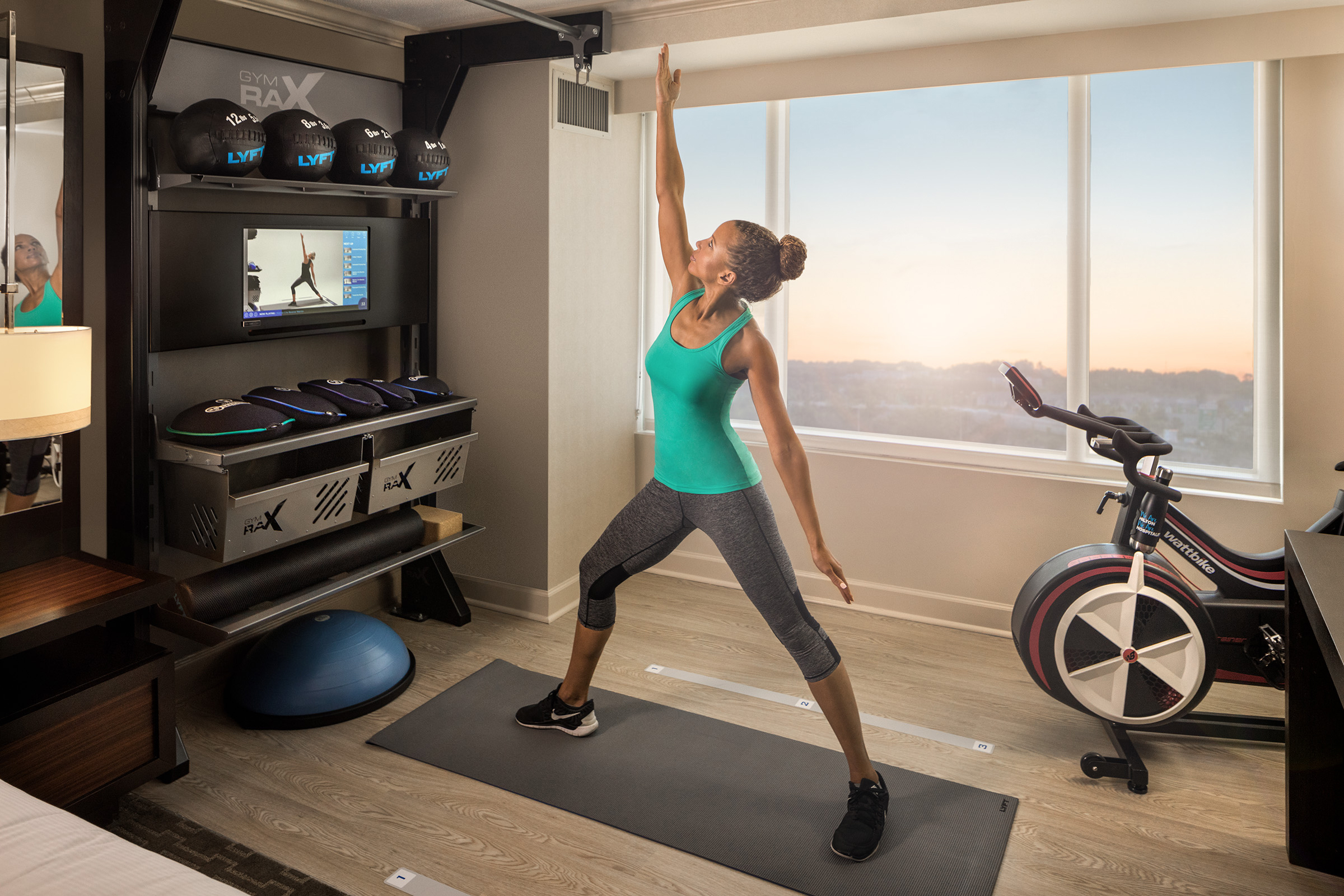 "The variety of activity the room enables is motivating. One morning a guest can decide to roll out of bed for quick guided stretch and yoga poses. Then later that evening, he or she may return from a stressful day and take a brisk bike ride while catching up on a favorite show or the day's business news. The room is made to suit the varied and evolving wellness habits of our guests.
"We know that no matter how determined people are about making healthy decisions while at home, the ability to replicate those choices are often not as accessible as they should be while traveling. We're creating choice and control for guests to drive their own fitness experience."
Back in 2013, Intercontinental Hotels Group launched a new wellness brand called Even. With seven hotels across the US (including three in New York), all rooms come with yoga mats, resistance bands, foam rollers, yoga blocks, core exercise ball and bespoke workout videos as standard.
Since 2001, Kimpton's Topaz hotel in Washington DC has been selling rooms with a choice of recumbent bikes, V bikes or elliptical edgers.
When the Kameha Grand in Zurich opened in 2015, it created a speciality suite with a running machine, luxury free-weights and a Kinesis machine.
[dropcap size=big]D[/dropcap]utch scientist Henk Hesselink, who works at the Netherlands Aerospace Centre (NLR), believes planes should be landing and taking off not on the long straight runways we are all familiar with, but on a single circular loop of tarmac that surrounds the airport and its terminals.
He envisions a banked 3km runway (three times longer than a conventional landing strip) on which three planes could land or take-off at the same time, making it more efficient. "People really want to fly [but] airports are getting more congested. The circular runway is a more efficient way to handle all this traffic," says Hesselink.
However, the "Endless Runway" would also help pilots counter risky crosswinds that can buffet planes when landing on conventional runways, as aircraft could choose a point on the loop that was safest in terms of the direction the wind was blowing.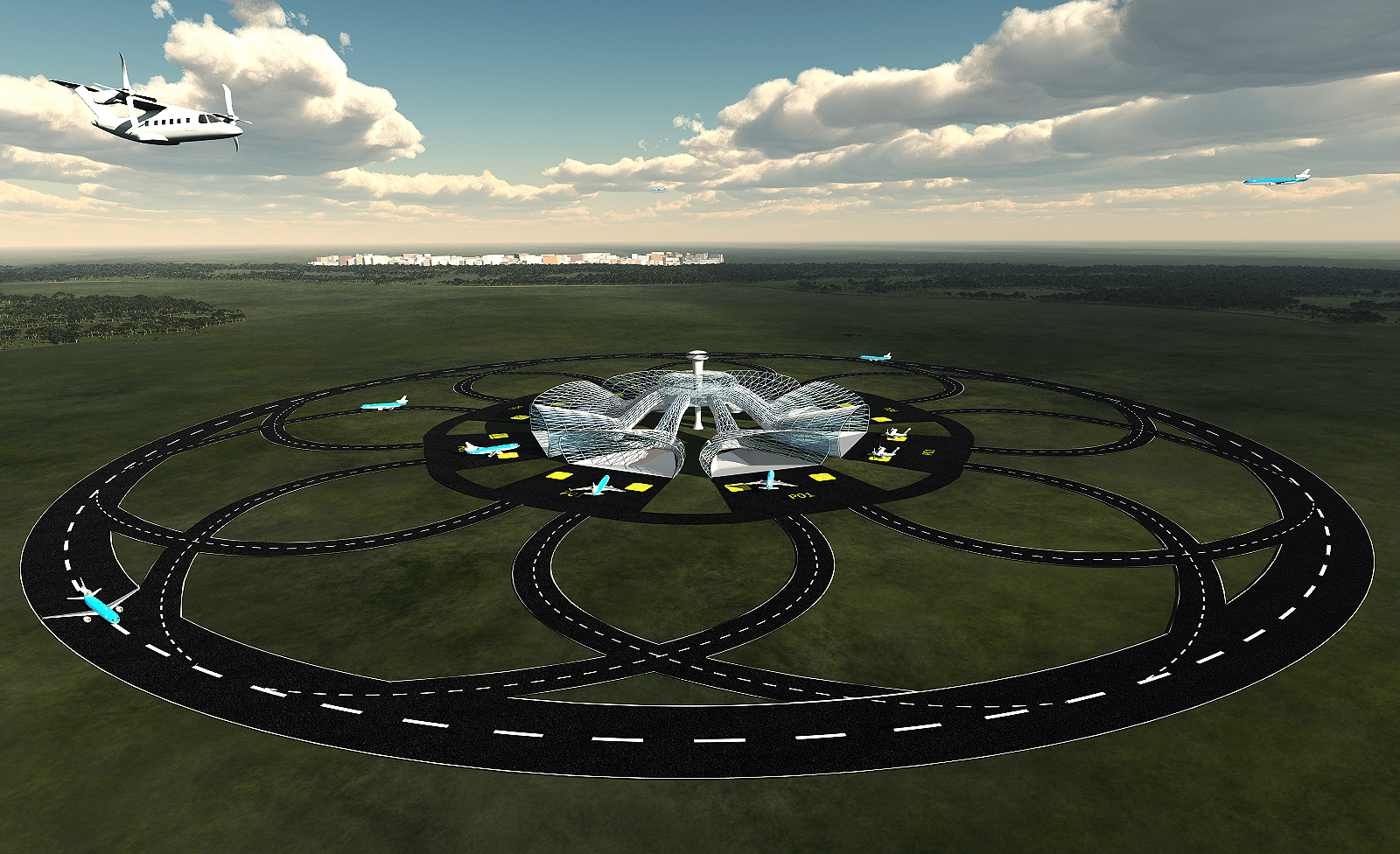 A circular runway could also help ease noise pollution as flight paths could be more even distributed, instead of always coming in over the same sets of houses.
Although military tests were carried out in the 1960s, no circular runways for commercial aviation have ever been built before. What would it be like for people on board? Hesselink says: "The passengers will experience a slight turn similar to a turn in the air. Because of the centrifugal forces, the aircraft will automatically go slower, and go towards the centre of the runway."
According to Jeff Gilmore on avgeekery.com, one of the most significant challenges would come from pilots. "Changes that force pilots to learn new skills in aviation are pretty common. What is unprecedented though is a change that is so fundamental as how to land a plane. This would require massive retraining in procedures, intense expenditures for flight training, and new types of instrumentation inside and outside the cockpit."
That may be so, but research (and funding from the European Commission) into the feasibility of circular runways will continue, because in the long term, they could make flying greener, safer and more efficient.
[dropcap size=big]G[/dropcap]reat news for people who find it difficult to sleep on planes, Qatar Airways has designed a new business class cabin that features seats that convert into fully flat double beds – a first for the industry.
The new patented Q Suite is arranged 1-2-1 across the business class cabin, meaning that window seats are best for solo travellers, while pairs in the middle are for couples. At the touch of a button, these seats recline fully flat to create what is essentially a double mattress. Pillows, white cotton sheets and duvets are provided, as well as “do not disturb” signs.
With two seats facing backwards and two forwards, these central pairs also convert into quads thanks to retracting dividing panels that allow groups to share a meal together or conduct a business meeting. If you want to display your own photos, presentations or movies, you can even plug your own devices into the in-flight entertainment system.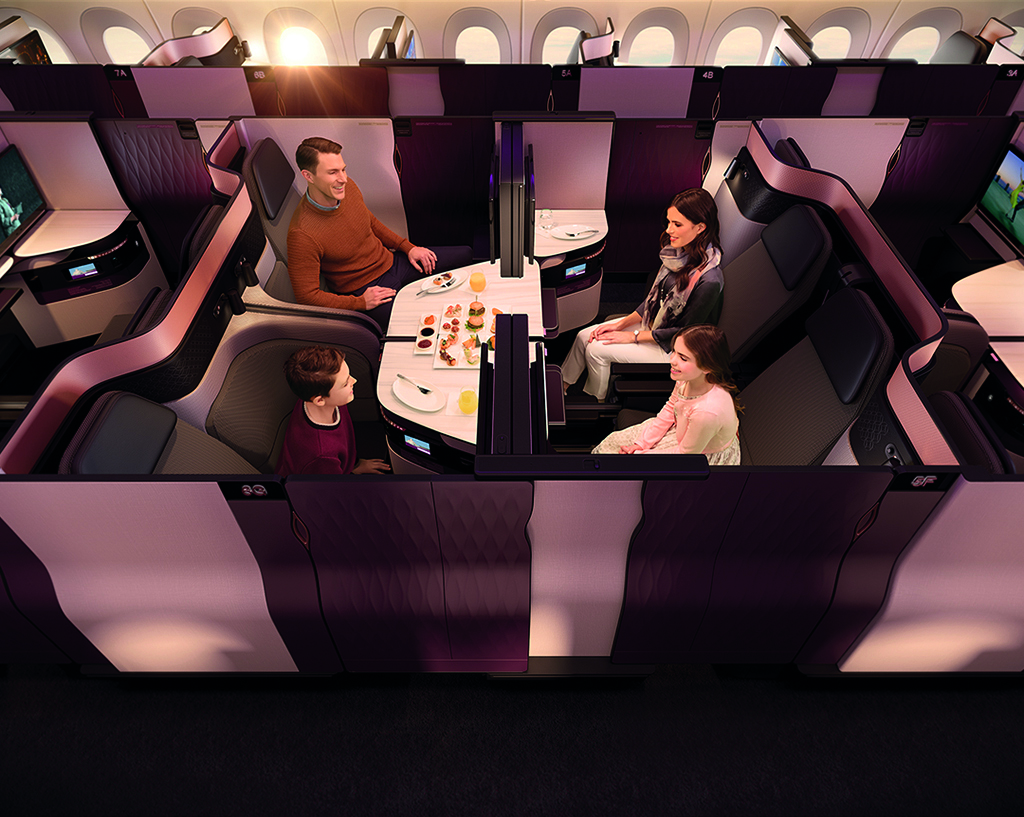 Not only this but the Q Suite has a sliding door similar to many first class products in the sky, meaning passengers have absolute privacy in their own little cabin. The double beds will be fitted on B777s and A350s, with the first being the B777 from Doha to London in June 2017, then Paris and New York JFK.
Qatar Airways group chief executive, Akbar Al Baker, said: “This new product offering – an unrivalled enhancement of our already award-winning Business Class cabin – will absolutely challenge industry norms and expectations.
“This is truly the future of premium travel, and I am delighted at the reaction from our travellers, media and industry experts. In this, our 20th year, I am proud to still be leading the industry in terms of innovation and ambition to ensure we continue to offer our passengers the absolute best in both product and service.”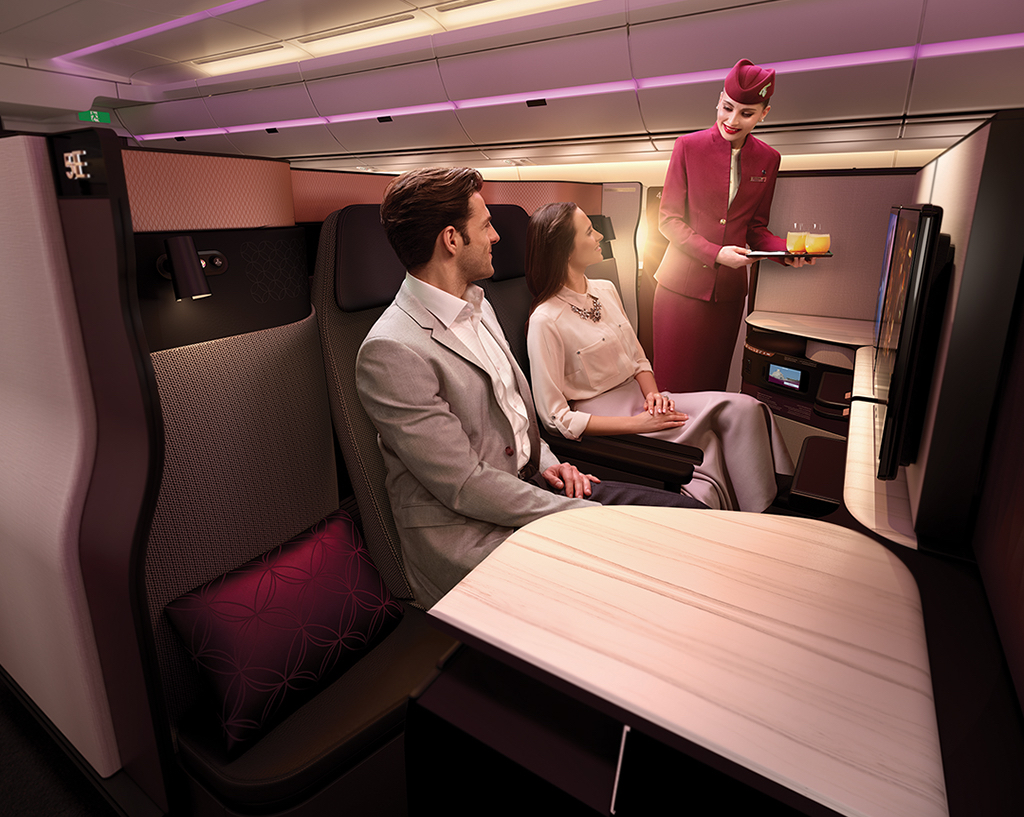 Known for pioneering industry firsts, Qatar Airways is the national carrier of the State of Qatar, and is one of the fastest growing airlines operating one of the youngest fleets in the world. Qatar Airways has a 194 planes flying to more than 150 destinations.
Not quite a double bed (but almost), back in 2010, Air New Zealand launched its innovative Skycouch. Installed on the B777-300ER that flies between London, LA and Auckland, it’s a row of three economy class seats, which have padded footrests that flip up to meet the back of the seats in front to create a flat surface that is five-foot one-inch long (from window to aisle).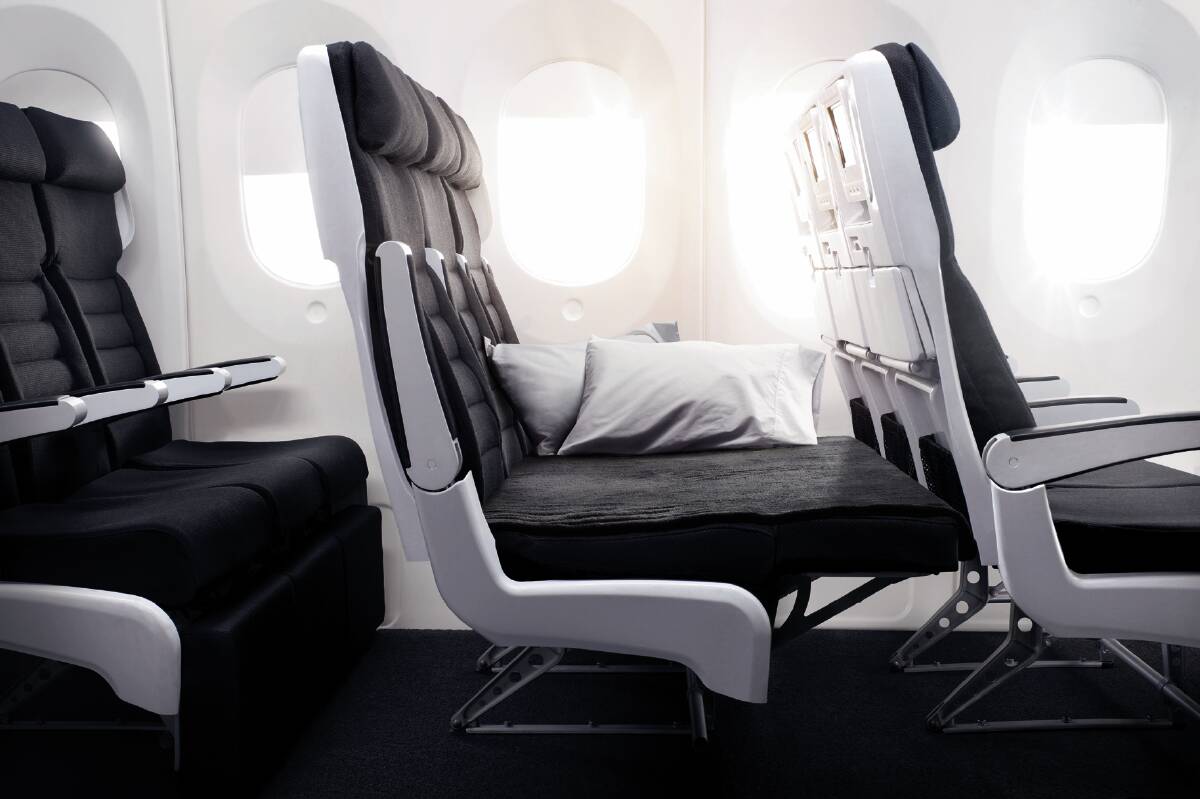 The airline advertises it as big enough for two grown adults on sleep on but in reality it’s too cramped. However, it works well for a parent and child or two adults when one of them is stretched out and the other is sitting up watching a film.
In 2014, after a licensing agreement with Air New Zealand, China Airlines also installed the Skycouch, although it rebranded it as “Family Couch”.
It is the only airline in Asia to fly it, and it is found on its B777 and A350 aircraft on routes between Taipei and Los Angeles, San Francisco, New York, Frankfurt, Amsterdam, Vienna, and Rome.
If you’re looking for a remote, unspoiled, and secluded destination for your next getaway, I think I’ve found your answer: the Moon.
Yes, in 2018, two lucky (and presumably rather rich) tourists will become the first civilians to fly within touching distance of the Moon. The wannabe astronauts, who have not been named, approached SpaceX to thrust them into a lunar orbit.
With deposits paid and the technology being developed as we speak, the manned flight is scheduled to take place in less than two years.
It will mark mankind’s first return to Deep Space in 35 years. And it’s merely a stepping stone for SpaceX’s ambitious vision of establishing a human colony on Mars.
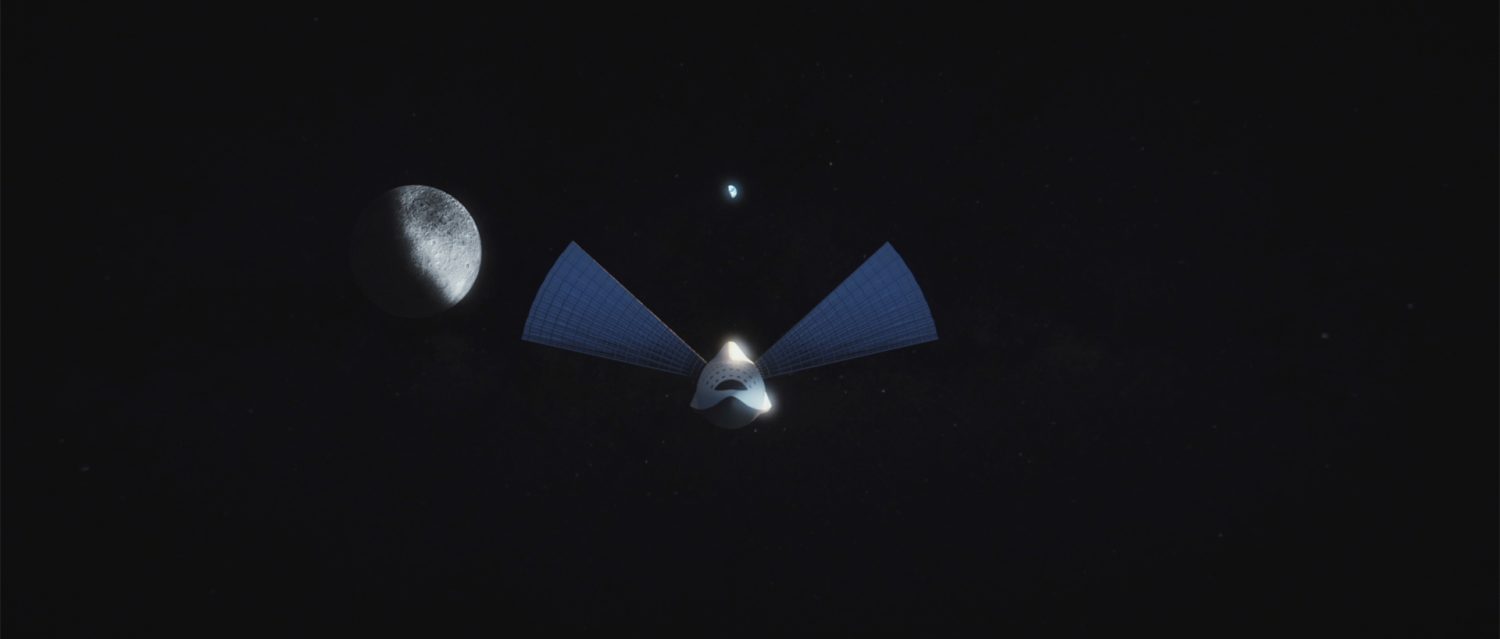 The intrepid Space tourists will launch in 2018 from the famous Pad 39A at Cape Canaveral. They’ll follow in the footsteps of Apollo astronauts such as Neil Armstrong, Buzz Aldrin and Michael Collins.
The “holiday” will last roughly a week, with a two-and-a-half day journey to reach the Moon. The flight itself will be automated, leaving the two travellers to sit back and enjoy the view.
The pair will, however, receive extensive training in order to react to emergencies, and potentially fly the craft manually if necessary.
The spacecraft will “skim the surface of the Moon” – which is space-lingo for entering the Moon’s orbit, not physically touching down – before using a slingshot-like motion to thrust back toward Earth.
SpaceX has not revealed how much the tourists have paid for the privilege, other than alluding to a “significant deposit".
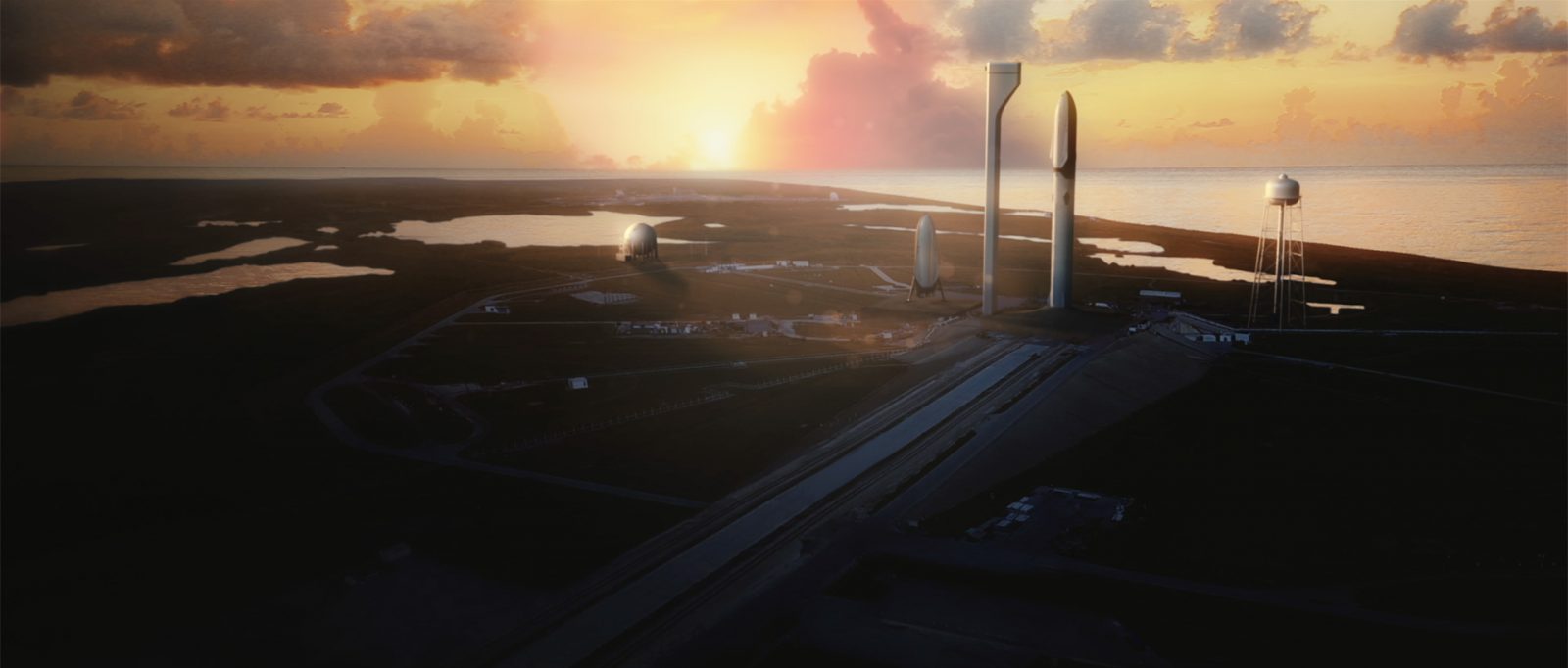 SpaceX is the wildly ambitious project of Elon Musk, the man who made his fortune as co-founder of PayPal and also runs Tesla Motors.
Last month, it successfully launched a rocket to the International Space Station (ISS) on a resupply mission. However, setting their sights on the Moon is the next stage in the company’s development.
The mission will involve two key pieces of hardware. First, the “Falcon Heavy” rocket. The Falcon Heavy will be the most powerful vehicle since NASA’s Saturn V, which flew Apollo astronauts to the Moon in the 1960s and 1970s.
Secondly, the Dragon 2 which is the capsule designed to house the Space tourists.
The announcement comes just six months after SpaceX’s Falcon 9 exploded on the launchpad. Fortunately, that particular rocket contained just satellite equipment, and a follow-up launch in February this year was successful.
I can’t help but think of a quote Musk made to Bloomberg a few years back: “It is remarkable how many things you can explode. I’m lucky I have all my fingers.”
Test launches for the new lunar equipment – Falcon Heavy and Dragon 2 – will take place later this year.
Musk and his team still maintain the utopian vision of flying to Mars by 2020. They aim to establish a settlement and fly humans back and forth for the “affordable” sum of US$500,000.
The concept of private, manned flights to space is not particularly new.
Russian space agency Roscosmos has already flown seven tourists on week-long vacations to the ISS. The journeys took place between 2001 and 2009, and the civilian passengers paid between US$20 million and US$40 million for the experience. Next year, it will open for business again.
Of course, you can’t discuss Space tourism and not include Virgin. Richard Branson has been advocating the possibility since the 1990s, and the Virgin Galactic arm of his company is known as “the world’s first commercial spaceline".
Virgin Galactic is now selling tickets for “suborbital” flights, just outside the Earth’s atmosphere. Tickets cost US$250,000 and allow passengers to experience about six minutes of weightlessness and stunning views of the curvature of our planet.
However, Virgin’s tourist flights do not orbit the Earth, let alone the Moon. It offers little difference to the much cheaper “vomit comet” that treats passengers to periods of zero gravity as it makes an elliptical free-fall.
You start to see why SpaceX’s manned Moon orbit is so ambitious.
Are we on the brink of a Space tourism revolution? The first telling signs are certainly emerging. Just last month, Globetrender reported on stylish new space suits developed by Boeing. The suits are already generating interest from SpaceX and other Space tourism companies, suggesting that practical, commercial space flight is on the horizon.
Other major players are testing and developing their own spacecraft. Amazon’s Jeff Bezos, for example, successfully launched his “Blue Origin” craft last year, and now plans to develop an Amazon-style delivery service to the Moon.
The barrier here is cost. As Musk once explained, sending people to Space in a single-use rocket is like throwing away a B747 after a single flight to London.
For space tourism to become viable, we need to develop reusable rockets. It’s something that SpaceX has diverted much of its energy into.
For now, the early stages are emerging, but your options are limited (and expensive). You can either pay Virgin Galactic US$250,000 for a suborbital flight, drop Elon Musk an email and commission your own lunar trip or take a trip on the vomit comet.
As for the 2018 Moon vacation, SpaceX summed up the future of space tourism nicely: “These individuals will travel into space carrying the hopes and dreams of all humankind, driven by the universal human spirit of exploration.”
[dropcap size=big]N[/dropcap]ASA has announced it has found a solar system of seven Earth-sized exoplanets – located 39 light years away, three of them could host alien life forms. Unfortunately, the most advanced of our current spacecraft would take about 18,500 years to travel just one light year, so visiting looks out of the question just yet.
However, even from an unfathomable distance, experts have revealed details of their nature. Orbiting the TRAPPIST-1 star, three of the exoplanets (planets found outside our own solar system) have the potential for great seas and lakes on their surfaces. Dubbed the Holy Grail, the orbs are a similar size to Earth and sit within a “temperate zone” that has all the right conditions for alien life.

Although the exoplanets would be darker than our own, they would feel warm to a human standing on their surface, and the huge pink sun, which would appear ten times bigger than our own, would sometimes be joined by one of the other exoplanets that would appear like a moon in the sky at certain points in the year.
The six innermost planets are rocky but the mass of the seventh and farthest exoplanet has not yet been established – scientists believe it could be an icy, "snowball-like" world.
NASA says: “In contrast to our sun, the TRAPPIST-1 star – classified as an ultra-cool dwarf – is so cool that liquid water could survive on planets orbiting very close to it, closer than is possible on planets in our solar system. All seven of the TRAPPIST-1 planetary orbits are closer to their host star than Mercury is to our sun.
“The planets also are very close to each other. If a person was standing on one of the planet’s surface, they could gaze up and potentially see geological features or clouds of neighbouring worlds, which would sometimes appear larger than the moon in Earth's sky.”
According to astronomers, there could be 40 billion habitable planets in our galaxy alone. Scientists say that even if there isn’t life around the TRAPPIST-1 dwarf star right now, it could emerge in the future.
Dr Amaury Triaud, of the Institute of Astronomy in Cambridge, has been reported as saying: “We hope we will know if there's life there within the next decade.” The discovery has been hailed an “accelerated leap forward” in the search for extra-terrestrial life.
NASA came across the solar system using the Spitzer Space Telescope, as well as several observatories on the ground. Lead researcher Michaël Gillon, of the University of Liège, says: “The planets are all close to each other and very close to the star, which is very reminiscent of the moons around Jupiter. “Still, the star is so small and cold that the seven planets are temperate, which means that they could have some liquid water – and maybe life, by extension – on the surface.”
“This discovery could be a significant piece in the puzzle of finding habitable environments, places that are conducive to life,” said Thomas Zurbuchen, associate administrator of the agency’s Science Mission Directorate in Washington.
“Answering the question ‘are we alone’ is a top science priority and finding so many planets like these for the first time in the habitable zone is a remarkable step forward toward that goal.”
Every time I get on a plane, there’s a silent battle of elbows. The middle seat is worst of all, where space is squeezed to a minimum. But there’s good news for middle-seat flyers; a solution is on the horizon, and it's called the Side Slip.
An innovative new Colorado company called Molon Labe Designs has created a new, roomier middle seat. By implementing a staggered design, the middle seat sits lower and further back than usual, slotting in just behind the window and aisle seats. It gives the passenger an extra three inches to spread out. And lower arm rests also mean more elbow room.
Did Molon Labe Designs just make the middle seat the best choice on the plane?
There’s good news for the airlines too. The guys behind this new design claim it will save hours in boarding time, and perhaps millions of dollars in costs. But how, exactly?
The so-called “Side Slip seat” serves a dual purpose. Because of its staggered design, the aisle seat slides on top of the middle seat. Voila, more room in the aisle for boarding.
While one passenger is busy hauling his hand luggage into the overhead containers, you simply move around him. No more waiting to file down through the plane. The man behind Molon Labe Designs, Hank Scott, sums it up: “We have the widest aisle of any airplane on the planet.”
It means airlines can complete the boarding process faster – up to ten minutes faster according to Scott. When you consider that every minute on the ground costs an airline up to US$100, this is a big deal. Faster boarding means faster turnarounds and lower fuel costs.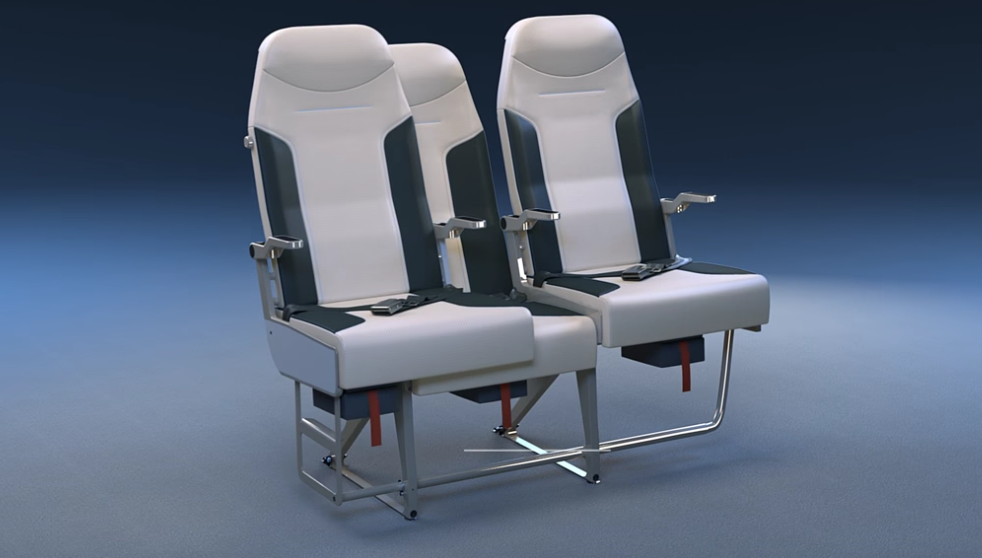 While the extra passenger room is a bonus, it is the financial saving that Scott is relying on to convince the airlines to adopt the technology. “No one is going to buy a seat because it just makes the customers happier. We offer the airlines better profits through faster turnarounds.”
Scott claims the largest airlines could save hundreds of thousands of dollars every day, and up to US$245 million per year. Every turnaround burns through fuel to power the air conditioning and electronics. Shaving just ten minutes off the ground time could drastically reduce fuel consumption.
Not only that, but those ten minutes add up quickly, and airlines could theoretically squeeze in another flight during the day.
The unique design has been in the development process for years. It is now in its fifth prototype iteration, and has just passed crash testing at the Federal Aviation Administration. This was the final rigorous test before Scott can take the design to airlines.
Still, he’s already made a head-start by cosying up to Boeing, Airbus and 24 other major airlines. Pending approval, we could see this innovative design in the skies by the end of the year.
With more space for passengers and huge savings for airlines, the Side Slip seat could be a game-changer.
Described as “lightweight, highly mobile, minimalistic and innovative,” the new Boeing Blue spacesuit has been designed for crew members to wear aboard the CST-100 Starliner, which is set to make low-Earth orbit flights and travel to the International Space Station in early 2018.
Weighing 20 pounds, the suit is ten pounds lighter than its predecessor, allowing extra movement within the shoulder and arm joints, creating less pressure on the body during launch and landing procedures. It is not for use outside the vehicle as won’t shield them from solar radiation or micro meteoroids.
Designed by David Clark Co, it is a more simplified and stylish take on the bulky “orange pumpkin suits” worn by astronauts on the Space Shuttle. "The most important part is that the suit will keep you alive,” says astronaut Eric Boe. “It is a lot lighter, more form-fitting and it's simpler, which is always a good thing. Complicated systems have more ways they can break, so simple is better on something like this."
The Boeing Blue spacesuit will feature maximised comfort and digital advantages adapted for 21st-century astronauts. The helmet and visor are attached to the onesie by a zip lining, complete with a comfy headset for communication. Boeing says: “The suit’s hood-like soft helmet sports a wide polycarbonate visor to give Starliner passengers better peripheral vision throughout their ride to and from space.”
Vents help cool the person inside, as well as pressurise the suit when required. Touchscreen leather gloves will work on smart-screens and tablets built into the spacecraft, whilst storage pockets attached to the legs provide quick access to a survival kit and personal items. What’s really trendy, though, is the lightweight, integrated footwear designed by Reebok. The boots are breathable and slip-resistant.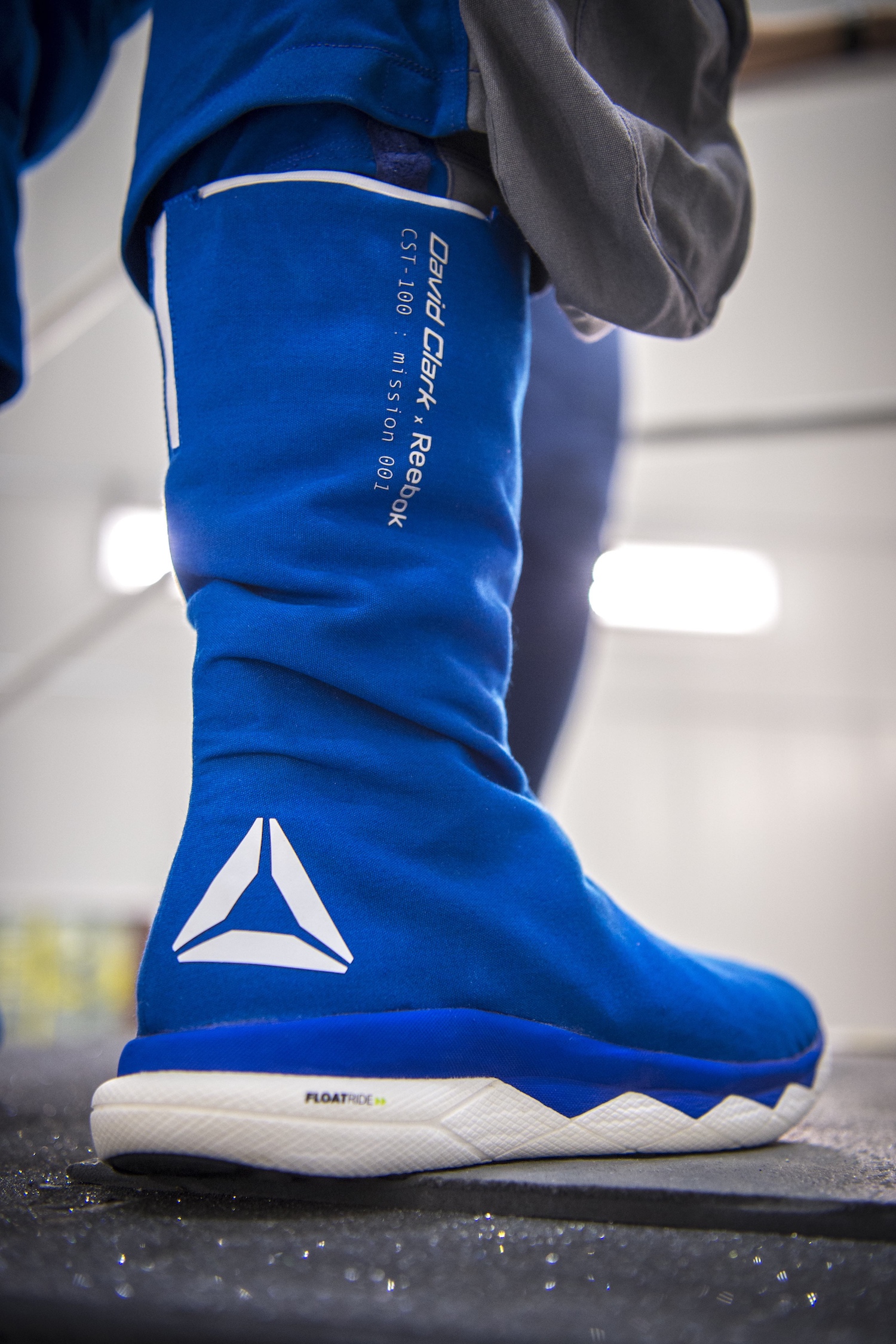 The Boeing Blue has been approved by veteran astronaut Chris Ferguson. He says: “Spacesuits have come in different sizes and shapes and designs, and I think this fits the Boeing vehicle."
Richard Watson, subsystem manager for spacesuits for NASA's commercial crew program, says: "The spacesuit acts as the emergency backup to the spacecraft's redundant life support systems. If everything goes perfectly on a mission, then you don't need a spacesuit. It's like having a fire extinguisher close by in the cockpit. You need it to be effective if it is needed."
In the future, the Boeing Blue could be adopted for use in the emerging space tourism industry. Several companies such as Virgin Galactic and Blue Origin are currently building spacecraft and carrying out test flights in the hope of providing sub-orbital tours to the general public as early as 2018.
Meanwhile, Elon Musk founder of Space X, announced last year that he had hired costume designer Jose Fernandez, who has worked on Batman v Superman, Iron Man, The Avengers and Tron: Legacy, to design spacesuits for his astronauts. Does this mean space tourists will look more like Hollywood superheroes? Globetrender hopes so.
“It’s pretty bad ass,” Fernandez said on Newsweek. “[Musk] kept saying, ‘Anyone looks better in a tux, no matter what size or shape they are,’ and when people put this space suit on, he wants them to look better than when they did without it, like a tux. You look heroic in it. It’s an iconic thing to be a part of.”
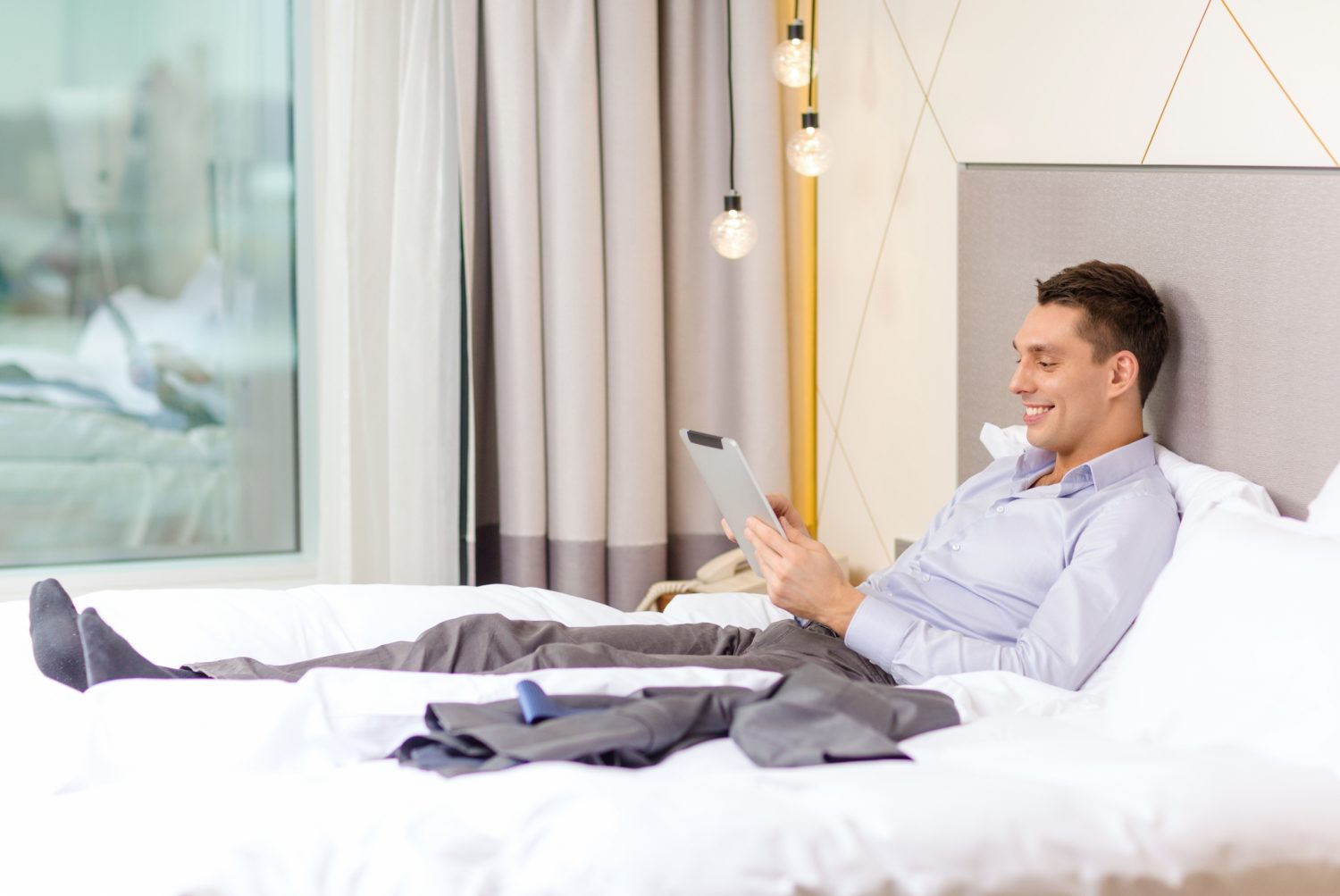
In two pioneering Aloft hotels, guests can now turn off the lights with a simple “Goodnight”. They can adjust the room temperature and play their favourite music by asking out loud. Turning the lights back on again is simple, just say “Good morning”. Welcome to the world of voice-activated hotel rooms…
Currently being tested in Aloft’s Boston and Santa Clara hotels, the voice-activated rooms are code-named Project Jetson.
The technology uses an iPad with Apple’s built-in voice-recognition virtual assistant, Siri, to respond to guest commands. The initiative is the latest in a long line of high-tech developments from the Aloft brand (part of the Starwood group) that includes a robot butler called Botlr, keyless smartphone room entry and emoji-text room service.
“We love to be on the cutting edge of everything,” Aloft’s global brand manager, Eric Marlo told Bloomberg. “We truly operate like a startup, throwing a lot of ideas at the wall to see what sticks.”
While their "emoji room service" is unlikely to stick, voice activation looks set to become a global standard across hotels in the next decade.
Clarion Hotels in Amsterdam ran a similar trial in August using Amazon’s voice assistant, Alexa. It’s currently only available in one room, allowing guests to book a taxi, set a wake-up alarm and play music all with voice commands.
Aloft’s Project Jetson also invites guests to discover local attractions or find directions to a business meeting. “Hey Siri, where’s the nearest sushi bar?” or “Hey Siri, how do I get to the subway?”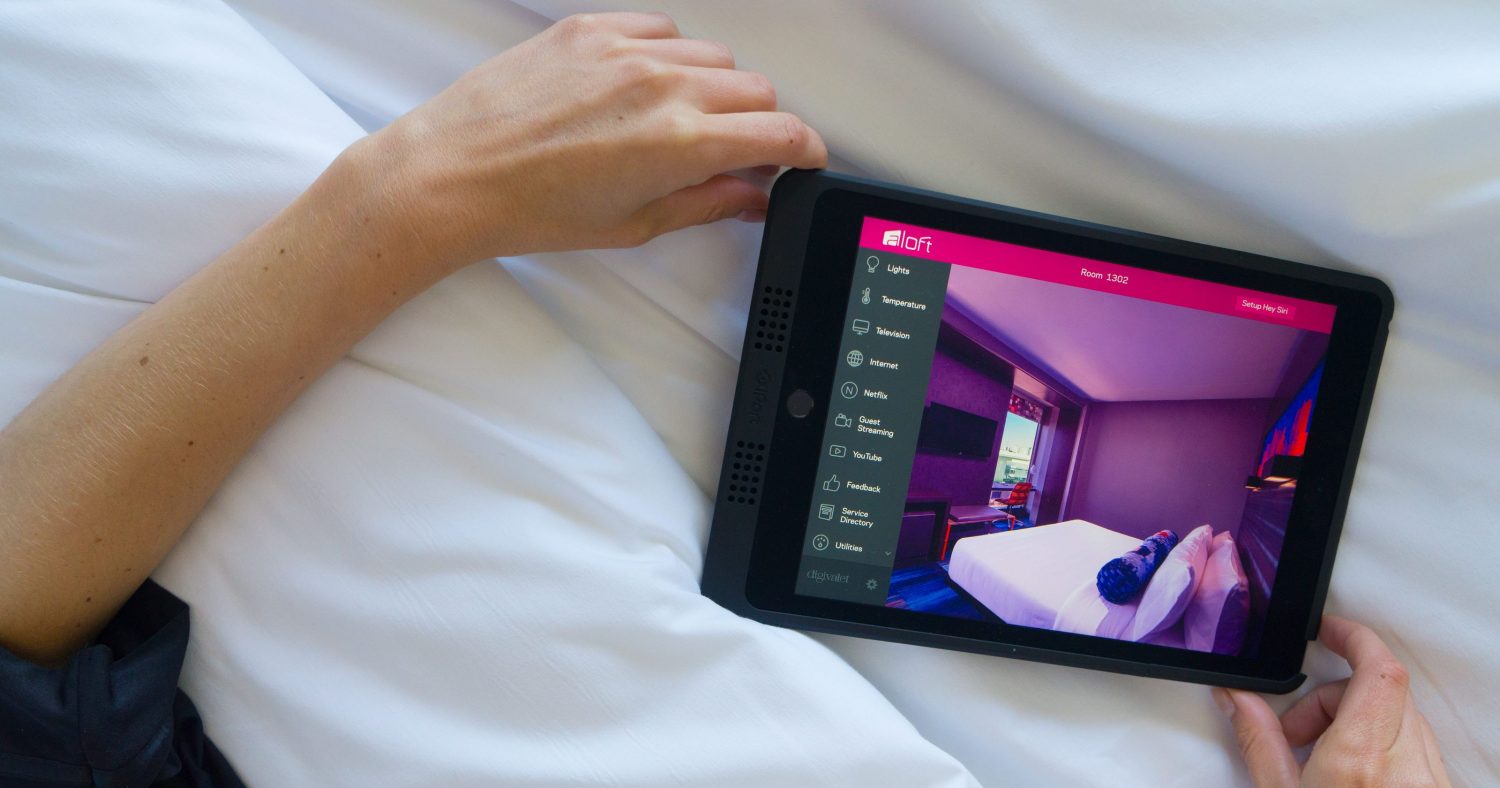 Aloft’s Project Jetson is still in its infancy, but Aloft is already developing the next iterations of the voice-activated hotel. “We literally launched these [Siri-powered] rooms on Wednesday and we’re already thinking about generations two and three,” Marlo said.
Version two will include "triggers" that react to your personal preferences and remembers your routine and habits. For example, Siri may automatically dim the lights at 6pm and put on a relaxing playlist. It may wake you at 7am by automatically increasing the light and playing soft music. Guests will also be able to connect through their own iPhone or iPad rather than using the hotel’s shared devices.
The third iteration will allow guests to set up multiple preferences to differentiate between business trips and family holidays, and ultimately trigger their preferences as soon as they unlock the hotel door; with their smartphone room key, of course.
Eventually, Aloft plans to create a fully immersive and intuitive hotel experience. It's also working on a bathroom pressure pad that automatically adjusts the lighting as you walk in. No more fumbling around for the light switch in the middle of the night. A touchscreen mirror that displays guests’ emails and stock tickers is already piloting at an Element hotel (Aloft’s sister brand) in New Jersey.
The technology is all part of a growing trend known as "the Internet of Things". It’s the seamless integration and personalisation of all appliances and gadgets in the home, office or indeed hotel room. Wiring them with wifi makes them "smart". As our homes become more digitized and connected, so we will expect the same from our hotel rooms.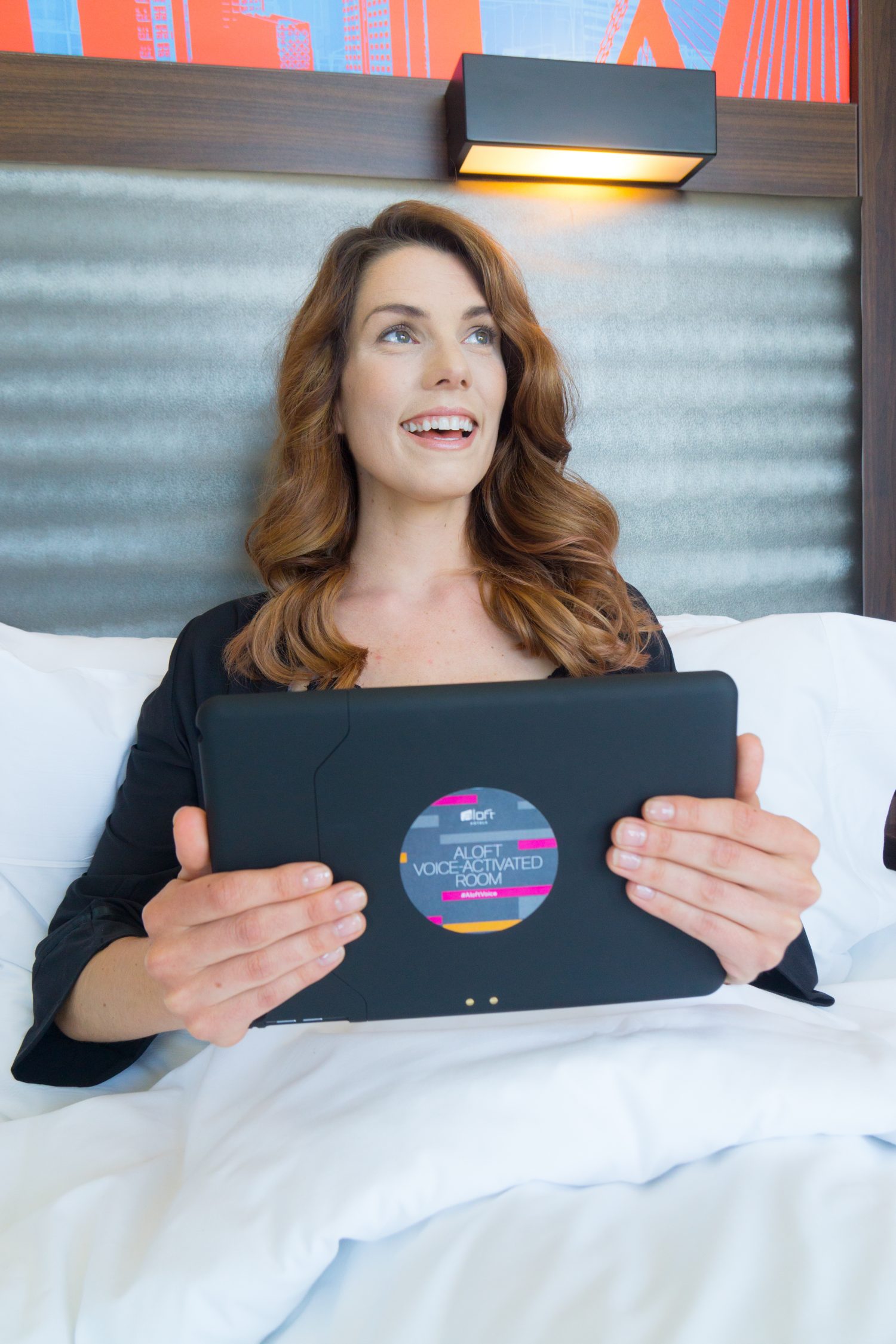 Of course, Project Jetson still has a number of hurdles to overcome, not least the cost of supplying iPads to every room in its catalogue. Aloft must also address the security concern of passing data and information to a shared iPad and network.
Aloft says that any information is wiped and reset at the end of each guest’s stay, which should allay any immediate worries. But can that be relied upon?
It must also contend with the enormous wifi capacity and bandwidth required to execute Project Jetson seamlessly and on a large scale. It will require an injection of cash to upgrade their hotels across the country.
Voice-activated hotel rooms are a promising development and one with true scalability. Far from a simple gimmick, Globetrender hopes this will become a staple feature in hotel rooms of the (near) future, so there is no more fumbling for the light switch in the middle of the night.
Tourists are flocking to the Sydney Opera House, Downing Street and the Golden Gate Bridge this summer. But it’s not for the reason you think.
They’re hunting Pokemon.
This year, millennials aren’t just choosing their holiday destination based on climate, cultural curiousness or nightlife. According to a survey of 500 young people by Hotels.com, more than half (55 per cent) are choosing their summer hotspot based on the likeliness of catching a Pikachu or two.
I am, of course, talking about Pokemon Go, the app that invites gamers to leave their sofa and hunt Pokemon in the real world. The game makes ingenious use of ‘augmented reality’, a technology that ‘augments’ the real world by adding visual elements to it; in this case, Pokemon. Using the camera within the app, you can catch Pikachu among the ruins of Machu Pichu, or Squirtel emerging from Lake Michigan.
Videos have already emerged of hundreds chasing across Central Park to catch an elusive rare Pokemon, and in Japan, crowds queue to enter Shinjuku Gyoen National Garden, or "Pikachu Forest", at the cost of 200 yen, just so they can catch new pocket monsters.
Travel media is calling it “a new way to see the world”, and a spokesperson for Hotels.com insists that the phenomenon is “opening our eyes to culture, landmarks, and travel”. The New York Times even encouraged readers to use Pokemon Go as a tour guide.
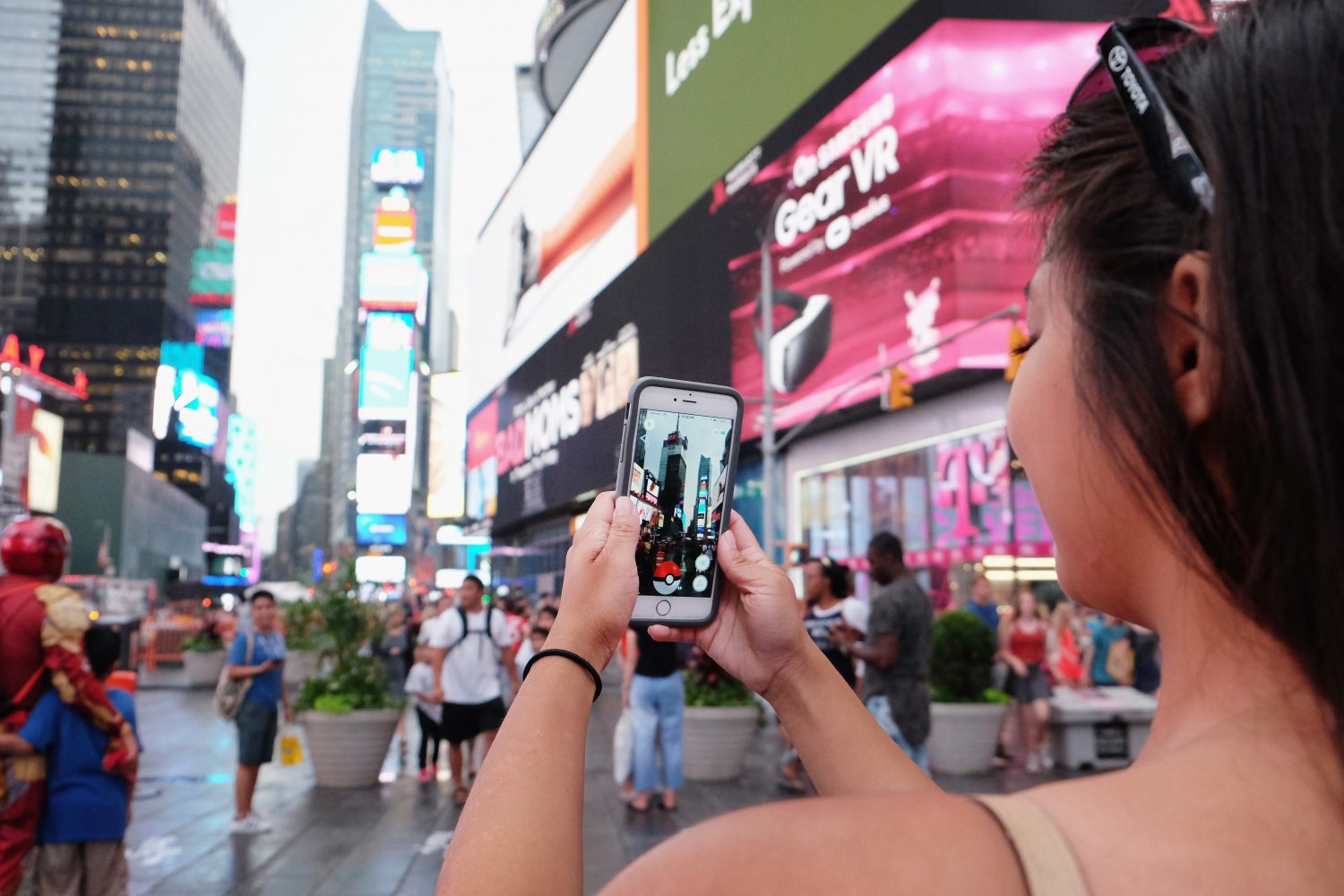
It may be a stretch to call Pokemon Go a millennial’s cultural guidebook, but - as Hotels.com reports – 35 per cent of younger travelers do believe they’ll learn more about their holiday destination by playing the game. (They will also spend an average four hours a day interfacing with it.)
That’s because the app uses real landmarks, like the London Eye or the Pyramids of Giza, as ‘Pokestops’, with each offering a snippet of history or cultural significance when clicked.
Embarrassingly, I have learnt more about my home city through Pokestop snippets than I have in the last 12 months living here.
As well as learning about the local landmarks, holiday makers are likely to see more of the world with Pokémon Go in their pocket; tourists using the app are expected to walk more than four kilometers every day in search of Pokemon.
Hotels.com reports that 45 per cent of holidaymakers will spend more time than ever exploring a city this summer and 35 per cent believe they’ll learn more about a destination because of Pokemon Go.
They are also becoming more intrepid in their willingness to go to ever-more remote places in search of Pokemon.
Hotels.com found 13 per cent of players would head for the Australian outback, 9 per cent the Arctic Circle, 9 per cent Mount Everest, 8 per cent the North Pole, 6 per cent the Outer Hebrides and 6 per cent North Korea.
One man has already quit his job on his quest to catch ‘em all. Tom Currie is combining Pokemon with his love of travel, setting out on a two-month quest around New Zealand. “I wanted to have an adventure,” Currie said. "I get to walk around and explore towns I've never been to.” Another man secured sponsorship from Marriott Rewards and Expedia to travel the world as a Pokemon Trainer.
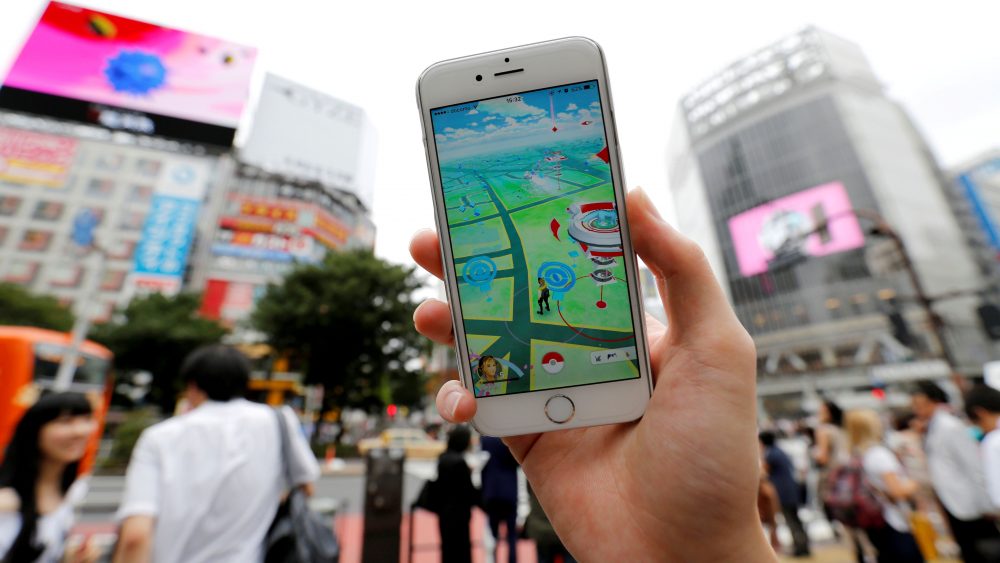
Exploration, exercise and community are at the heart of the travel and leisure industry, and the smartest companies are taking advantage.
Savvy tour operators are now offering around-the-world Poke-adventures, such as this six-week trip through Bangkok, Cairo, and Machu Picchu.
Restaurants and bars are also cashing in on the excitement. Maxwell’s bar in London, for example, reported a 26 per cent increase in revenue thanks to their position as a ‘Pokestop’. The bar spends up to £100 a day on in-game purchases to set ‘lures’ that attract Pokemon - and thirsty Pokemon hunters.
Even entire cities are jumping on the bandwagon. Michigan’s tourist board has published a list of Pokemon hotspots to entice visitors. Basel, Switzerland released an official video of actors dressed as Pikachu attacking people with giant poke balls to encourage tourists to visit the city. (It’s as hilarious as it sounds).
Meanwhile, a taxi firm in Manchester, UK now has ‘specific Pokemon drivers’ who will shuttle you to all the best spots in the city, all for a flat fee of £20.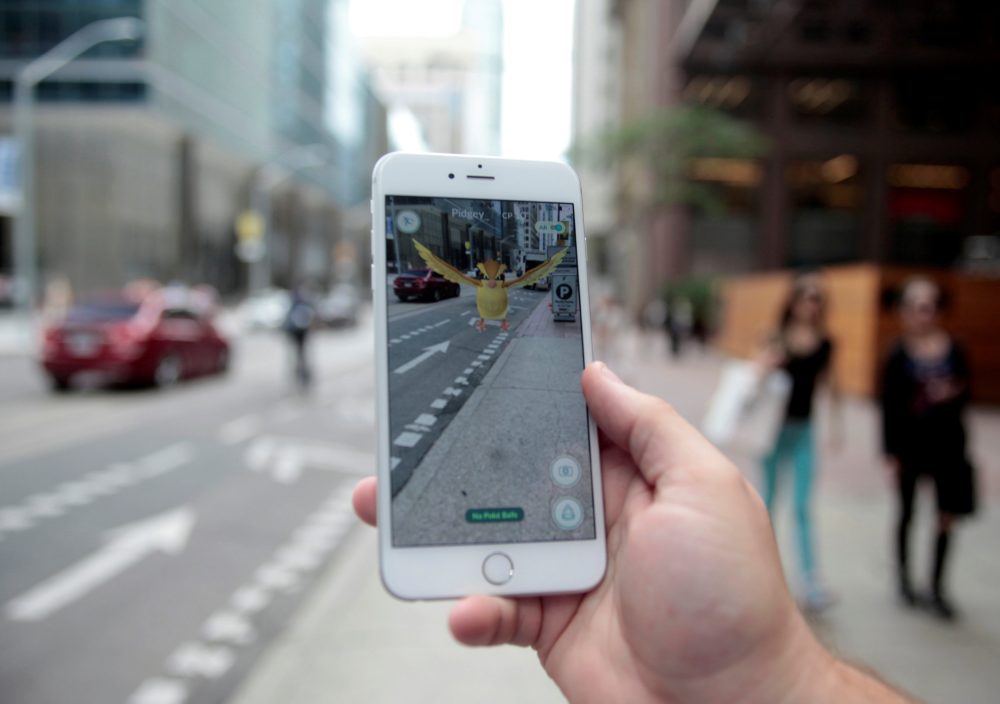 Of course, not all tourist spots are happy about the game. Staff at Washington DC’s holocaust memorial are angered by the three Pokestops on their site. “Playing the game is not appropriate in the museum” a spokesman told The Washington Post.
The Kuwait government has banned Pokemon hunting at sensitive landmarks like mosques, while Iran has gone for a full-blown shutdown of the game in its country for "security concerns".
Ultimately, the Pokemon furore is a short-term, hyper-popular trend. Smart travel companies, restaurants, and tourist boards will ride the wave for a few months, and travelers will immerse themselves in new places.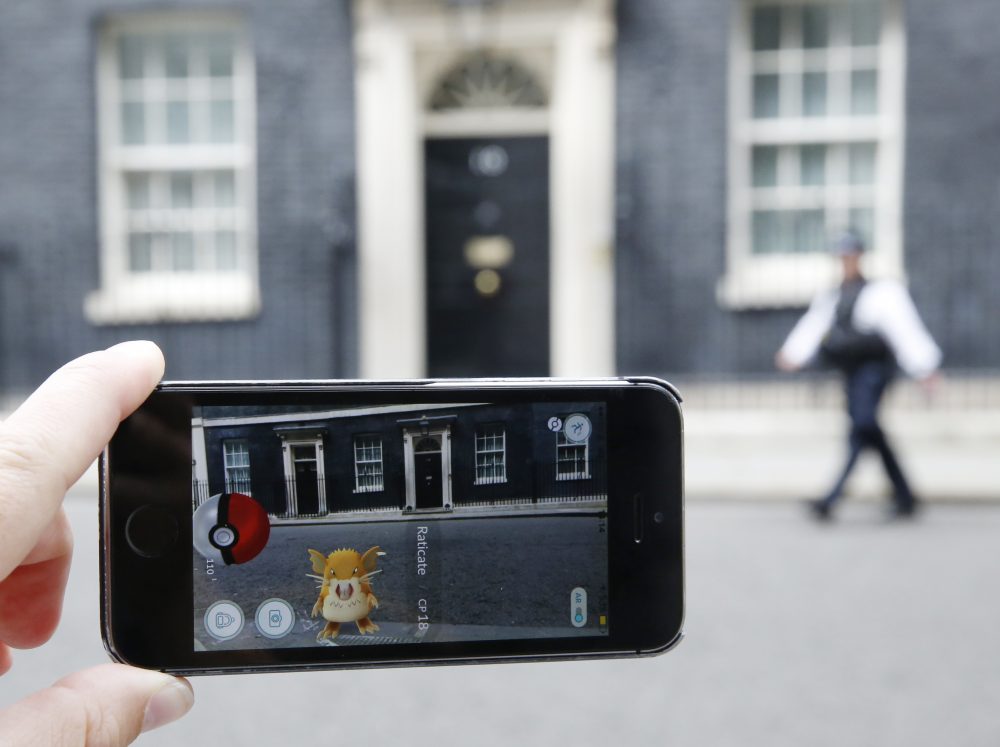 But while Pokemon Go may be short-lived, augmented reality is not. The application of augmented reality in the travel industry is fledgling, but there is enormous potential here.
In the last couple of years, a few travel apps have already popped up that allow smartphones users to point at a landmark and see information about it. Imagine augmented reality tour guides in museums and art galleries.
There is also Blippar, which unlocks offers and deals by scanning real-life objects, pages in magazines, beer bottle labels or posters in the street.
Pokemon Go is the first breakthrough application of a technology that has been bubbling in the tech world for half a decade. Now it’s the new normal, and its time to embrace it.
Now, if you’ll excuse me, there’s a Snorlax in Regent’s Park, and I must catch it.
[dropcap size=big]T[/dropcap]his summer, British Airways announced a partnership with meditation app Headspace, installing versions of its soothing instructional videos on in-flight entertainment systems.
The nine individual tutorials, each no more than ten minutes long, are designed to help passengers find inner calm, cope with anxiety during turbulence and help them get a good night's rest, as well as reducing the impact of jet-lag on arrival.
Headspace meditation was created by former monk (now millionaire) Andy Puddicombe in 2012, and has since become wildly popular, with more than five million downloads to mobile phones and iPads.
Proponents of transcendental meditation (TM), which is slightly less accessible in that it requires a guru to give you a secret mantra, have long said that practising this for 20 minutes can give you the kind of deep rest you only get with eight hours' sleep. If that's the case, then we all need to be doing it when we travel.
Puddicombe said: “We’re really excited to be launching the Headspace in-flight channel with British Airways. The content has been designed to enhance every stage of the journey, before, during and after the flight, with specific exercises to help passengers feel relaxed, refreshed and recharged.
“It is also an opportunity to learn a beneficial new skill, something you can use at your destination and beyond, for a healthier and happier life."
Rival carrier Virgin Atlantic was ahead of the game, though, having started offering Headspace meditation on board its flights since 2011. And now it is paying even more attention to the well-being of Upper Class travellers by also providing them with hot towels infused with De Mamiel aromatherapy oils.
Those on day flights will receive "Enliven", a blend of bergamot, sweet orange and yang ylang, while those travelling at night will get "High Altitude", a blend of fragonia, eucalyptus and lavender.
Jetsetters needing to sleep will also be provided with a This Works pillow spray, with 100 per cent natural essential oils of lavender, vetivert and wild camomile. The fact that Upper Class passengers also get to lie fully-flat in beds made up with soft cotton sheets helps too…
In January, US-carrier Delta Air Lines added its own in-flight meditation app – "OMG. I Can Meditate – to its Studio Suites. Passengers can access sessions via seat-back screens or by streaming them over the on-board wifi.
The ten-minute guided meditations are presented by meditation coach Lynne Goldberg, and have names such as "Relaxing in the Clouds" and "Blanket of Love".
Co-founder of the app, Garner Bornstein, said: "Many people experience travel-related stress, whether a fear of flying or family or business-related pressures waiting upon arrival. Meditating on board can be a really helpful, and enjoyable, way to alleviate this stress."
For some years, Amsterdam Schiphol has had a meditation centre for all religions in its airport, helping passengers centre themselves before getting on the plane.
Having tried meditation ourselves, Globetrender predicts the technique will catch on in a big way. But being on a plane might be the closest we ever get to actually levitating.
[dropcap size=big]N[/dropcap]ew Globetrender contributor Rachael Ellenger investigates Sneakairs. A new form of wearable tech developed in partnership with Easyjet, these "smart" trainers sync with your mobile and help you navigate cities on foot.
I'm lost. I've been in Lisbon a week and still don't know the way to the food market from my hostel without checking a map. With my eyes glued to my phone screen rather than the street ahead of me, last night's story of a daylight mugging at knife point for a phone in South America rings in my ears.
I wish we weren't all so reliant on our phones. Like many people I have a love-hate relationship with technology. I love what it can tell and teach us but hate how it makes us vulnerable and adds weight to our luggage. Having just moved to Portugal, and knowing that I will be moving around a lot, only the necessary has come with me.
Once upon a time, my dad hauled a laptop, video camera and DSLR camera to Spain for a ten day holiday, as well as all of his clothes. Today, I have watched a short film, taken hundreds of photographs, answered emails, called home, and planned my route around the city all from a smartphone.
The idea of wearable tech, the next stage of this technological evolution, fascinates me. Clunky watches and LED T-shirts have no place in anyone's wardrobe, but there is space for multifunctional items streamlined to the wearer's needs that are beautiful and inconspicuous.
With Nike’s fitness tracker counting calories, Jawbone wristbands to monitor sleep patterns, smartwatches from Apple and Samsung covering connectivity requirements, and a jewellery range from Netatmo of statement pieces that monitor the skin's UV exposure, Easyjet is building on the trend with its new "smart shoes".
Whether you need to find your way to a local landmark, restaurant, or back to your hostel after a heavy night out, Easyjet's Sneakairs will lead you there. The smart shoes have small, built-in sensors that, when paired via Bluetooth to a smartphone app, direct the wearer by triggering vibrations within the smart shoe.
The prototype was developed by D6 in collaboration with Easyjet, and tested at the Barcelona Street Project last month. Digital area director for D6, Nuria Martinez, said a gap in the market for navigation technology was identified and that the shoe is “a great fit for an airline such as Easyjet, which flies so many people to new, perhaps unfamiliar destinations".
She added: "Throughout this project we had to factor in [that the device] should be low in energy consumption and small, and we think it fulfils that brief.”
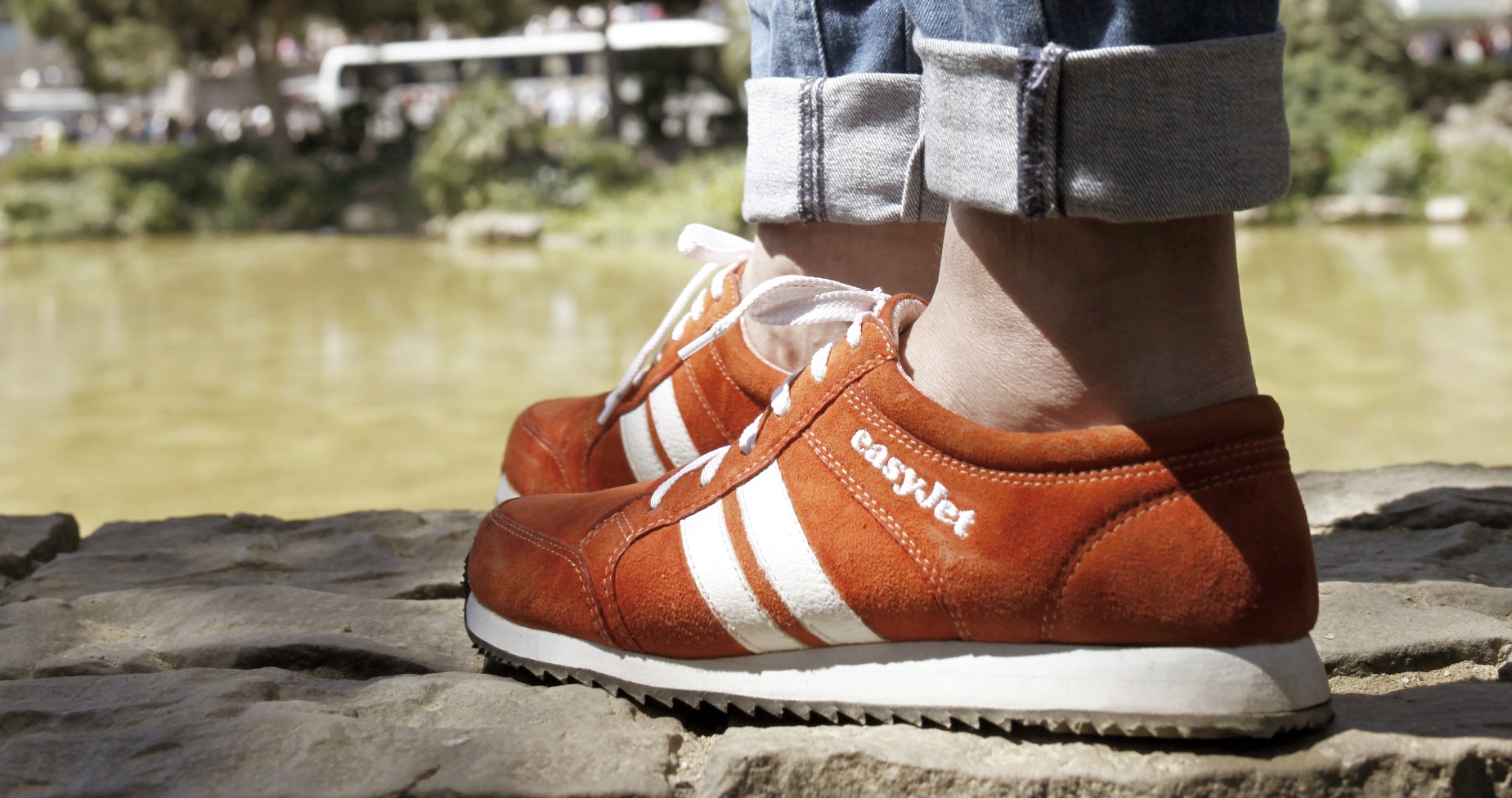
Easyjet's prototype Sneakairs were tested in Barcelona and may one day be available to buy on board
It is unsurprising that Easyjet have invested in such helpful smart tech. Peter Duffy, marketing director for the airline, says: “The Sneakairs are yet another example of how Easyjet is always at the forefront of technology. Our passengers embrace technology before they travel and while they travel with us, so why not once they arrive at their destination?
“We are looking at making this technology available for purchase on board in the future, offering a very practical solution to those passengers who want to relax visiting a new place without the need of a map and enjoy every moment while they explore a new city.”
The Easyjet app itself has been downloaded more than 16 million times, and provides helpful guidance on directions to airport gates, gate numbers and luggage belts. The Sneakairs could one day work in tandem with the app so that gates and luggage can be found without checking airport signs.
Easyjet is forging the way when it comes to developing wearable tech for travel, unveiling revolutionary cabin crew and engineer smart uniforms embedded with features that improve communication, visibility and passenger safety features, to coincide with its 20th birthday last year.
This approach to allowing both staff and travellers to engage better and more safely with their environment via wearable smart tech will undoubtedly catch on, so long as the tech works smoothly.
The idea of keeping hands and eyes free for ice cream, photography, and vigilance is a solo-traveller's dream. However, no one wants to compromise on individuality. For wearable tech such as Easyjet's Sneakairs to go global, it needs to be practical, personal, affordable – and cool.
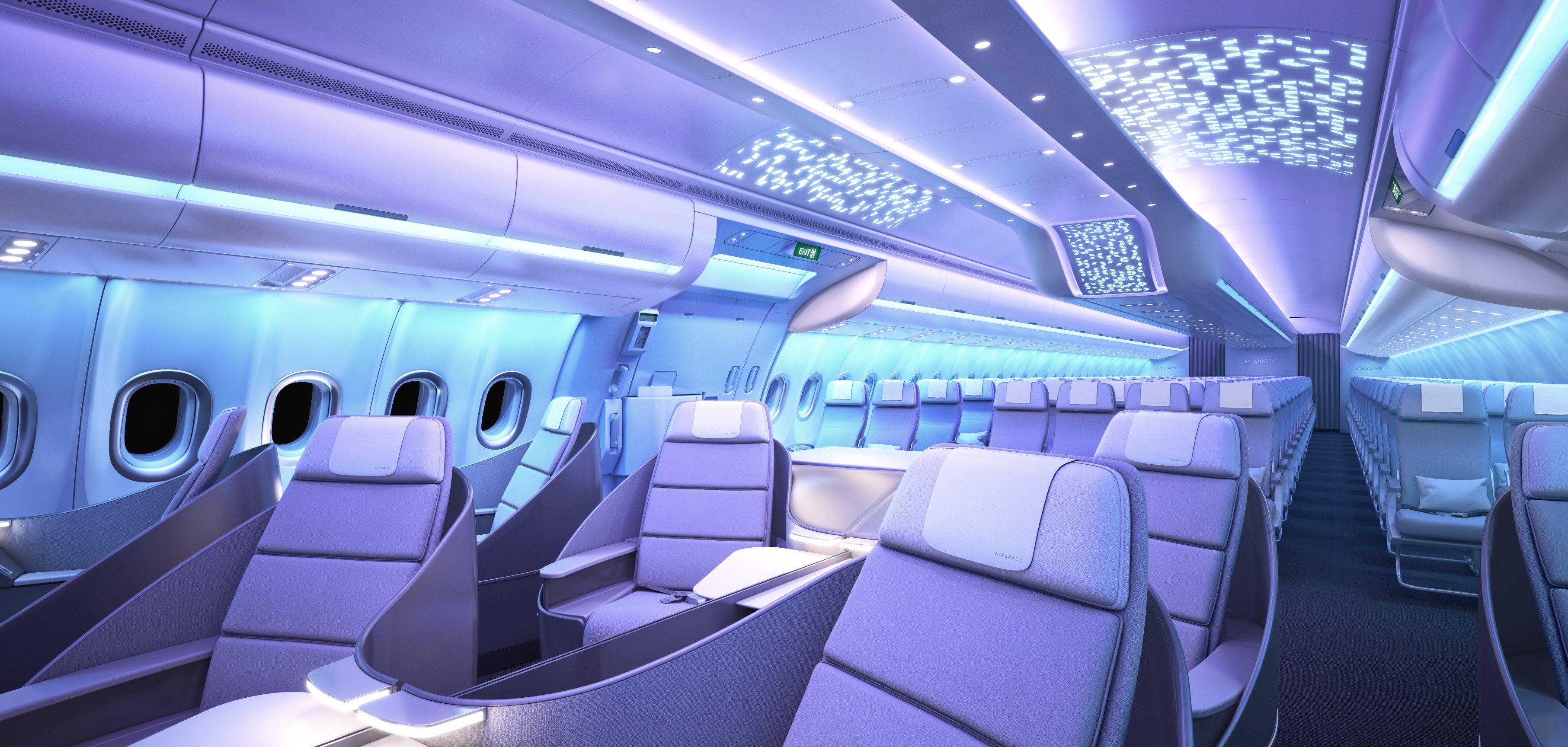
[dropcap size=big]F[/dropcap]rench aircraft manufacturer Airbus has revealed stunning new designs for its upcoming A330neo jet that will encompass ambient lighting projected on to sleek interiors, larger overhead bins and toilets that play soothing soundscapes.
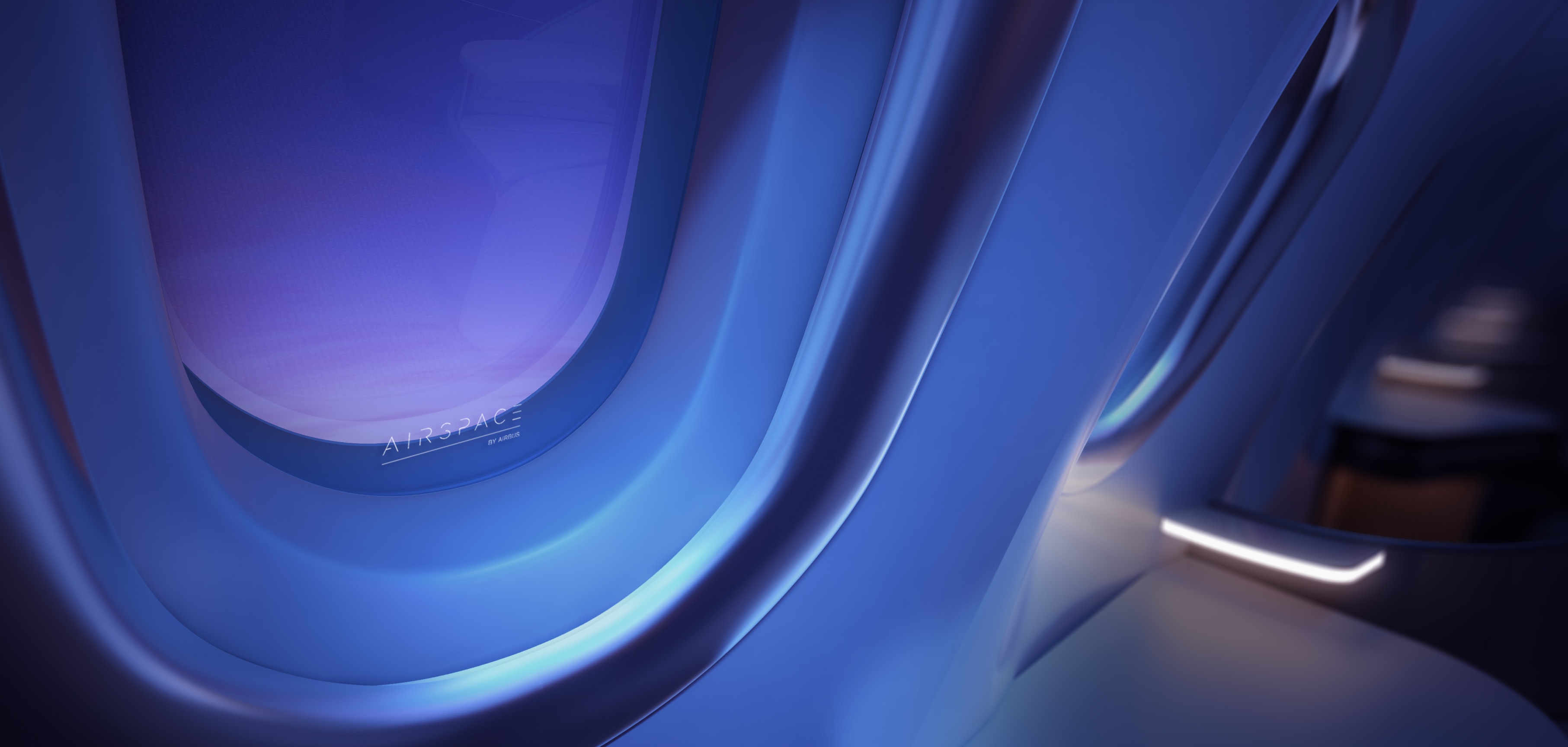
“Travelling is as much a state of mind as it is a physical action. This is why Airspace by Airbus aims to transport you with a cabin environment that is uplifting and inspiring from the moment you step aboard,” it says.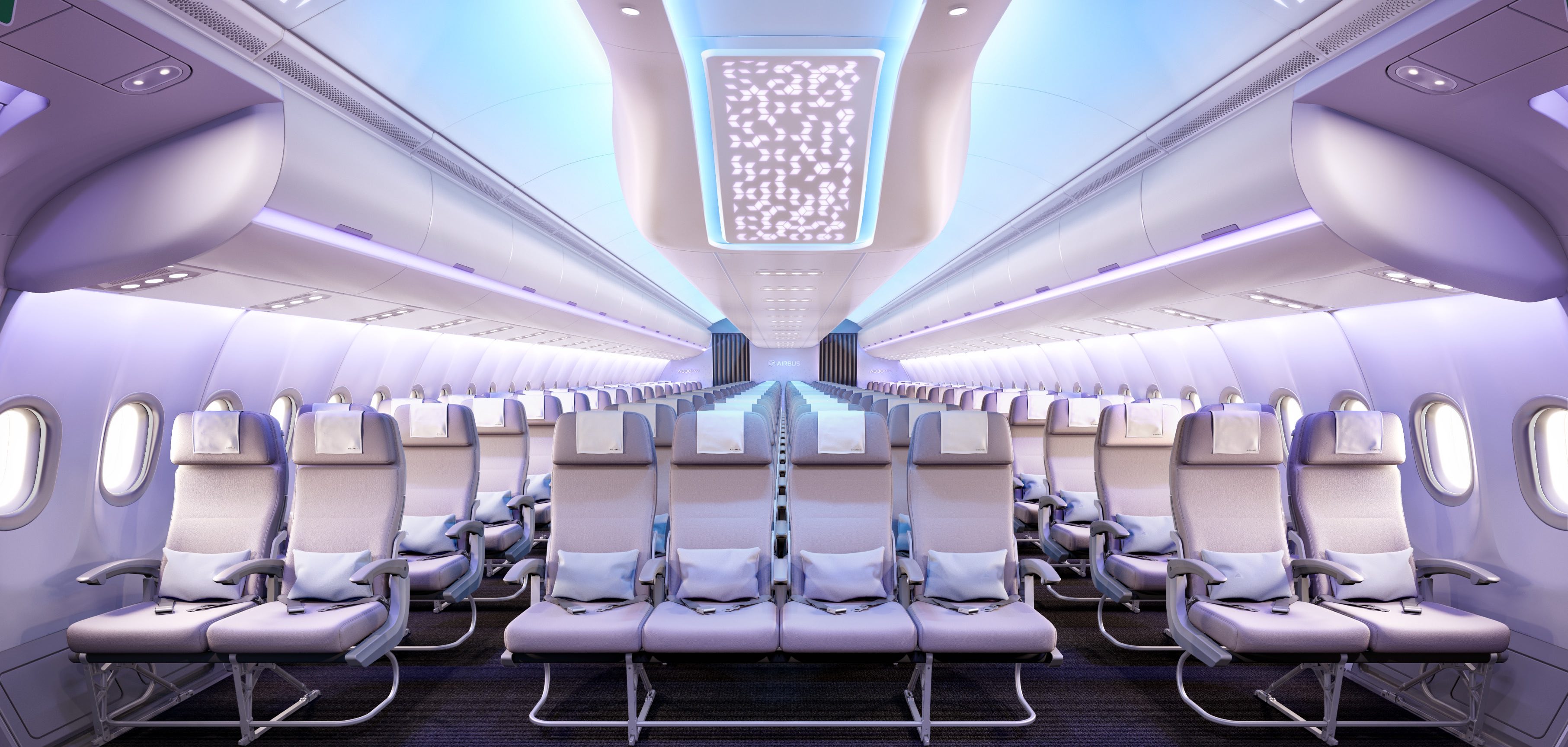 Airspace by Airbus, as the concept has been named, will feature on its new twin-aisle A330neo planes, which will be delivered next year to carriers such as Delta Air Lines, AirAsia X and Garuda Indonesia.
Passengers in coach class will be seated in slim, pale seats facing cutting-edge in-flight entertainment screens playing hundreds of HD and even 3D films. They will also be able to connect personal devices to stream their own pre-loaded TV shows and movies from iPads and smartphones.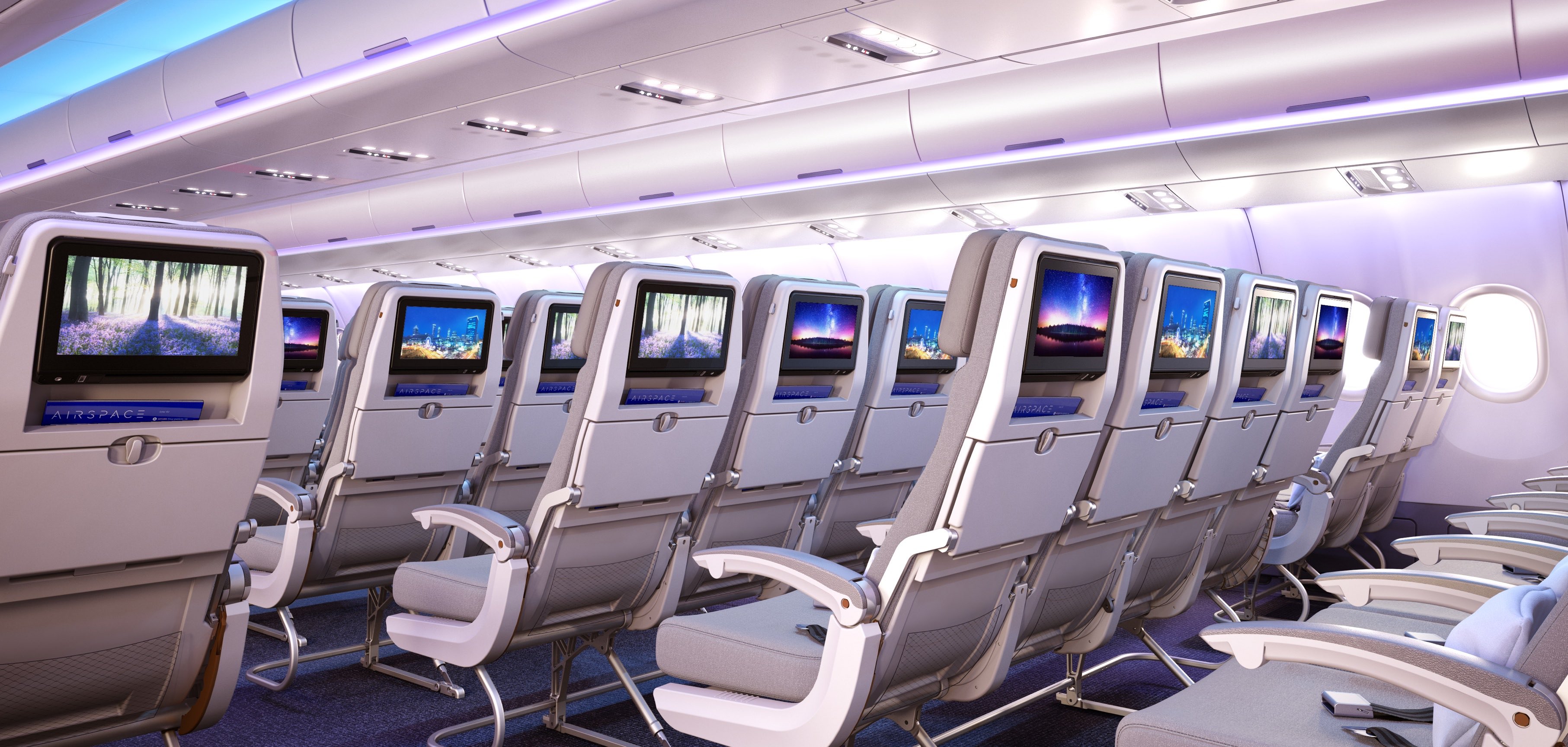 Airbus says internet connectivity will also be available: “You can use your own mobile or smartphone, tablet or laptop to send and receive text messages and emails, access the internet or make and receive phone calls.
“The A350 XWB was the first aircraft in the world to be designed with such built-in broadband connectivity already in place and active from its first day of service. Airspace by Airbus will continue to make this innovation accessible to all.”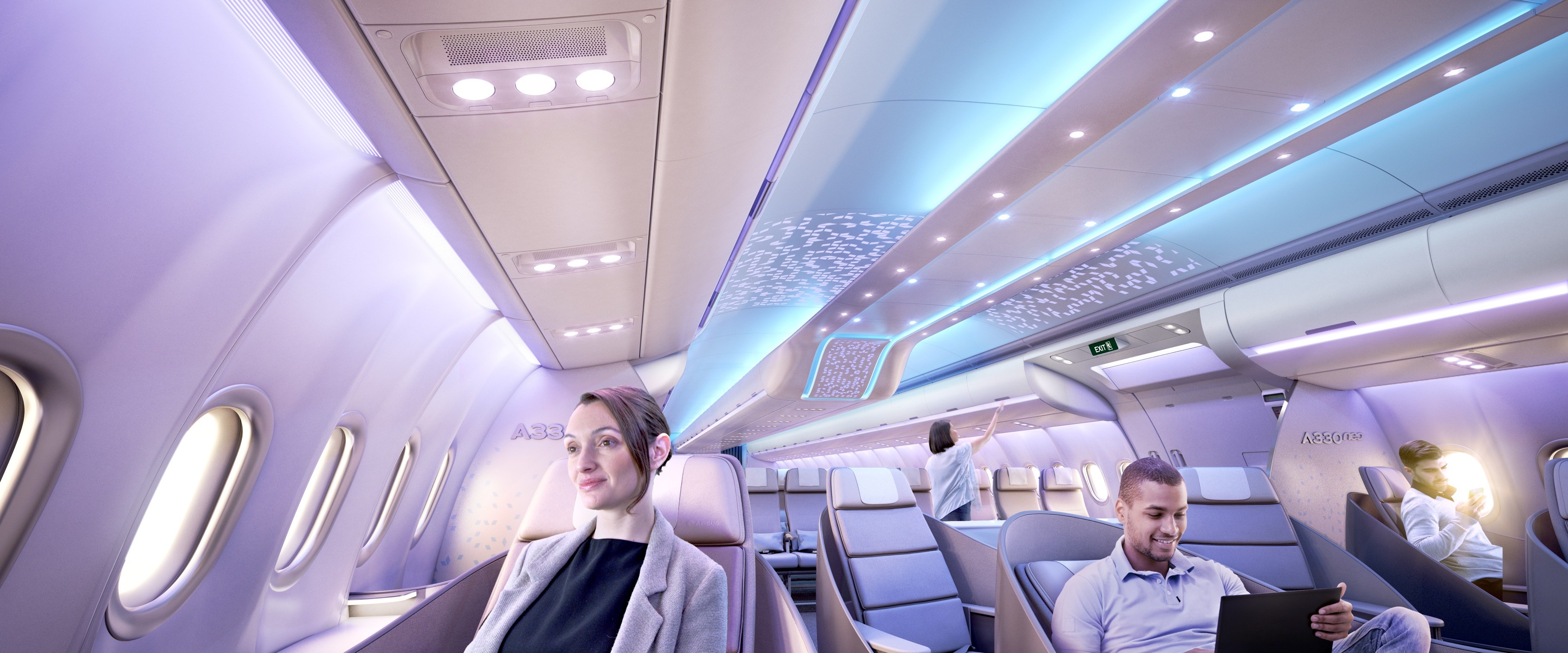 The aircraft will come in two variants – the A330-800neo and larger A330-900neo. The company says: “With a range of 7,500 nautical miles, the A330-800neo will typically seat 257 passengers in three classes, while offering capacity for up to 406 travellers in a high-density configuration.
  "The longer-fuselage A330-900neo version is to accommodate 287 seats in a typical three-class layout or up to 440 for high-density configurations, and provide a range of 6,550 nautical miles.”
 Economy seats will be 18 inches wide – the same as existing A330s with Delta, for example, but a little more generous than on Garuda’s existing fleet (at 17.8 inches). Kiran Rao, executive vice-president of marketing and strategy for Airbus says "this is one inch wider than our competitors”.
The space under each seat will be unobstructed so every passenger will be able to store bags here or extend their legs fully. (There will not be any bulky control boxes for the entertainment system stored here as on older planes.)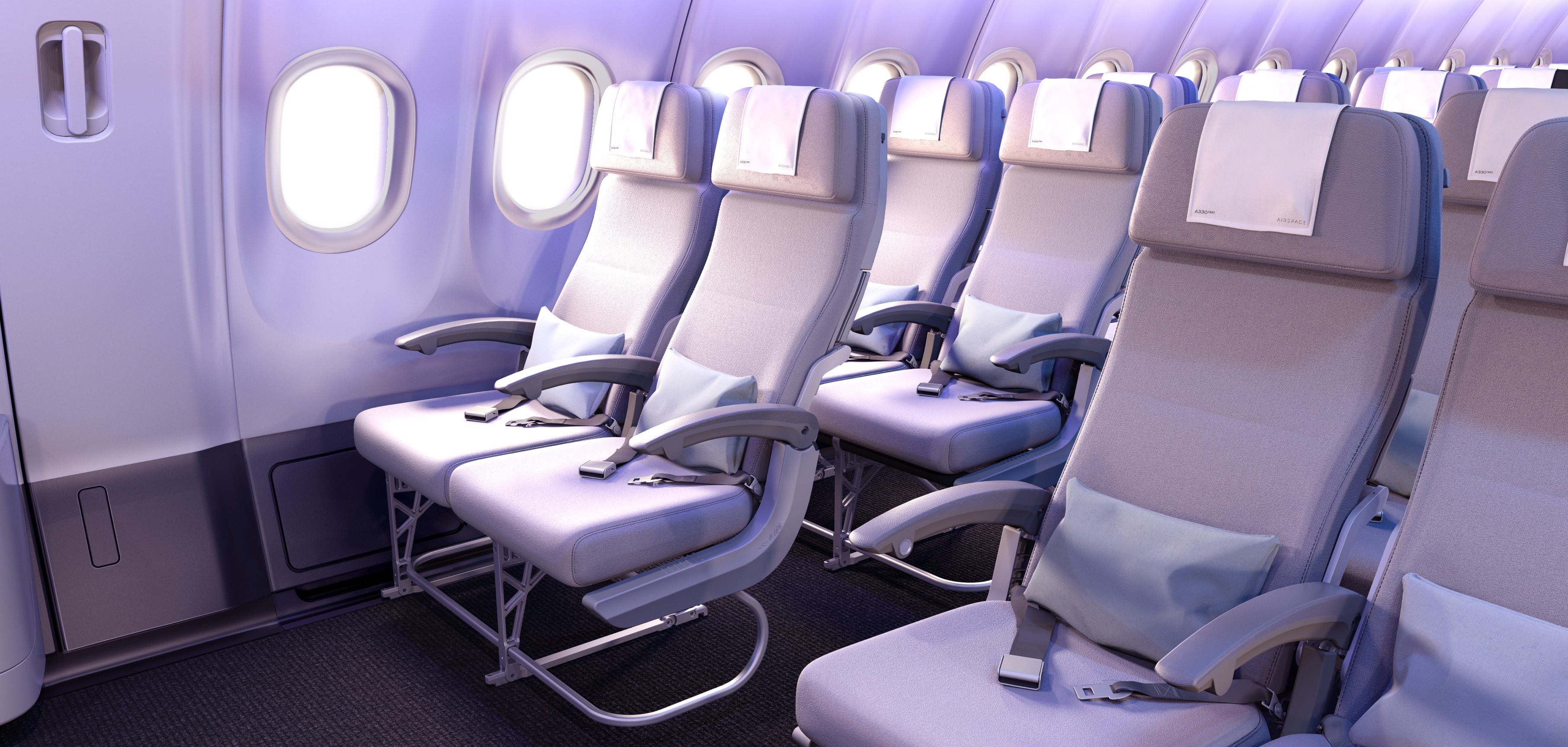 Business class, at the front of the plane, will of course be the height of luxury with fully flat beds installed by the airlines according to their own designs.
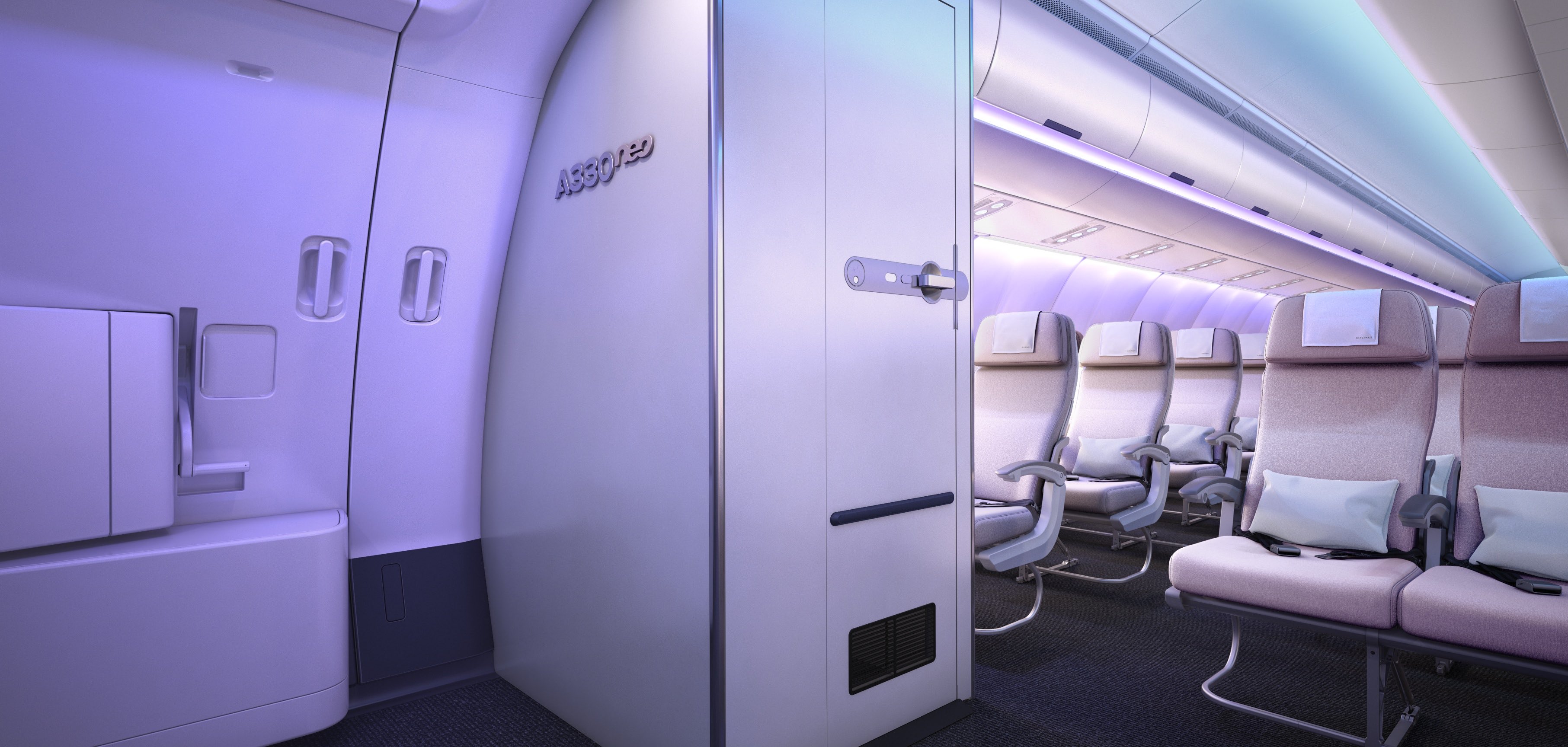
 Restrooms will sport self-flushing toilets, touchless taps, aroma dispensers and anti-bacterial surfaces, as well as speakers to play background music.
  Meanwhile, the cabin itself will be quieter, thanks to top-notch Rolls-Royce engines.
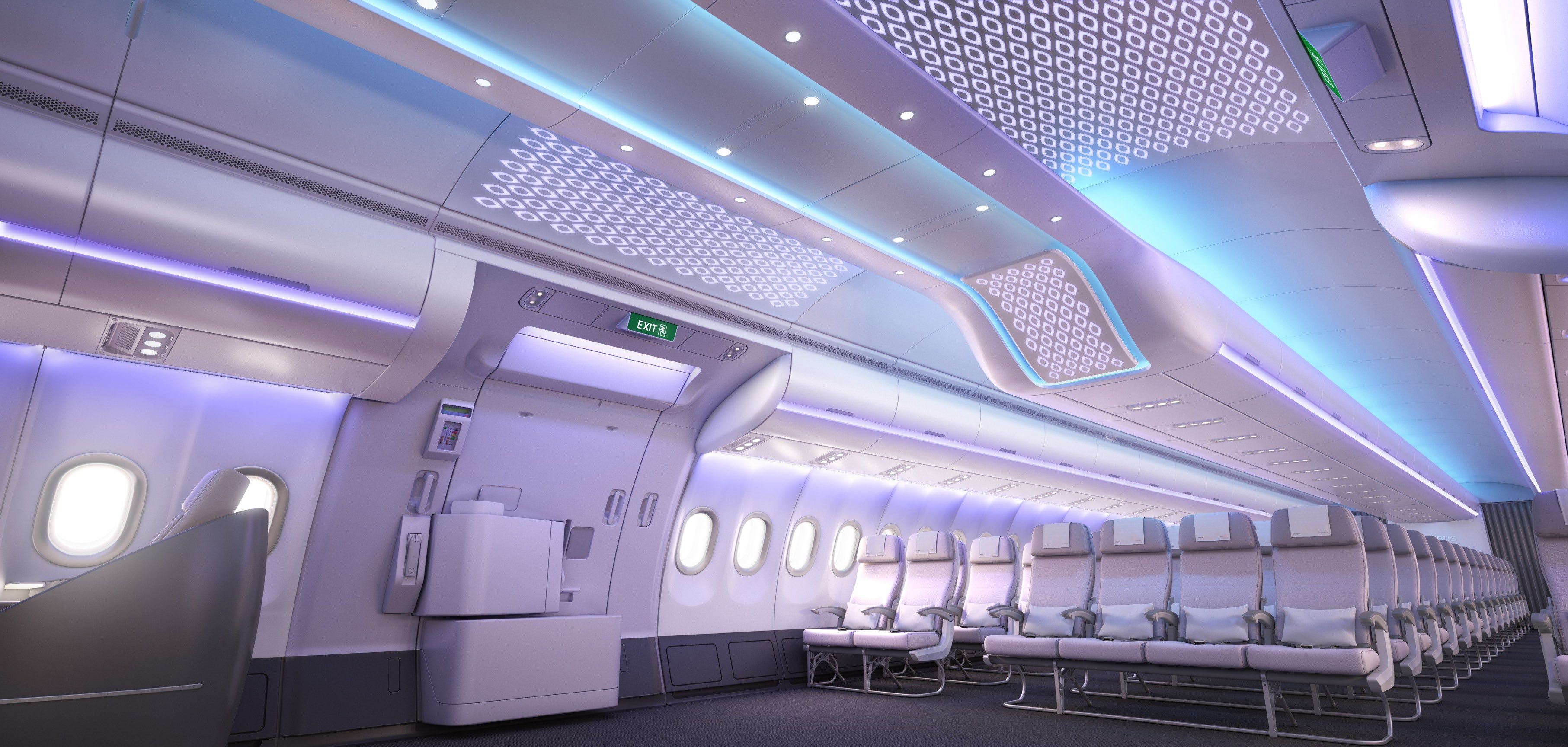
Airbus says: “Finishes are high quality, ergonomic and hardwearing, extending the life of the interior.” It adds that the overall look will be “cleaner”.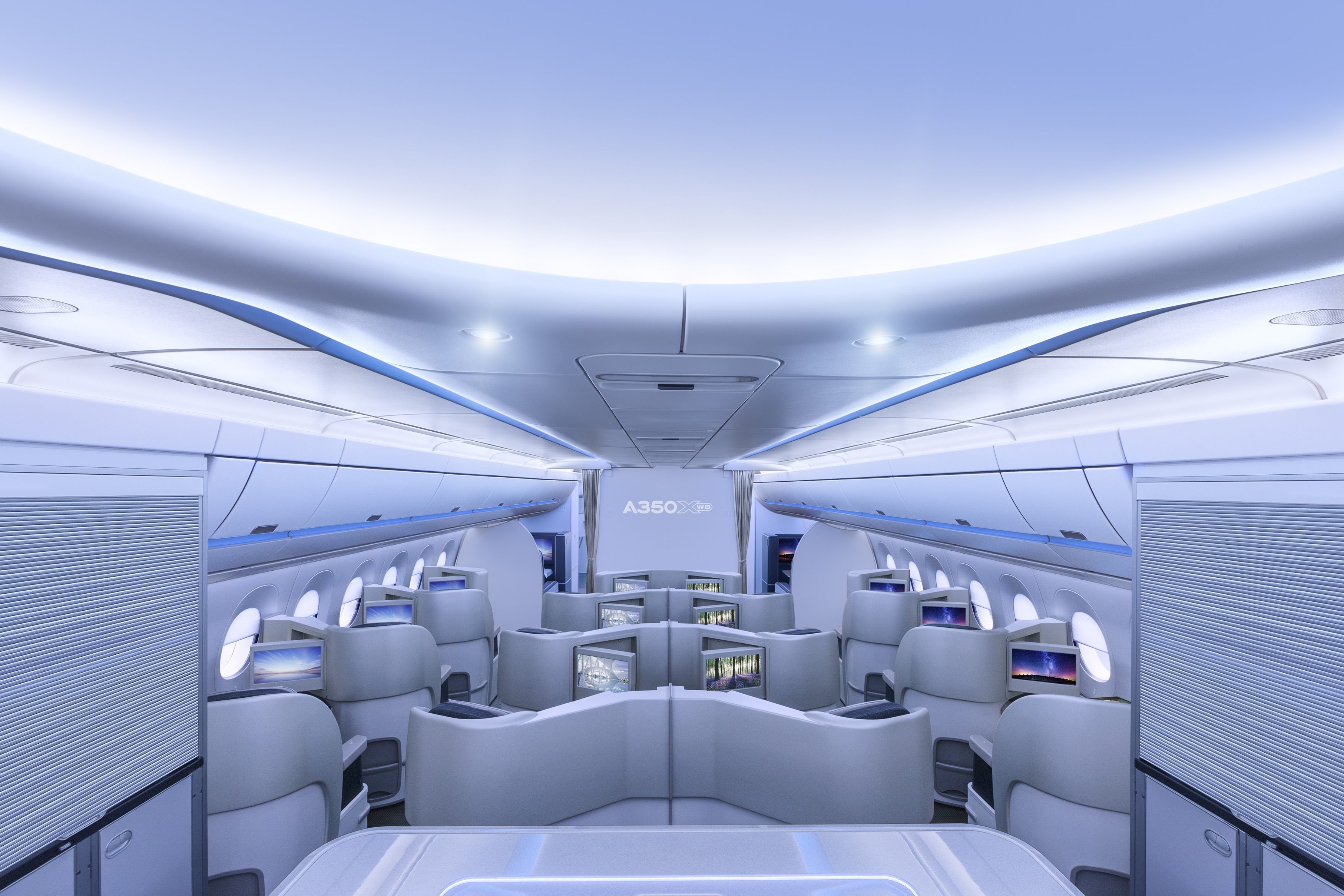 “From our customisable entrance way to latest technology LED lighting throughout the cabin and at your seat, everything about your surroundings suggests your journey is going to be a pleasant one. The lighting is computer-controlled to reflect the mood of the time of day or stage of the flight,” says the manufacturer.
 The design will be extended to new A350 and A380 superjumbos in coming years. Airbus says: “Expanses of grey plastic everywhere you look are now so last century.”
[dropcap size=big]I[/dropcap]n the future, the world’s wealthiest travellers may be able to book seats in the SkyDeck, a transparent capsule on the roof of a jet, affording uninterrupted views of the clouds in every direction.
Designed by aeropace engineering company Windspeed Technologies, the sci-fi bubble – known as the SkyDeck – will sit just behind the wings, and will be made from the same high-strength polycarbonate used for the canopies of fighter jets.
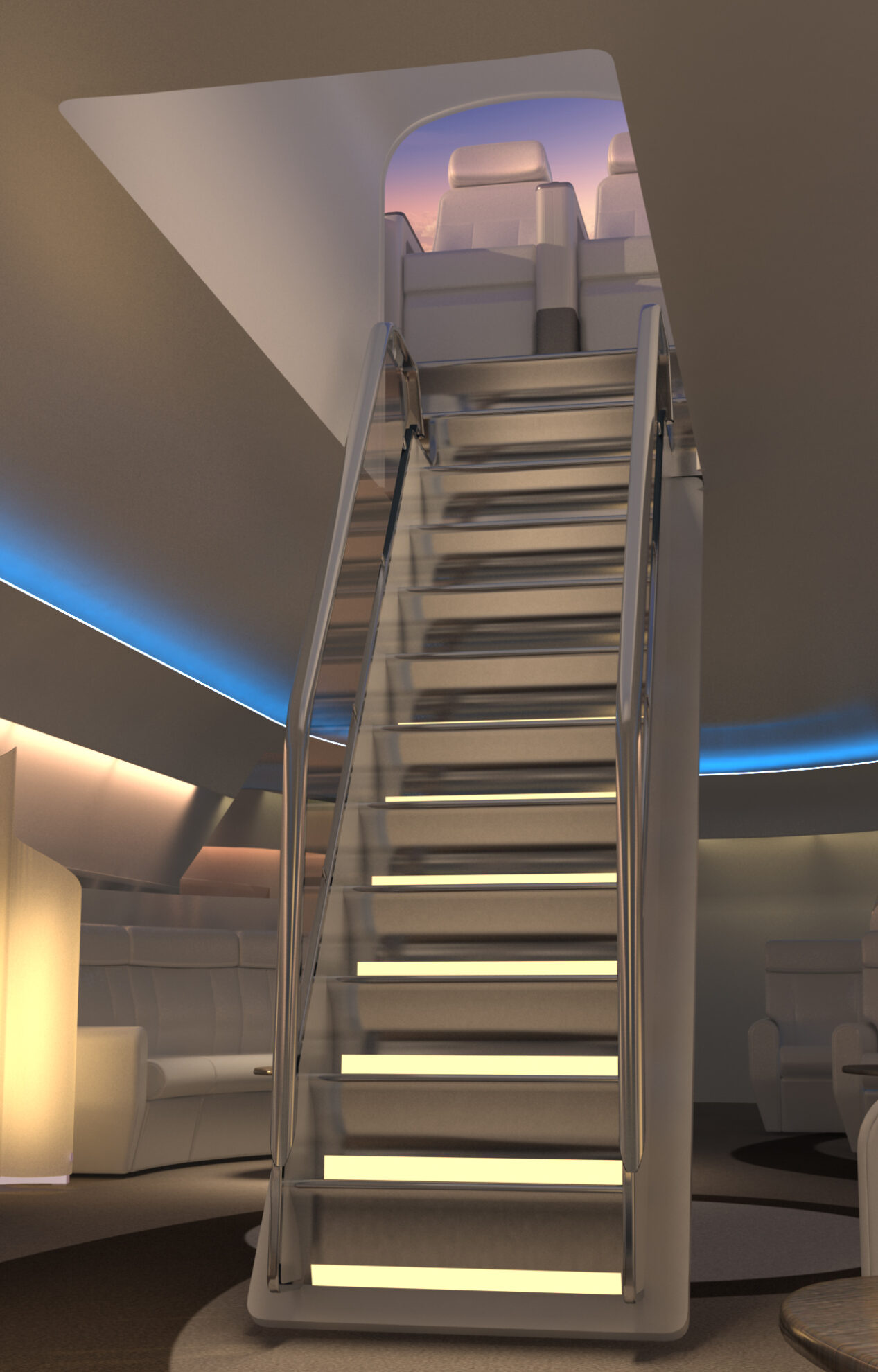
Once on board, passengers will either access the seats by walking up a flight of stairs from the main cabin, or rise up from inside the plane via a lift in a column-shaped chute.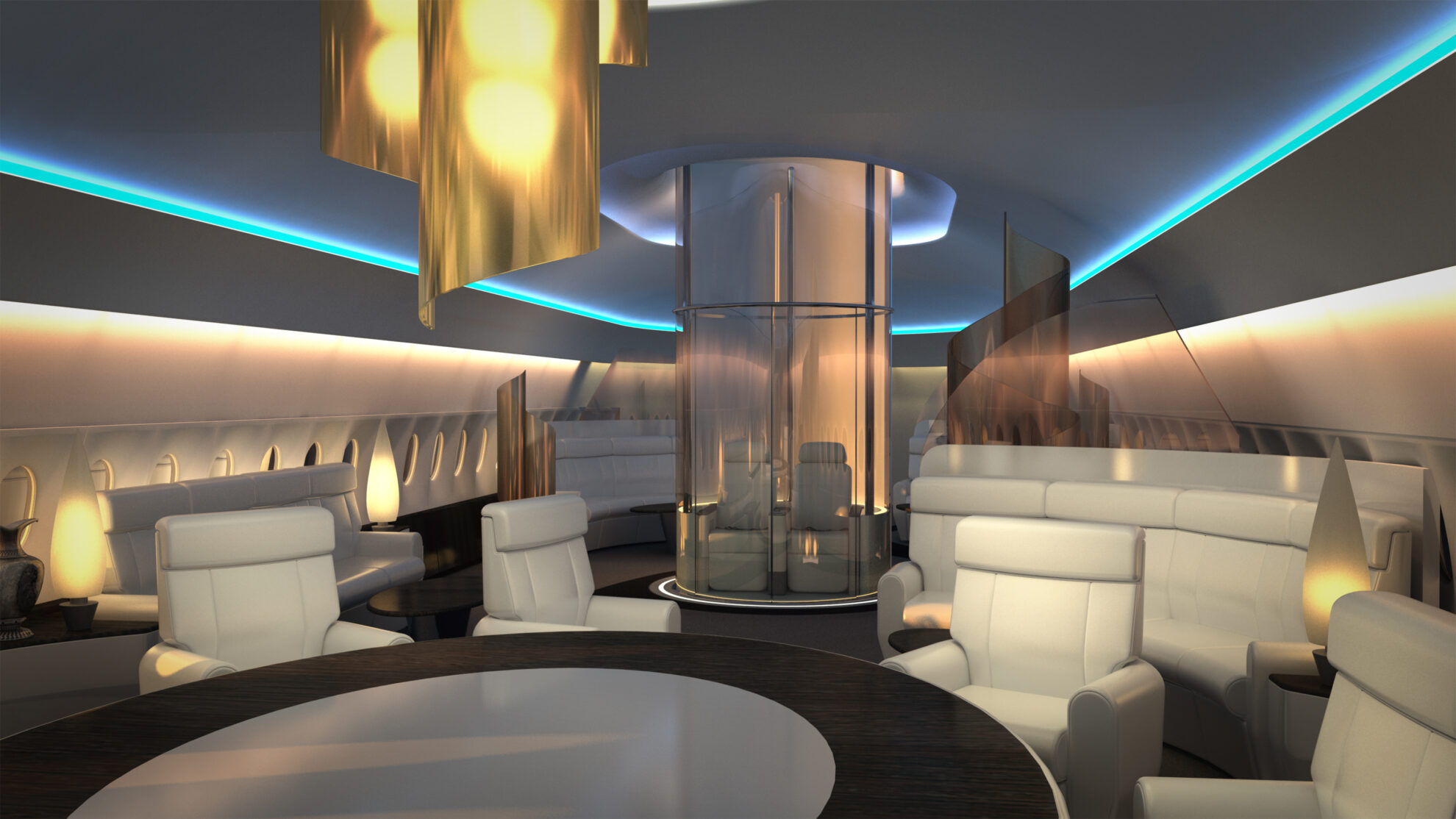 The seats will also be mounted in such a way as to be able to rotate (like a high-tech office spinner chair) to offer 360-degree panoramas. In-flight entertainment screens will also be installed in the unlikely event passengers get bored.
Windspeed Technologies says: “The uniqueness of the design is that it allows passengers to safely position themselves at a safe semi-external location of the aircraft while enjoying a thrilling view.
“In addition, GPS systems will be integrated in the design of the platform and seats to provide the viewer with real-time position and flight information.”
 Once the company has received firm orders from airlines, it will start installing the SkyDeck on planes. It won’t be cheap, though – Windspeed says each one would cost between US$8 million and US$25 million.
Given Etihad airways is selling its two-person, hotel room-style suite on its A380 for £12,500 one-way (click here to read more), on the right route, the SkyDeck could be compelling from a business point of view.
If it cost US$10 million to install, and sold for, say, US$20,000 a pair, it would only require 250 return journeys to cover the cost. (Selling a daily flight, it could recoup the outlay within a year.)
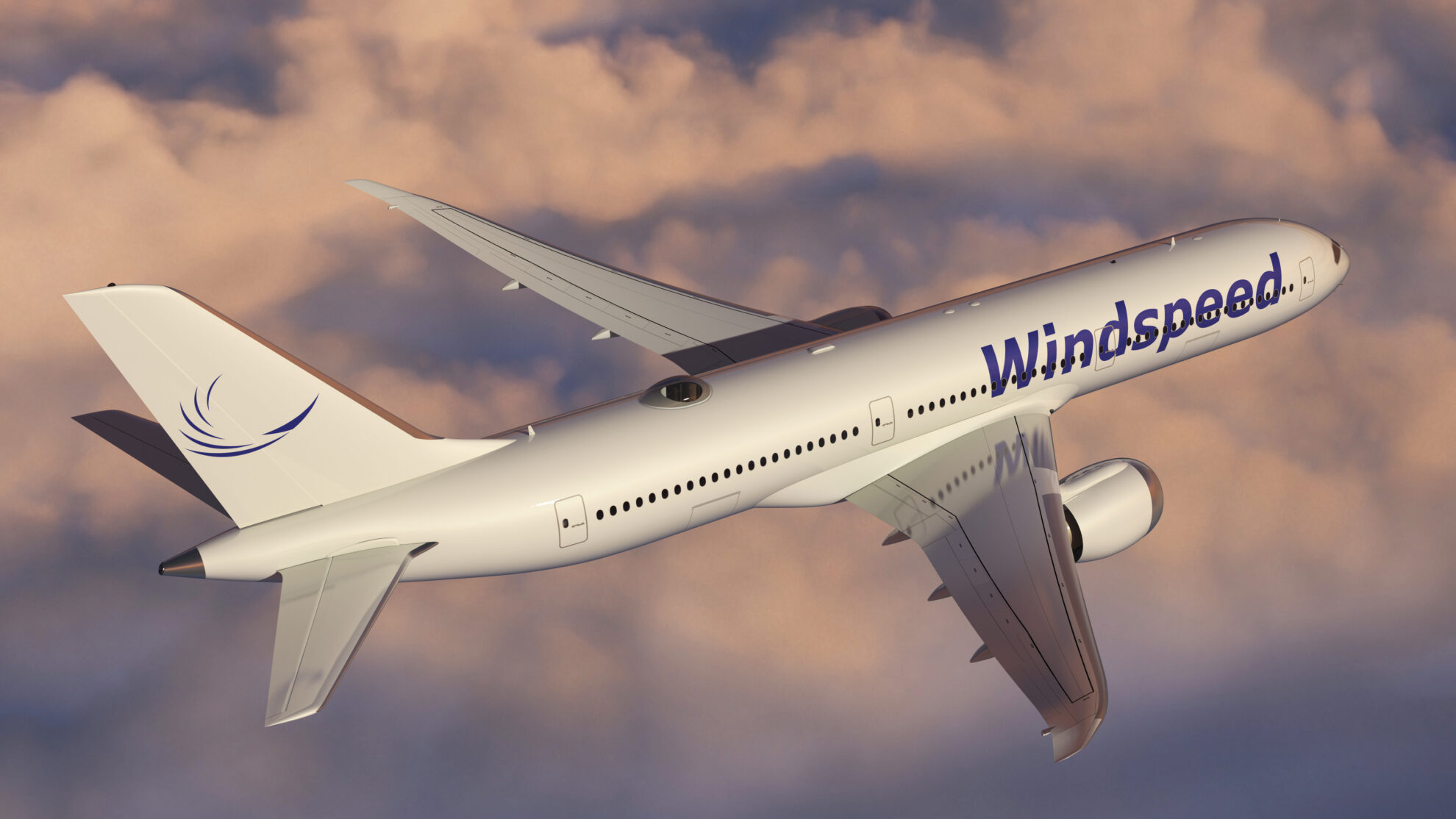 Windspeed says: “Many design hurdles had to be overcome including the structural integrity of the canopy to withstand a bird strike, condensation, noise levels, UV protection and aerodynamic drag. [However] we have succeeded in resolving all of these concerns.”
It adds: “Considering the fact that Windspeed has been highly involved in major aircraft development programs such as the B787-8, 787-9, 787-10 and the new 777X, the engineering needed for the SkyDeck is pretty straight forward.”
Windspeed says that it would take 18 months to roll out from receipt of an order, but aircraft would only be grounded for three to four months for installation and testing.
[dropcap size=big]L[/dropcap]aunching in the autumn, the Dutch capital will see the unveiling of the inaugural property from Zoku, a new lifestyle brand that provides guests with customisable 'smart lofts'.
Described as a "home-office hybrids", there will be 133 Zoku Lofts measuring 25 sqm. Each will have customisable interiors with a four-person table in the centre of the room. Furnishings will be from Danish design brand Muuto, guests will be able to choose their own art, and wifi will be free.
Zoku said: "The Zoku Loft also features a fully-equipped kitchen, cleverly designed extensive storage space, an alcove desk with office supplies, and an elevated, loft-style sleeping space, which can be accessed by a retractable staircase, and screened off to make the loft cosy, business-like or something in between."
Guests can even keep fit, using pull-up rings attached to the ceiling, or by attending bootcamp and yoga classes.
There will also be 500 sqm of "social space" for communal living and working, and a "residential kitchen for meals and dinner parties". Other facilities will include a bar, meeting rooms, a 24/7 shop, a treatment room, gym, games room, music room, locker room, launderette, pantry and a "decompression room" for a shower if your room isn't ready.
Community managers will "roam the public spaces, helping with personal requests and facilitating professional and social connections through their broad networks within Zoku and the city".
The Zoku concept has been created in conjunction with trend-forecasting agency the Future Laboratory, award-winning interior design and architecture company Concrete, and public crowdsourcing.
Chris Sanderson, co-founder of the Future Laboratory in London, said: "The merging of business and leisure represents one of the fastest-growing and dynamic business opportunities in recent years. Today's business travellers are re-writing the rules. Their outlook on work and play demands new services and a new approach to the hospitality sectors."
According to Zoku, the company wants to open "at least five new locations with a total of around 750 smart lofts as soon as possible". Other possible cities include London, Paris, Berlin, Hamburg, Barcelona, Vienna and Copenhagen.