The Ritz-Carlton, Langkawi has introduced a new private yacht experience designed to take guests around the island’s archipelago. Named Dayang Mastura, the sailing catamaran offers curated journeys along Langkawi’s Andaman coastline, combining leisure, dining and exploration at sea.
The yacht is a Lagoon 620 catamaran and forms part of the resort’s wider effort to expand its guest experiences beyond the property. Excursions are tailored to different occasions, including small celebrations, group gatherings, couples’ trips and corporate events, with itineraries shaped around the surrounding islands and coastal landscapes.
With space for up to 20 guests, the yacht includes indoor and outdoor dining areas, a lounge, sun decks and a dedicated space for yoga and meditation. It also has four ensuite cabins, allowing for extended stays on board. Guests can take part in activities such as paddleboarding, kayaking, snorkelling and fishing during their journey.
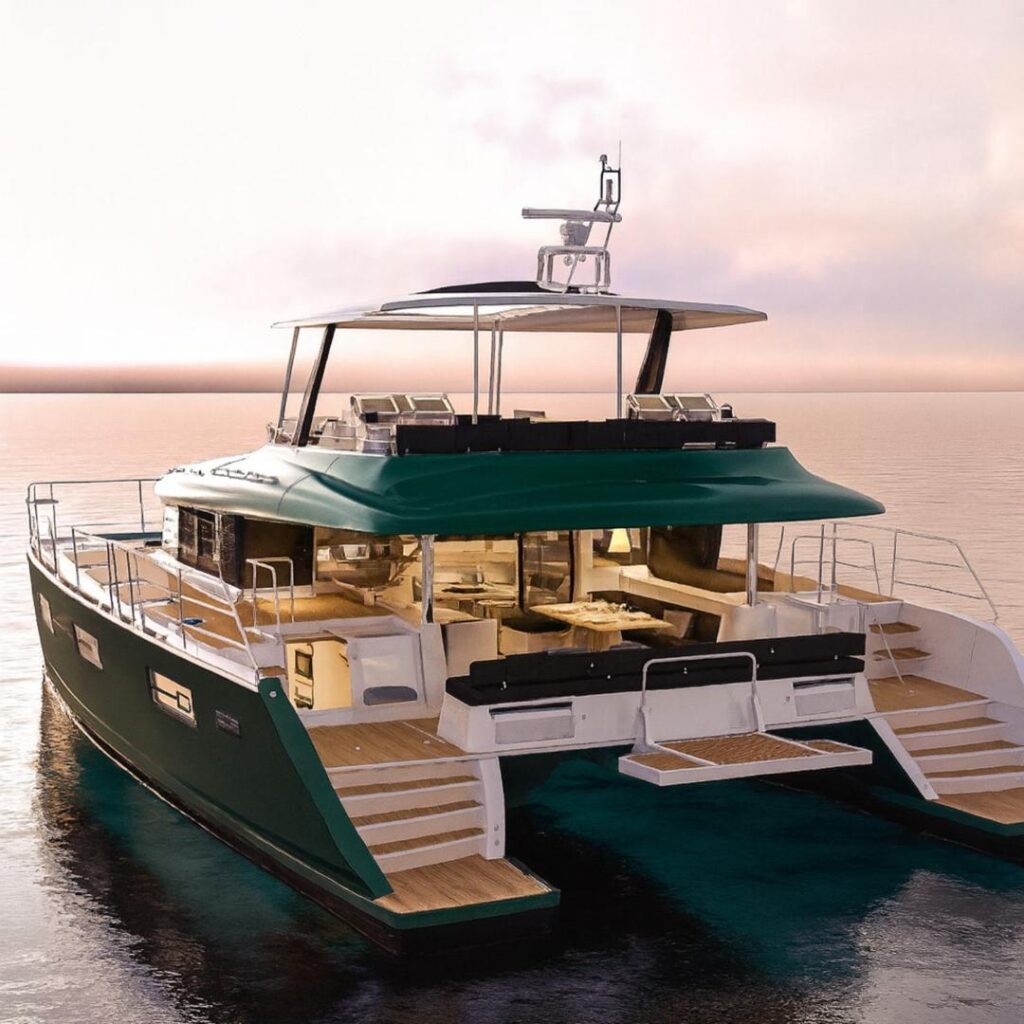
Each trip departs from Telaga Harbour Park marina, located a short drive from the resort. Guests are welcomed on board by a captain and crew before sailing along the Machinchang Coast and through the Straits of Chinchin. Routes include stops near islands such as Pulau Rebak Besar and Pulau Intan Kecil, where calm waters provide opportunities for swimming and snorkelling among reef fish.
Food plays a central role in the experience, with menus prepared by a private chef and inspired by local cuisine. Dishes include Kuih Rotan, Kerabu Kale, and Kuih Lapis, alongside fresh fruit and canapés. During sunset cruises, guests are served items such as Lempeng with Sambal Bilis, Thai Beef Salad, Banana Cake and Pandan Financiers while travelling along the coastline.
The experience is available as a full-day charter or a shorter sunset sailing. Prices for private hire start from MYR 8,800, approximately £1,600.
By introducing a private yacht, The Ritz-Carlton, Langkawi is responding to growing demand for more personalised and location-specific travel experiences. The offering allows guests to explore the destination in a more flexible way, combining accommodation-style comfort with access to remote coastal areas.
Preferred Hotels & Resorts has announced its first private jet travel experience, offering guests a lavish opportunity to visit seven countries aboard a private aircraft featuring lie-flat leather seating and chef-made meals, washed down with premium wines and spirits.
The 17-night "Legendary Journeys" itinerary, scheduled for October 2026, takes in Singapore, India, Rwanda, Kenya, Greece, Morocco and London. A 17-member service team will manage all logistics, whilst a professional photographer and videographer will document the journey.
On-the-ground experiences include gorilla trekking in Rwanda, a royal celebration in Jaipur, private wildlife encounters in Kenya and dining beneath the stars in Morocco's Atlas Mountains.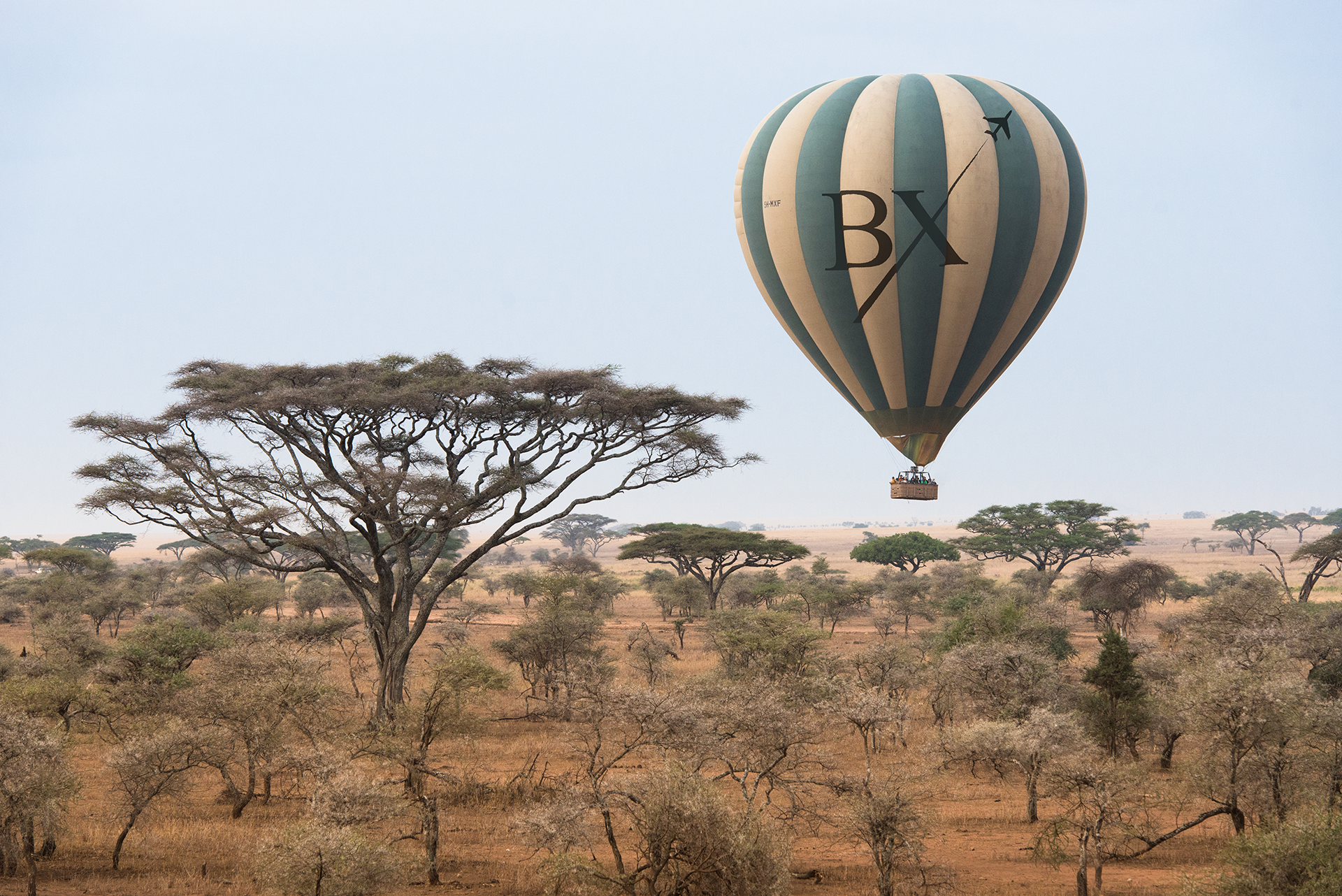
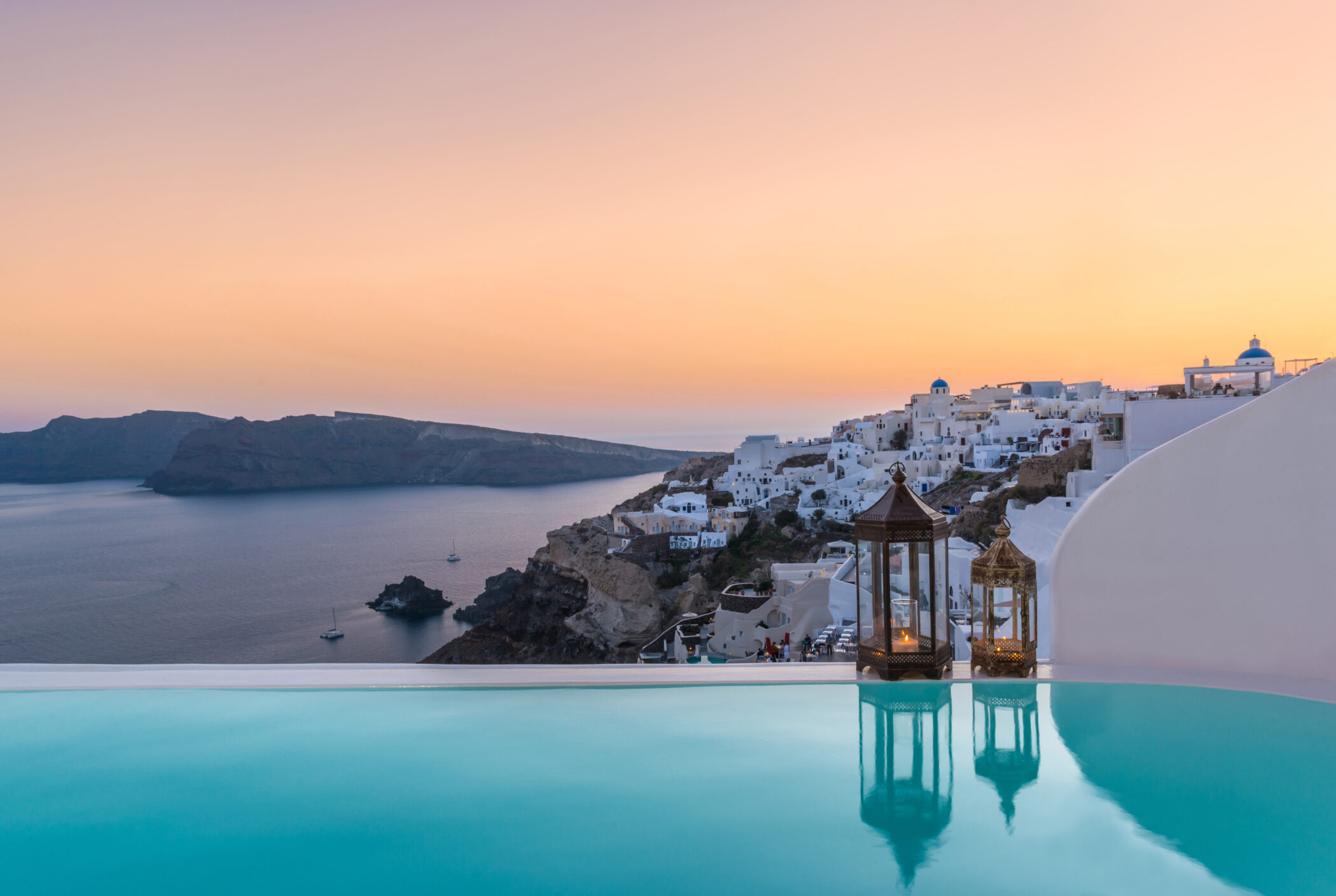 The itinerary features stays at four members of Preferred Hotels & Resorts' Legend Collection, including The Fullerton Bay Hotel in Singapore, The Leela Palace Jaipur, Andronis Luxury Suites in Santorini and The Londoner. Additional accommodations include partner properties in Rwanda, Kenya and Morocco.
Unique highlights include a private reception hosted by Rwanda's President Kagame, helicopter flights over the Virunga Mountains, witnessing the Great Migration in Kenya, sunrise hot-air balloon safaris with champagne breakfast, and exclusive wine tastings of rare Assyrtiko vintages in Santorini.
The journey concludes with a champagne toast on The Londoner's rooftop terrace overlooking Leicester Square.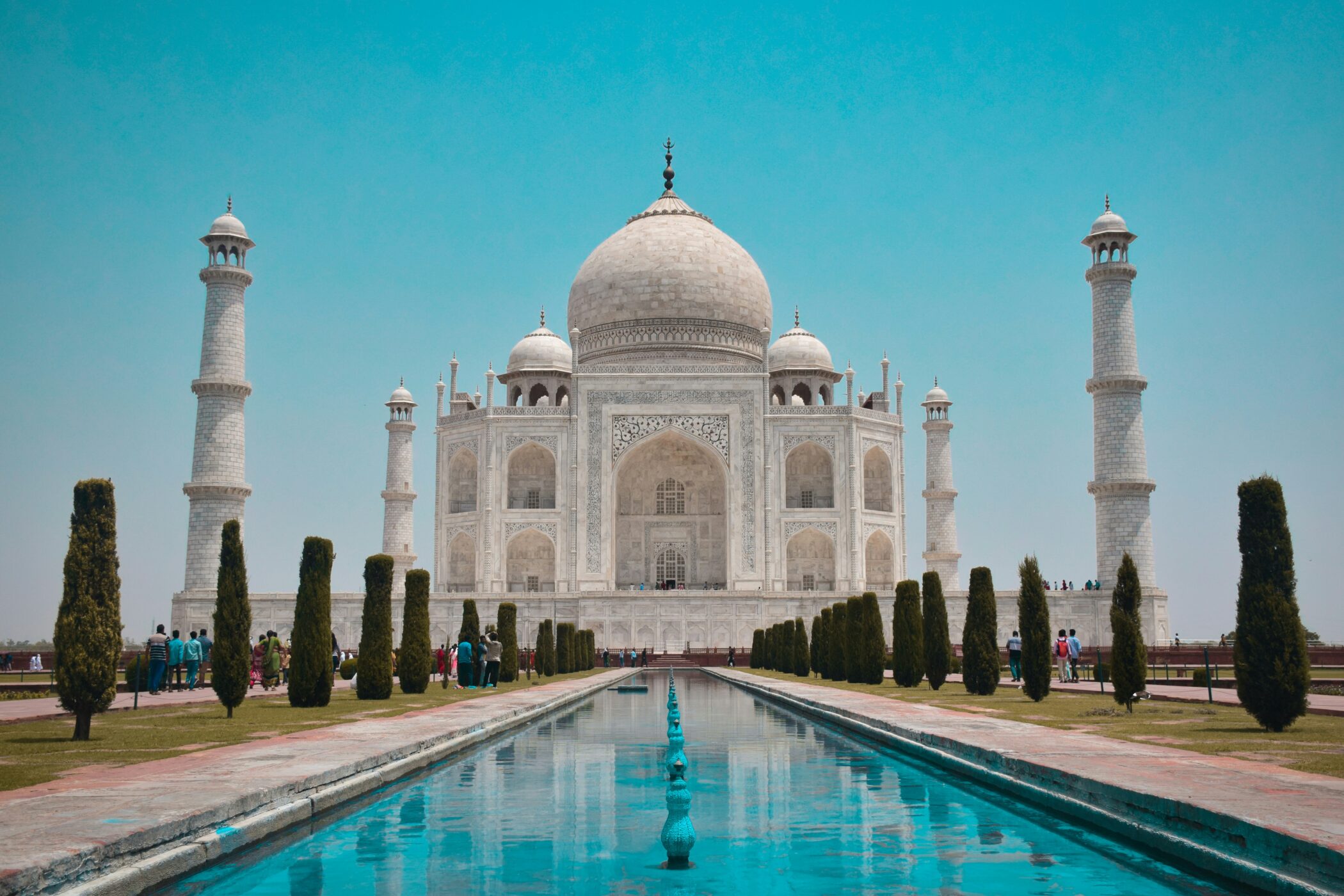
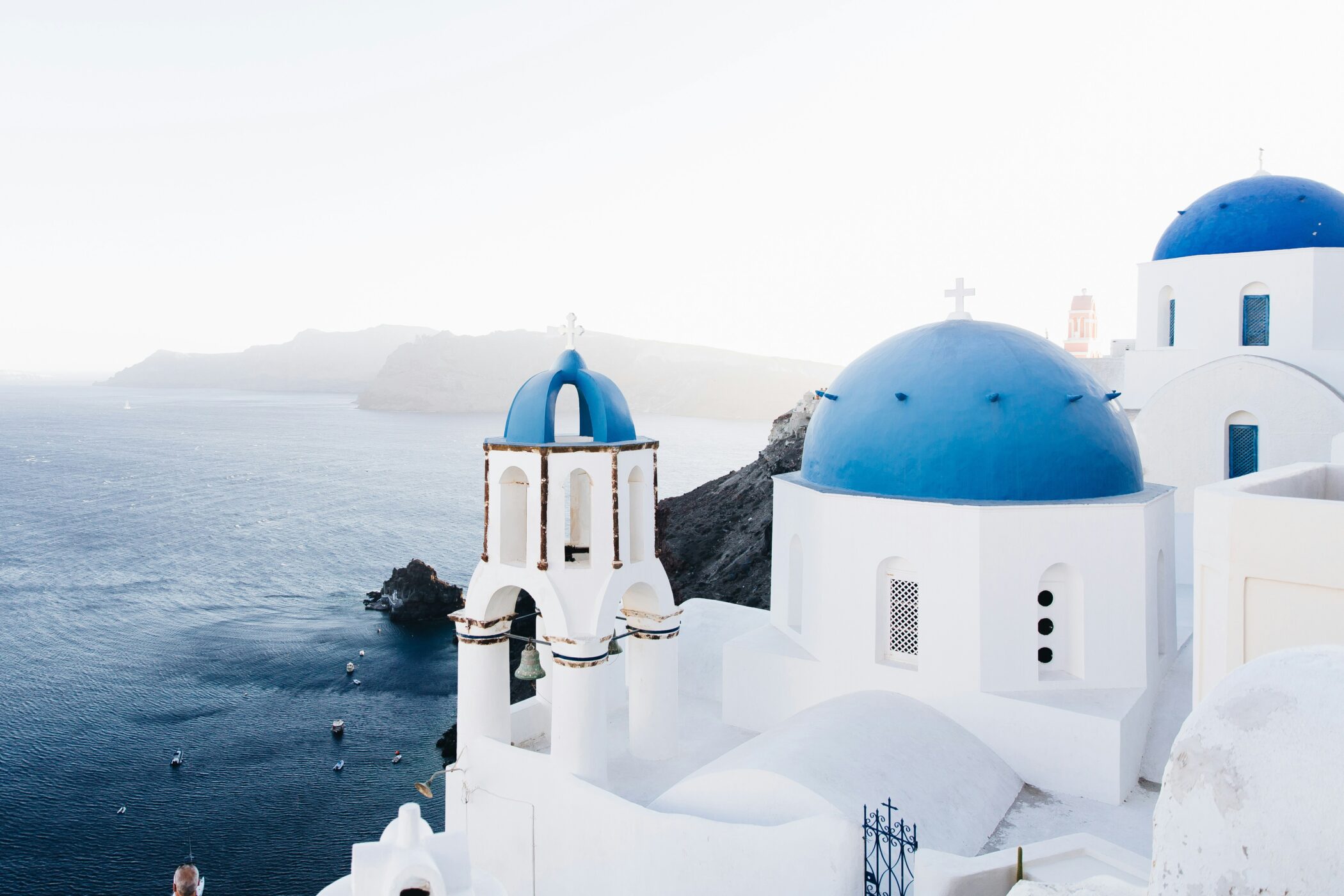 Spots are limited to 29 couples, with single occupancy available upon request. Pricing begins at US$133,500 per person (based on double occupancy).
Lindsey Ueberroth, chief executive of Preferred Hotels & Resorts, says: "Our mission has always been to connect travellers with the world's most remarkable independent hotels and destinations in ways that are both unforgettable and transformative. Aligned with our recently released Luxury Travel Report 2025, which found that 61% of affluent travellers see once-in-a-lifetime moments as the ultimate luxury and 75% seek experiences curated by those 'in the know,' the Legendary Journeys experience delivers rare adventures with personalised service, crafted to feel effortless, memorable, and truly legacy-defining."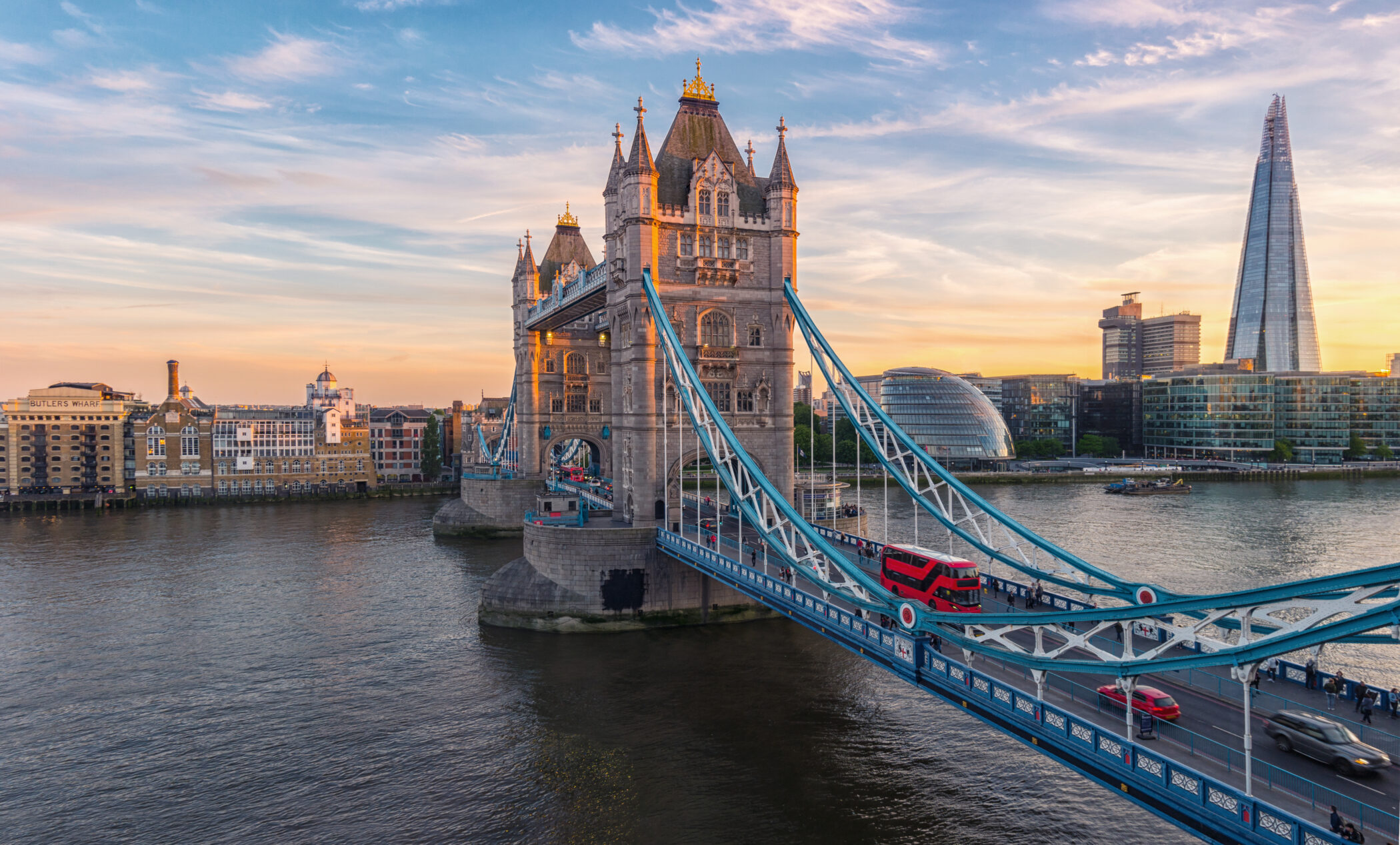 Participants will receive complimentary Titanium status in Preferred Hotels' I Prefer Hotel Rewards programme plus one million points, equivalent to more than 10 complimentary nights at more than 650 participating properties worldwide. The experience includes seamless transfers, private VIP airport access, luggage concierge services and personalised gifts.
The launch responds to Preferred Hotels' 2025 Luxury Travel Report findings that affluent travellers increasingly prioritise curated, once-in-a-lifetime experiences over material luxury.
It might have an illustrious literary history but the Orient Express brand continues to captivate audiences. Whose social media feeds haven’t been graced with UGC videos of its Dolce Vita train coursing through the russet folds of rural Italy this summer? Come June 2026, a new stream of ultra-luxurious armchair tourism will ensue as the brand’s first ship, Orient Express Corinthian, glides into motion on a maiden voyage through the French and Italian rivieras.
It comes at a pivotal moment for luxury ocean travel. Next year, Four Seasons will also launch its much-anticipated yacht, closely followed by Aman’s in 2027 – both following the Ritz-Carlton’s fleet of boats which have been coasting since 2022. The Corinthian will join this new convention-defying genre of boat travel. They’re neither cruises, nor yachts in the typical sense. Both extensions of the hotel experience, while offering something radically different.
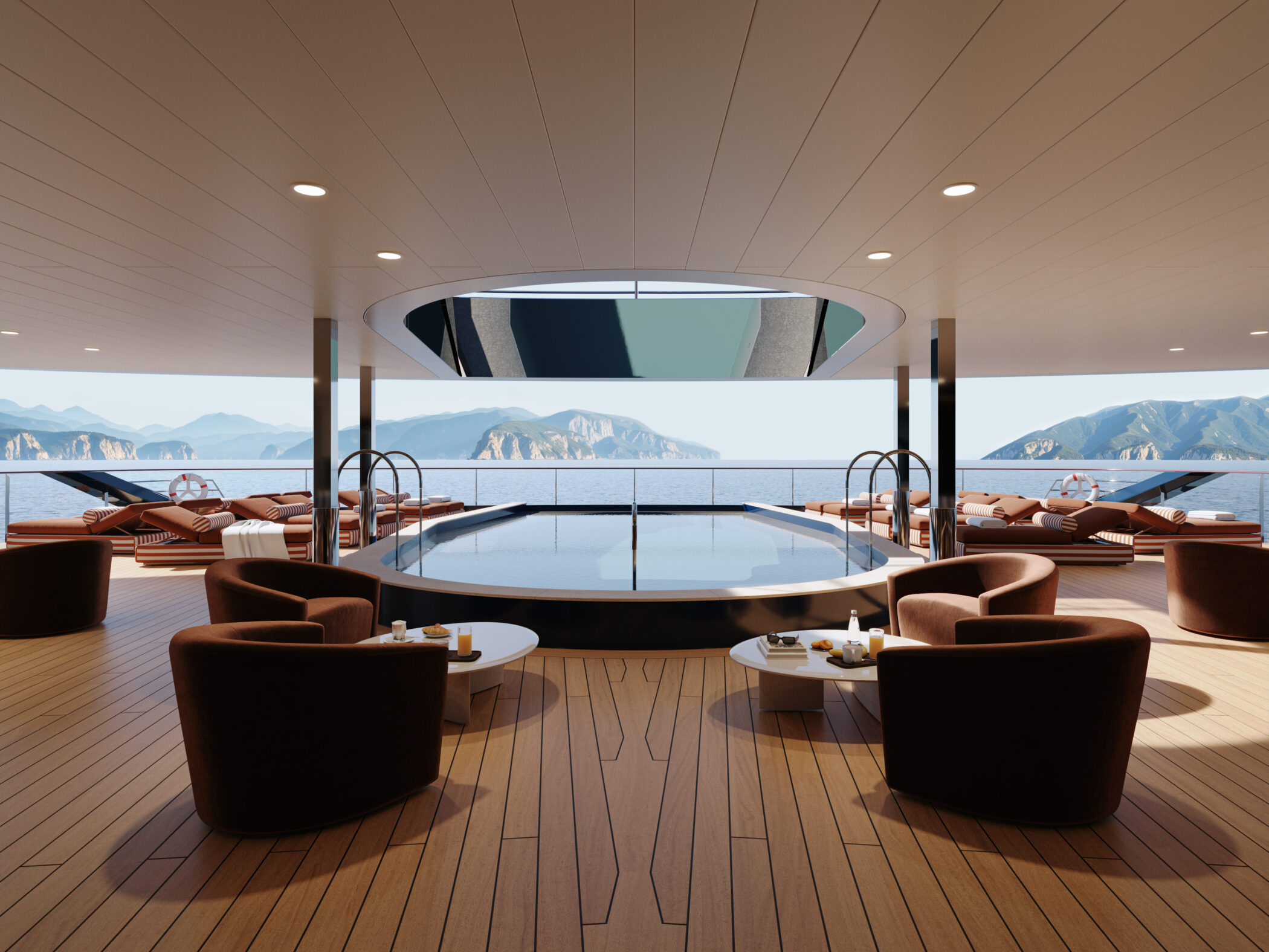
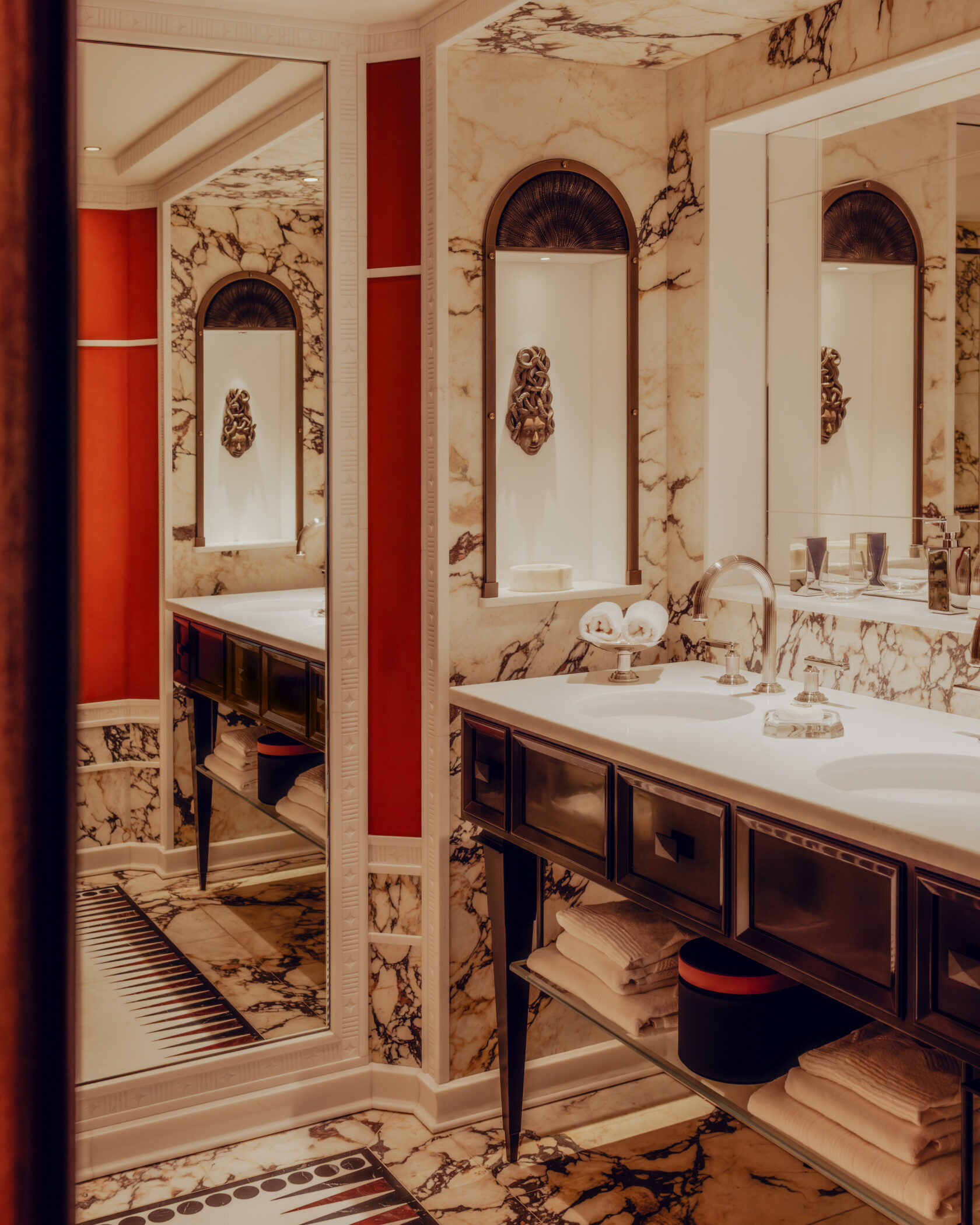
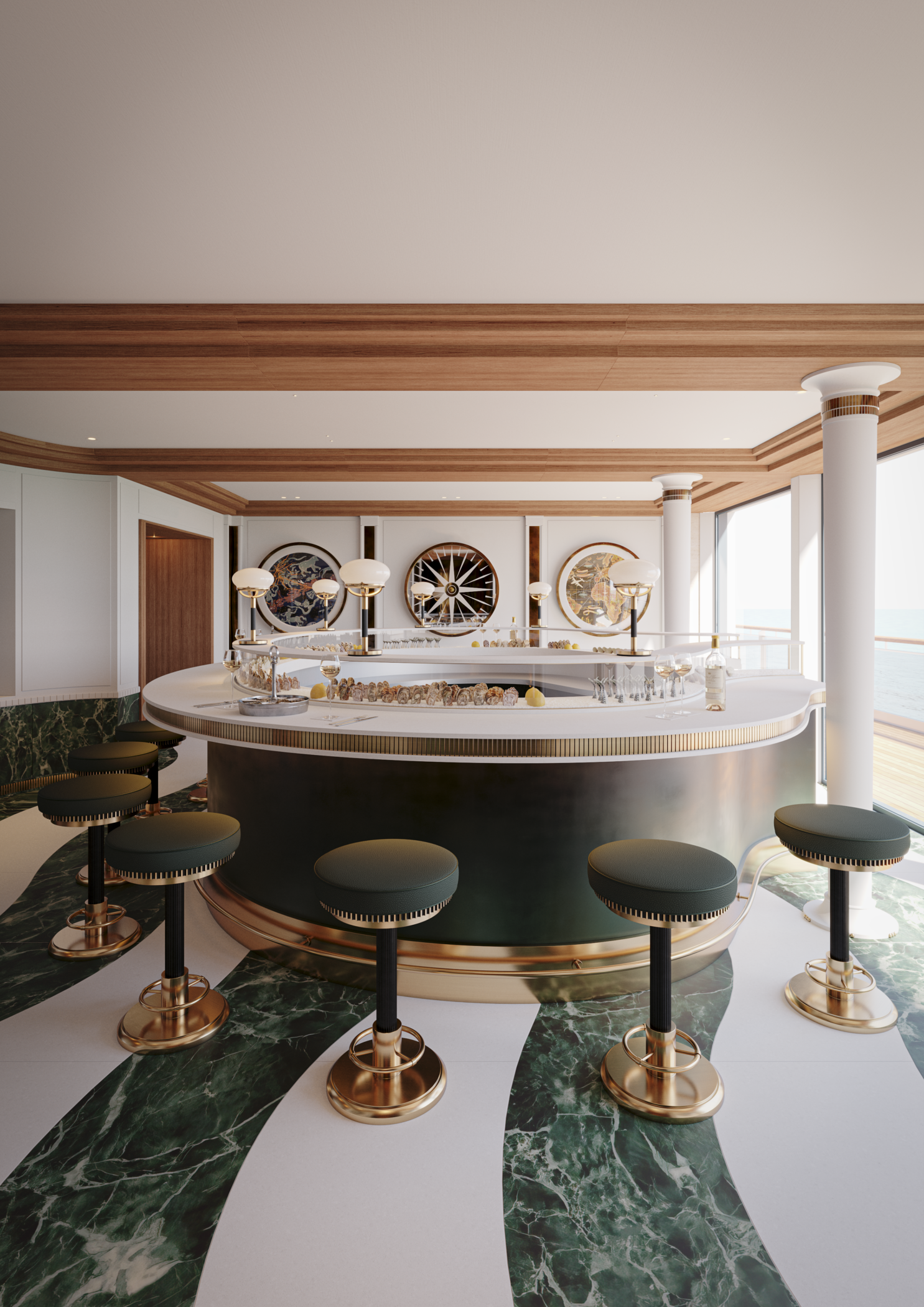
For its part, Corinthian will accommodate a maximum of 110 guests in 54 suites, boasting a cabaret, cinema, spa, recording studio, two pools, 5 restaurants and 8 bars – including an Art Deco-inspired speakeasy. We sat down with the CEO of Orient Express Sailing Yacht, Philippe Brault, fresh from the shipyard of Saint Nazaire, where over 500 staff are busy bringing the Orient Express’ new vision to life.
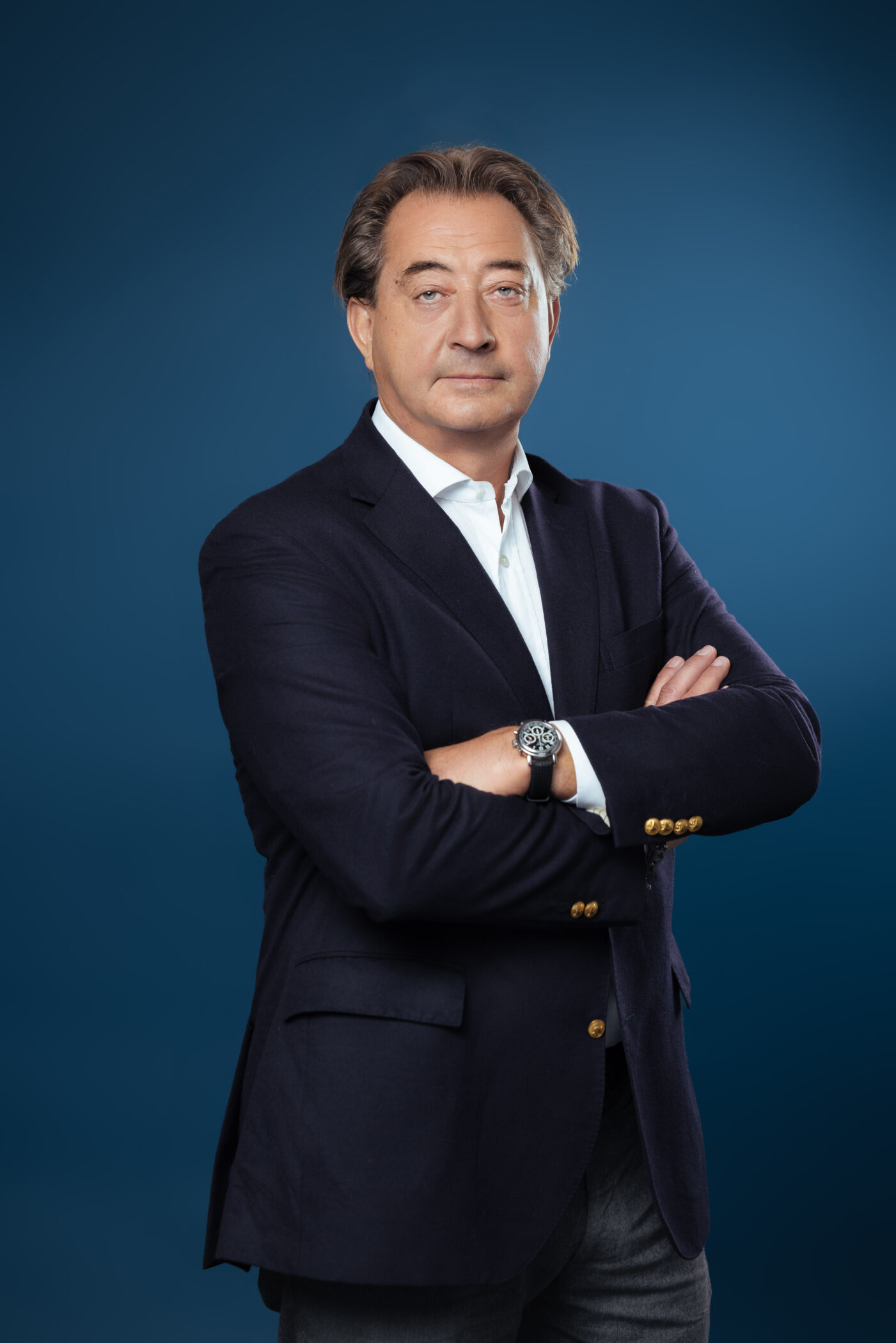
How did the idea of expanding Orient Express into ocean travel first take shape?
Six or seven years ago I met with the chairman of Accor, and at that time I suggested he venture into the cruise business with very small ships. At that time, Ritz-Carlton was paving the way. And of course, later after COVID, Four Seasons and Aman started developing their own boats as well.
Once Accor took over the Orient Express brand [2022], it started rejuvenating the trains. But in fact, the Orient Express brand’s origin story is rooted in ocean travel. Since the very beginning, the brand’s founder, Georges Nagelmackers, was sailing on transatlantic liners. He decided to bring the sleeper cars and the craftsmanship and the luxury-grade service he experienced on these liners to trains. So it was only logical that Orient Express would develop this third vertical [alongside hotels and trains].
There’s no doubt that all of these experiences will overlap. So we might have clients flying in from America, sleeping in an Orient Express hotel in Rome and then boarding a ship and maybe taking the train back to Paris.
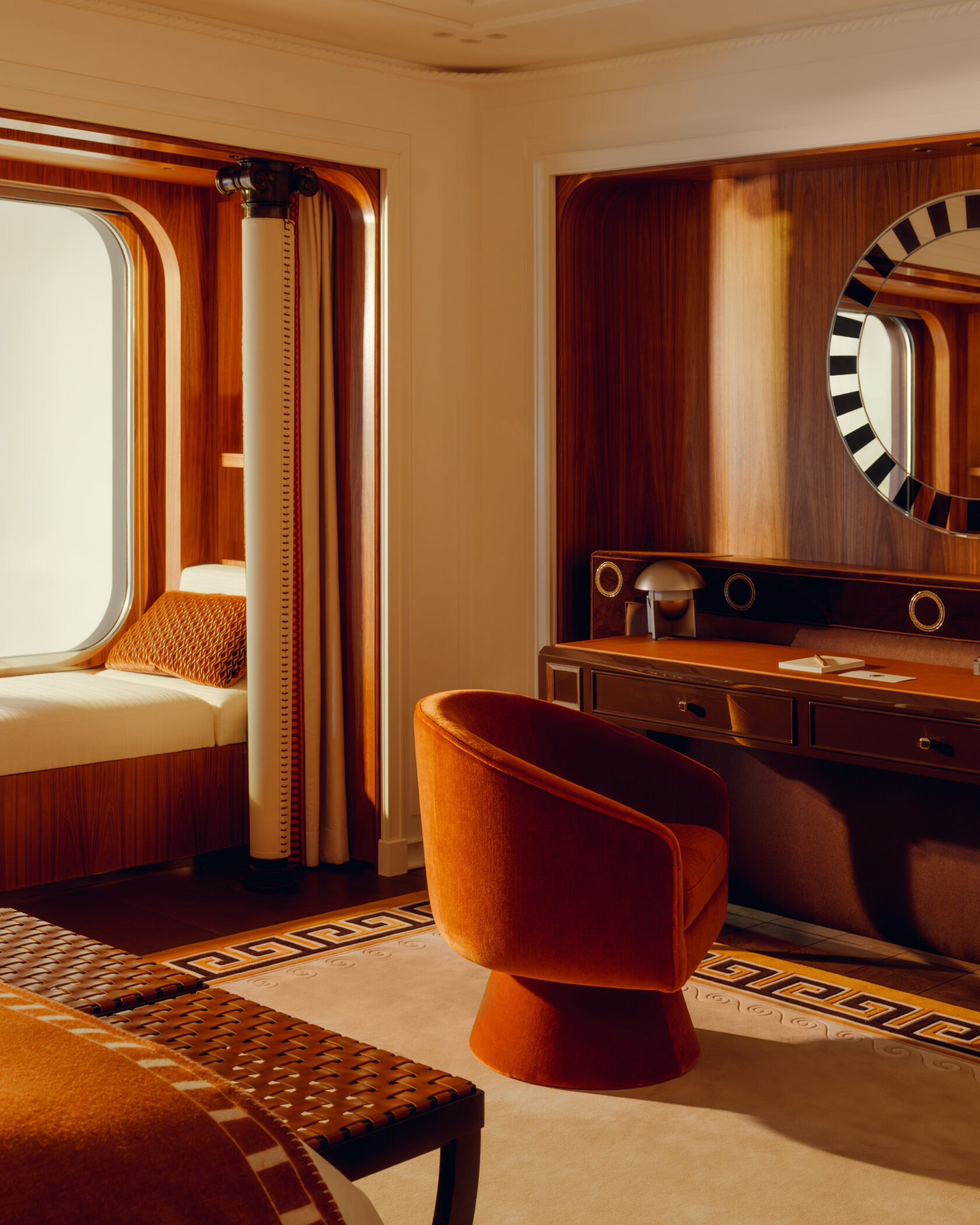
Dolce Vita Orient Express has captivated attention on social media with its glamorous 60s-style interiors. How will Corinthian continue this aesthetic legacy?
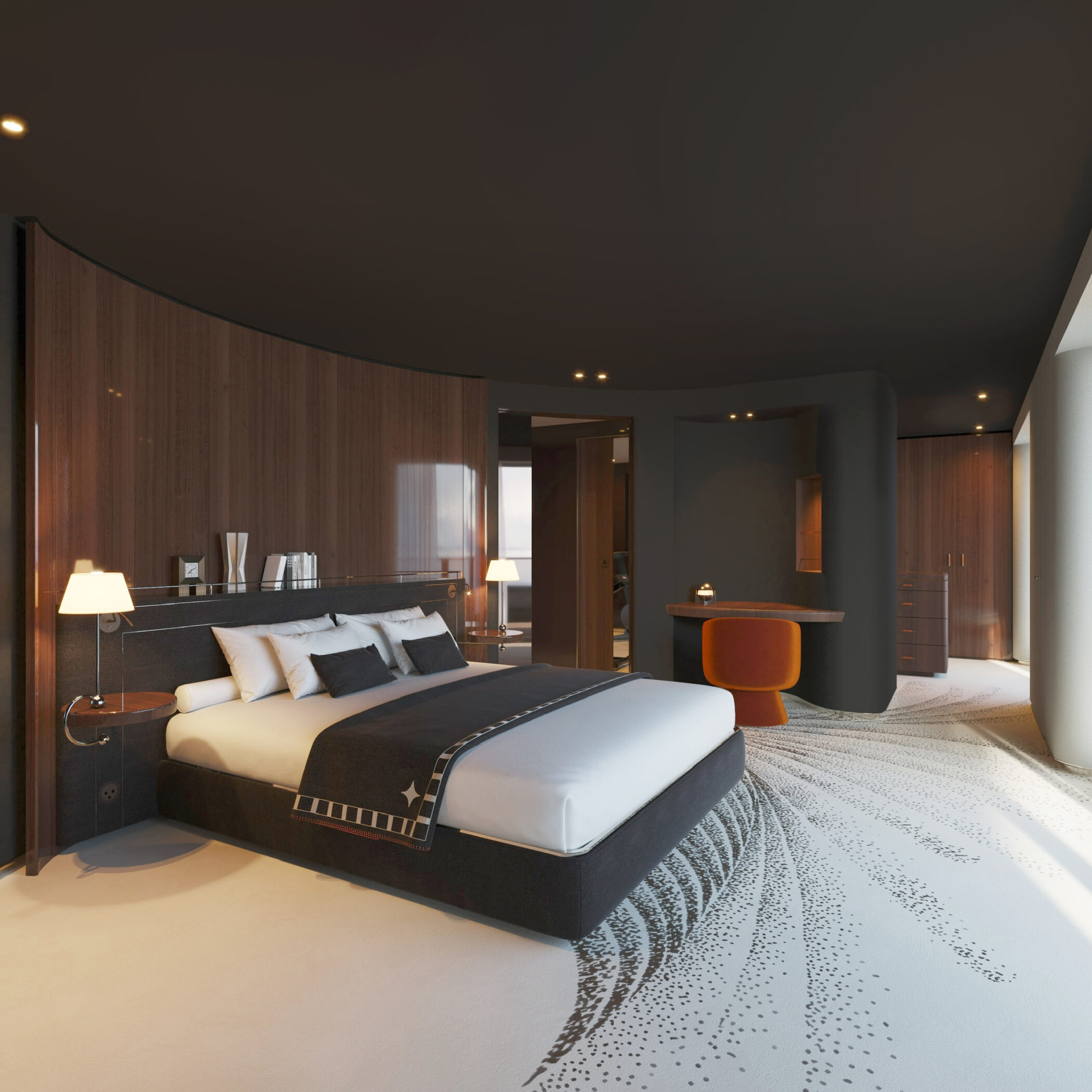
Well there’s one common denominator: our architect and Orient Express’ artistic director, Maxime d’Angeac. He isn’t responsible for the Dolce Vita, but he has designed the upcoming 2027 Istanbul train. His style is more Art Deco. He was really trying to figure out what Art Deco would mean for the 21st century; how do you bring that future vision to a heritage brand like Orient Express.
And there are small elements like in the cabin you have a button that calls for the butler, like you would have found in these transatlantic liners.
What differentiates Orient Express Corinthian from Ritz-Carlton, Four Seasons and Aman’s venture into the luxury yachting space?
The first thing that comes to mind is the sails and the boat’s hybrid propulsion system. These sails are real masts. They’re nice right? But they’re not just for show. We’ll be able to cruise at 17 knots under proper wind conditions, which is even faster than when just using our engines. So it’s a genuine propulsion and, of course, it’s free.
We went to a first-class shipyard in France called Chantiers de l’Atlantique. And they’re famous for building the huge, mass-market ships of brands like MSC or Caribbean. But because I know those guys, when we propositioned them with a much more prestigious project, they were up for it. So we’ve been managing something that is super sophisticated within an industrial process of an international shipyard.
Research repeatedly suggests that sustainability isn’t a key driver of purchasing intent. Why the investment in sails?
When we decided to go for this third vertical being the yachts, the boss of Accor said, “I want something super sustainable”. I told him, you know what, we are maybe lucky. Because there are three shipyards in the world able to build a ship with this level of luxury finish, and one of them [Chantiers de l’Atlantique] already had a design on the shelf for a cruise sailing ship. It had the volumes, the flexibility and the sales all mapped out, but it had something like 150 cabins.
So we started there. On the one hand, it enabled us to make something sustainable. On the other hand, it saved us time. The market after COVID was picking up and everyone was running after all the shipyard slots. If you start from scratch it takes a year or two. So we just took the model, lengthened the ship by 20 metres, and instead of doing 150 cabins we placed only 54.
It seems like Orient Express is keen not to describe the Corinthian as a cruise. How is it different?
First difference: sails. Second difference: Yachting is all-inclusive. I’ve been the CEO of a yacht brokerage company. In yachting, the only thing where we are not as good as a yacht is the flexibility. When you’re on a yacht, let’s say 50, 60 or 80m yachts, you can sit next to the captain as the client and you can adapt your travels in real time. You can arrange spontaneous stop-offs or longer stays in certain bays with the local authorities. On a 220m yacht, you need authorisation. It has to be arranged maybe a year in advance, so we can’t compare it to yachting in terms of flexibility.
But to be honest, without any lack of humility, in every way our experience is better. On any yacht you have a dining room inside, sometimes two and an outside dining room. We have five restaurants and dining rooms. We have Yannick Alléno, a 17-Michelin starred chef signing the card. We have public spaces, even a music recording studio.
What do you expect will happen in the recording studio?
We have a lot of requests from individuals looking for private charters. I’m convinced that one day we’ll get an American or Indian client that will say, “for the wedding of my son I want Taylor Swift.”
Would Taylor Swift record an album onboard?
Well, she could. The studio will be of that quality at least.
 Most cruise ships are confined to docking in designated terminals – their sheer size procluding them from off-the-map destinations thus compounding tourism numbers in certain destinations like Amsterdam or Barcelona–
The Barcelona Port authorities did offer us a place which was next to the container cranes and beneath a massive Virgin cruise line – ships with around 14 decks. We said, we’re not going. We’re just not going. Our itineraries are built mainly around anchors. So approximately 60% of the time we’ll be anchored outside a port and we’ll use our Pascoe limousine tenders. We’ll be at anchorage and whenever we go into port, we’ll have dedicated terminals.
On an inclusive basis, every three days we’ll have an experience. That might be the privatisation of a villa. That may be a special dinner on the beach in the Caribbean.
And what about experiences exclusively available to Corinthian passengers?
There will be various opportunities. One example being the Palais Bulles, which was Pierre Cardin’s holiday home in Cannes: we can arrange a private dinner there. Or we’ll arrange a private dinner in the Roman theater in Taormina, or on the rooftop of the Guggenheim Museum.
And then the service on board: that’s another differentiator from cruise. We’re really targeting something that is closer to yachting in terms of profiles and culture. Like I said, we’ll be having guests who will be coming from our hotels and from our trains, so we should make them feel like they’re at home when they step aboard – there should be some kind of continuity. When you’re on a yacht, the crew only needs one day to know what you like or dislike. The second day they don’t even ask you a question, except to ask if you’d still like your eggs sunny-side up.
And finally, how about the offering for families. Will Orient Express Corinthian accommodate kids?
We've already had calls from people who want to come and we’ve responded positively. But out of principle we'll have just three or four weeks that are dedicated to kids. We have a playroom and there’ll be programming. On deck seven, suites can be combined, so you can imagine having one family in there with their own dining room.
"With Raffles, we're committed to expanding with purpose — introducing the brand in destinations that embody our legacy of cultural richness and exceptional service. We want each new opening to add depth and distinctiveness to our global footprint. This year, we were proud to open Raffles Sentosa Singapore and are preparing to welcome Raffles Jeddah. Looking ahead, 2026 will mark our debut in Saudi Arabia's Red Sea, and beyond that, several remarkable properties are in the pipeline.
"In India, we're deepening our presence with Raffles Ranthambore, which will blend ultra-luxury with the romance of wildlife exploration whilst Raffles Goa Shiroda will offer an exceptional resort experience set on more than 27 acres of pristine beachfront. In Europe, we're excited to introduce Raffles Lake Como, marking our entry into Italy with the conversion of the historic Grand Hotel Imperiale. With one of the region's most expansive lakefronts, the hotel will celebrate the artistry and architecture of 1920s Italian glamour. In Asia, Raffles Tokyo will be part of the major redevelopment of the city's iconic World Trade Centre in the Hamamatsuchō district, designed to serve both leisure and business travellers.
"We also have plans for the Raffles Peace Hotel Shanghai, one of the city's most storied landmarks, where we'll reintroduce the property with the glamorous Raffles touch. Finally, we're thrilled that Raffles Estera East Cape, set along one of the most exclusive and untouched beachfronts in Mexico's Los Cabos region, will represent our first resort in North America. Each of these openings is more than a hotel — it's a celebration of place, storytelling, and the enduring magic of hospitality done the Raffles way."
What makes a destination 'Raffles-worthy' in today's competitive hospitality landscape?
"We look for destinations that are rich in heritage, layered with culture, and already carry a compelling narrative. These are the surroundings where the Raffles brand naturally thrives, as it gives us something authentic to build upon. We're not driven by trends. Instead, we focus on the locations we know will resonate most with our guests, as well as those that are a natural fit with our brand ethos. As we grow, it's important that we have the right mix of vibrant urban hotels, exceptional resorts, and also in locations that might be unexpected or up and coming. Our recent expansion into India is a perfect example. Raffles Jaipur, which opened last year, beautifully combines the Raffles spirit of elegance and enchanted glamour with Indian craftsmanship and heritage. It's a true palace retreat, deeply rooted in culture yet crafted for the modern traveller."
With Raffles' headquarters now in New York, how does this shift reflect your vision for the brand's global identity?
"Making New York our global headquarters is a powerful reflection of our ambitions for Raffles as a global brand. New York is one of the world's great epicentres – a dynamic crossroads of commerce, culture, creativity, and innovation. Being here places us alongside some of the most influential names in luxury, challenging us to stay sharp, relevant, and bold in everything that we do. It also signals our commitment to expanding the Raffles footprint in North America – a key focus for future growth – and being here allows us to connect in a meaningful way with partners, talent, and guests, all who are helping to shape the next chapter of our story."
How do you balance heritage and reinvention when evolving a legacy brand like Raffles?
"It starts with a deep respect for the brand's DNA — understanding what has made it beloved over time and identifying the emotional truths that still resonate. From there, we have tried to reinterpret those distinct qualities in a way that feels bold, current, and culturally relevant, versus nostalgic or dated. For example, with our recent 'The Butler Did It' campaign for Raffles, we leaned into our Butler Service — a hallmark of the brand since 1887 — but we focused on modern imagery and storytelling. The campaign was shot in our flagship, Raffles Singapore, which is steeped in history, yet the campaign is anything but traditional – it's fresh, cinematic, and infused with personality. Ultimately, it's about creating a world where heritage and modernity don't compete, but complement and elevate each other."
What does luxury mean in 2025 – is the era of "quiet luxury" still relevant, or are we seeing a return to opulence?
"For me, the definition of luxury has never changed. At its core, luxury is the ability to create desire—to offer an experience or product so unique, so thoughtfully crafted, that it cannot be replicated elsewhere. How that desire is expressed evolves with time and culture, but the essence remains constant: excellence, authenticity, and emotional resonance. Today, luxury still represents uncompromising quality and craftsmanship, but more than ever, people are seeking heritage and narrative. They want to connect with a story and to feel they are part of something meaningful and enduring. Whilst the aesthetic of 'quiet luxury' remains influential, we are seeing a shift — not necessarily toward overt opulence, but toward a more expressive, personal form of luxury. It's less about loud logos and more about bold individuality, deeper storytelling, emotional richness, and a confidence in expressing who you are through the experiences you choose."
Do you think today's luxury travellers want to feel at home or transported? How do you design for both?
"In today's landscape, it's not an either-or — luxury travellers desire both. Our guests want to be immersed in a destination, to feel a true sense of place that reflects the culture and character of where they are. At the same time, they seek the ease, comfort, and familiarity of home, and this balance is where thoughtful design plays a critical role. At Raffles, for example, our guestrooms are intentionally designed to feel residential in nature —more like elegant private apartments than traditional hotel rooms. You'll find distinct entryways as well as clearly defined areas for living, sleeping, and dressing — spaces that feel intuitive and personal. We want to create experiences that are both emotionally transporting and deeply comfortable, where guests can feel grounded yet inspired."
How are consumer expectations shaping the way Raffles defines service, experience, and exclusivity?
"Today, where so many offerings can feel interchangeable, it's service and personalisation that truly set a brand apart. Our guests aren't just looking for comfort, although that matters too, they're looking for meaning, connection, and care. A highly personalised stay doesn't just meet expectations, it's what creates emotional loyalty and makes a guest return time and time again. At Raffles, we believe that magic is found in the unexpected and take pride in anticipating what will delight a guest — even before they realise it themselves. Our teams are the heart and soul of the Raffles experience, and nowhere is this more evident than in our signature Butler Service. Raffles pioneered the concept of hotel butlers with the opening of Raffles Singapore in 1887, and we've been leading the way in intuitive, bespoke service ever since. Our Butler Service is not transactional — it's emotional. It's about building trust, reading subtle cues, and creating an elevated experience that feels both effortless and deeply personal. As guest expectations evolve, our focus remains on delivering service that is quietly powerful, consistently attentive, and always uniquely Raffles."
Your campaign "The Butler Did It" reinterprets a classic luxury archetype. What message were you trying to send?
"From the outset, our goal was to create imagery so distinctive, it could only belong to Raffles — something that captured the soul of the brand in a bold and unmistakable way. We also wanted to drive awareness and shift the perception of Raffles. 'The Butler Did It' celebrates one of our most iconic brand signatures — our legendary Butler Service — but does so through a completely fresh lens: fashion-forward, cinematic, and a little unexpected. We wanted to convey how Raffles, whilst rooted in heritage, offers a modern guest experience full of elegance, wit, and a sense of enchanted glamour. This campaign is also a celebration of how Raffles creates magic at every turn — with Butlers who anticipate needs before guests even ask, delivering the kind of intuitive service that defines the brand. As Raffles continues to grow globally it felt important to reintroduce the brand to the world with a campaign that is as aspirational, playful, and elegant as the experience itself."
What's interesting about the intersection between fashion and hospitality? What trends do you predict?
"Fashion and hospitality are having a bit of a love affair right now—each is trying to court the other! I always say: luxury retail sells the dream, but in hospitality we deliver the dream. For a brand, there's no fuller expression of identity than hospitality as it offers a completely immersive experience, which I think is part of the appeal to fashion brands. This crossover between fashion and hospitality is showing up everywhere — from curated brand collaborations to exclusive retail partnerships and designer-led experiences. Both industries appeal to luxury seekers, tastemakers, and those curating a lifestyle, not just a purchase or a stay. The most exciting trend is this blending of worlds to elevate storytelling, where a stay becomes a statement, and a product becomes a piece of a guest's lived experience. For Raffles, we're intentionally aligning with brands and retail partners that reflect our values — elegance, glamour, artistry, and a refined point of view. Our goal is to position Raffles as a brand that floats effortlessly in that same aspirational space — where fashion and hospitality meet to inspire."
What new guest behaviours or mindsets are influencing how you develop future properties?
"Today's luxury travellers do not want a one-size-fits-all experience — they're seeking something distinctive, personal, and destination driven. A decade ago, a luxury hotel stay might have looked the same no matter where you were in the world: high-thread-count sheets, a white-tablecloth restaurant, and upscale — but often generic — design. Whilst comfort remains paramount, what's changed is the demand for deeper meaning. Guests now expect thoughtful design, culinary storytelling, and experiences that reflect the destination's soul. We believe our hotels shouldn't just show you a destination — they should be part of it. We aim to be woven into the cultural fabric of every place we call home. Raffles' 'Butler Did It' experiences are a great example — hyper-personalised, exclusive offerings that show guests the local culture in a way that is wholly unique to Raffles. We're also seeing growing demand for privacy, space, and flexibility — especially from families and multigenerational travellers. Our all-villa properties, like Raffles Bali, Raffles Al Areen Palace Bahrain, and our newest addition, Raffles Sentosa Singapore, have received incredibly positive feedback for offering that sense of sanctuary and home. Ultimately, we're designing properties that feel less like hotels and more like carefully curated experiences — places of inspiration, culture, and connection that guests want to return to again and again."
What role will sustainability and social impact play in the luxury space - how is Fairmont leading the way?
"Sustainability is no longer optional — it's essential to the future of the hospitality industry. Across both Fairmont and Raffles we take this responsibility seriously. As part of Accor, we are aligned with some of the most ambitious sustainability commitments in the hospitality sector. In an industry defined by competition, sustainability demands collaboration. These are global challenges, and we must work together to find meaningful, lasting solutions. Sustainability must begin before the first stone is even laid for a hotel. Every new project must consider its impact on the local environment, community, and culture — and make sustainable choices from the outset. Guests may not choose a hotel because of its sustainability practices, but they increasingly won't return to one that fails to meet their expectations in this space. We believe in making guests a part of the solution — whether that's through education, low-impact experiences, or opportunities to contribute positively to the ecosystem they're visiting. Hospitality has the power to create connection. When guests feel a meaningful link to a destination, they're more inclined to care for it — and to make more sustainable, thoughtful choices whilst there."
What's in the pipeline for Fairmont?
"We're thrilled to be ushering in a new era for Fairmont with the launch of our global brand campaign, 'Fairmont Presents: Make Special Happen' — our first in four years. The campaign draws on Fairmont's rich legacy as the stage for extraordinary moments in history and culture, from the signing of the UN Charter to iconic social events like Truman Capote's Black and White Ball. It's a cinematic homage to timeless elegance and meaningful gatherings, reimagined for a new generation of discerning travellers. In tandem, we're introducing Special Happens…, a curated series of unforgettable experiences that invite guests to create their own iconic moments — from dinner under the stars in Marrakesh to waterfall yoga by seaplane. These offerings span food, nature, nightlife, and the arts — and we'll continue to expand them throughout 2025."
What innovations – from design to tech to operations – are you most excited about shaping the guest experience in the years ahead?
"Innovation starts with a mindset: don't fear change. When it comes to traditional hospitality, you can have both a respect for tradition and a willingness to evolve. The question we should be asking is: how can we use modern tools to do what we've always done, only better? Technology is a great example as it presents new opportunities to create efficiencies, for both our guests and our teams. Artificial Intelligence, whilst still in the early stages of use in our industry, will open up important possibilities. But I'm adamant that it must enhance, not replace, the human connection. True innovation in hospitality is not about novelty for novelty's sake – it's about using new ideas to bring even more meaning, emotion, and care to the guest experience."
How does your vision for Raffles and Fairmont reflect where global travel is heading next?
"Global travel is shifting — it's less about checking boxes and more about seeking meaning, connection, and joy. Our vision for both Raffles and Fairmont reflects that evolution: thoughtful growth, immersive experiences, and service that creates real emotional resonance. Raffles is leaning into the future by creating intimate, imaginative stays — moments that feel almost dreamlike, where every detail is intentional, and every gesture feels elevated. That's what we mean by elegance and enchanted glamour. Fairmont is focused on amplifying its role as a cultural and social epicentre — properties that reflect the energy of their communities through vibrant design, dynamic dining, and storytelling that celebrates place. Both brands are rooted in history, but we don't see that as a limitation — it's our foundation as we evolve with intention. We're also investing in what truly matters: training, technology, partnerships, and design that allow us to deliver service that is deeply personal and human. And yes — we're going to have fun. The next era of luxury belongs to brands that aren't afraid to stand for something, and that's exactly what we're building with Raffles and Fairmont in ways that feel unique and distinct to each."
How do you predict and plan for the future as a company?
"I believe in what I call the power of three: taking care of our owners, our teams, and our guests. If you're planning with each of these groups in mind — listening, adapting, and staying one step ahead — you're building on solid ground. For our owners, that means delivering long-term value through thoughtful development, brand strength, and operational excellence. For our teams, it's about creating an environment where people feel supported, inspired, and empowered to grow — because passionate people are the heartbeat of exceptional hospitality. And for our guests, it's understanding not just what they want today, but what they'll be looking for tomorrow — anticipating needs, curating experiences, and staying relevant without chasing trends. Future-proofing the business isn't about prediction, it's about preparation. Staying grounded in our values whilst being agile enough to evolve. Ultimately, if we're leading with intention, listening with empathy, and acting with integrity across these three areas, we won't just keep up — we'll set the pace."
Six-figure holidays now account for 40% of bookings at specialist travel designer Untold Story Travel, marking a significant uptick in luxury travel demands.
The company reports a 50% year-on-year increase in high-value bookings compared to pre-pandemic levels – a rise in luxury holidays bookings echoed by finding from Top Villas.
The high-end rental company has shared data that shows vacations costing £78,000 or more surged by 68% in the past two years. The average booking value, meanwhile has reached £120,000 – read Globetrender's full report here.
Untold Story Travel specialises in crafting bespoke experiences through its network of local "storytellers" - from cultural icons to conservationists - who provide exclusive access to destinations worldwide.
"We are thrilled to have seen an increase in bookings of six-figure holidays of more than 50% year on year prior to the pandemic, meaning these high-value bookings now form 40% of our business” said Mark Allvey, co-founder of Untold Story Travel.
"Our team is dedicated to crafting journeys that are as unique as our clients themselves. Whether an exotic island escape, an arts and culture extravaganza or the adventure of a lifetime, we're dedicated to turning each ‘untold story’ into a lived experience guests will cherish forever."
Their flagship offering is a week-long exclusive hire of Nukutepipi, a private French Polynesian island designed by Cirque du Soleil's co-founder. The experience, accommodating up to 52 guests, includes astronomical dinners, deep-sea fishing expeditions followed by beachside barbecues and whale-watching.
Untold Story Travel offers a seven-night experience on the island from £1million based on up to 32 people sharing. This includes all accommodation, experiences and inter-island flights. International flights are not included.
A £120,000 Costa Rican adventure offers conservation experiences including camera trap projects studying spider monkeys and hammerhead shark tagging in Golfo Dulce.
In Japan, a £145,000 two-week journey features early morning Kenjutsu practice on Tokyo rooftops, visits to the country's largest wasabi farm, and helicopter flights over Mount Yoshino's 30,000 cherry trees during blossom season.
For £110,000, families can explore America's West Coast with activities ranging from private canyoneering in Zion National Park to sunset cruises along Santa Barbara's coastline. The same budget could fund an African adventure, including hot air ballooning over Namibia's deserts, helicopter trips to Victoria Falls, and exclusive game drives in Tanzania's Grumeti Reserve.
Each journey is tailored through personal consultations, focusing on creating unique narratives through travel rather than standard luxury packages. All prices exclude international flights but include accommodation, experiences, and internal transfers.
Luxury holidays costing more than £78,000 have surged by 68% in the past two years, according to new data from high-end villa rental agency Top Villas, offering a glimpse into the travel preferences of the ultra-wealthy.
The average booking value has reached £120,000, covering both accommodation and premium services, as affluent travellers increasingly seek personalised experiences.
"This illustrates a remarkable shift in the popularity of luxury stays and six-figure getaways, with significantly more travellers willing to spare no expense when it comes to having extraordinary and exclusive holidays, now more than ever," says James Mannings, CEO and co-founder of Top Villas.
The surge reflects changing preferences among wealthy travellers, who Mannings says are constantly raising the bar: "People now want the best of the best. It's about going the extra mile to make each holiday truly special, and travellers are seeking new ways to enhance their trips with exciting experiences and services, and are opting for ultra-luxe destinations and extravagant stays, with each of their getaways topping the last."
Must-have amenities for these luxury stays typically include fully-staffed accommodation with private chefs, housekeepers, and personal butlers. "Having a team of people around the clock who can take the weight of having to complete mundane, day-to-day tasks off of your shoulders means that your valuable time is not eaten up during a getaway," Mannings explains.
The trend extends to wellness services, with private fitness instructors and in-house spa treatments becoming standard requests. Pool attendants are increasingly being integrated into home staff teams, while exclusive experiences have seen a 100% increase in demand over the past two years.
These bespoke experiences range from securing coveted restaurant reservations to arranging private yacht charters and dining experiences with renowned chefs. Mannings cites securing New Year's Eve bookings at Miami's exclusive KiKi on the River as an example of their concierge capabilities.
VIP experiences are also seeing significant growth, with Disney World tours proving particularly popular. "We've seen a 40% increase in bookings for these VIP passes this year compared to 2023, and these tours can cost upwards US$6,500 per day," says Mannings.
Some requests venture into more unusual territory. The company has organised everything from private firework cruises to petting zoos for younger guests, and arranged thousands of fresh flowers for in-villa marriage proposals.
Security services have emerged as another essential requirement, with wealthy travellers increasingly requesting both property guards and personal chauffeurs to ensure privacy and safety throughout their stay.
"Luxury clients want to have maximum peace of mind during their getaways knowing that they're safe," Mannings notes, adding that guards often chaperone guests to various locations, "whether that be amusement parks, shopping malls, or beaches."
The company, which operates in more than 150 destinations worldwide, attributes the surge in ultra-luxury bookings to travellers seeking increasingly distinctive and exclusive holiday experiences.
Members of Walpole's community of British luxury lifestyle and travel brands, gathered earlier this week to discuss the findings of The Art of British Luxury Hospitality, a new report produced in collaboration with brand agency, Notable.
The panel also featured Charles Oak, hotel director for The Londoner; Julia Perowne, founder and CEO of Perowne International; Jules Maury, head of programme for Scott Dunn Private; and Gary Franklin, senior vice-president for trains and cruises at Belmond.
Southan said: "I feel like we're going to be entering the 'Age of Ego'. On the one hand, rightly so, we've been talking a lot about sustainability and responsible travel but at the same time you're going to see huge amount of wealth emerging, especially in Asia, and I think that this will create a kind of push back which will manifest as this Age of Ego, which will be the pursuit of self-gratification, hedonism, decadence, indulgence, pampering and status. It's going to be very selfish I suspect."
Consider how Gen Z are gobbling up caviar even though they are broke – it makes Millennials' penchant for avocado on toast seem positively humble.
Southan said: "We were talking about fragility in the earlier report but I think also what we've seen is that human beings are incredibly resilient and with that comes this [sense of] denial, essentially. We are so good at just carrying on even when the world is burning and we're experiencing these catastrophes, which is great on the one hand but also can be detrimental but I think this is the direction of things. With every trend you have a counter trend, just in the way that you've seen you know 'generation woke' emerging you're also seeing the rise of right wing politics around the world – these two things coexist.
"You see these paradoxes all the time. Travel is on the one hand going to be far more ethical and sustainable but the travel industry has got to be driving it because big industries have been trying to put the responsibility on consumers for so long. BP created the concept of the carbon footprint to make you and I all feel bad about how much carbon we are putting into the world when it's really these big corporations. So consumers – rightly or wrongly – are going to want to consume travel, they're going to want to travel to these places and have a fantastic time but we [the travel industry] have to be responsible for trying to lessen the impact of that."
"Travel is expected to be worth US$15.5 trillion dollars by 2030 – that's up from US$9.5 trillion today. There are about 2,700 billionaires right now on Earth – not many. There's 171 in the UK and 2.8 million millionaires in the UK. By 2030, experts believe there will be 50 million millionaires in China and six million millionaires in India. Look at where the wealth is going to be in about seven years' times. About 13% of the population of Singapore will be dollar millionaires. There is a lot of money coming out of this world and most of these people are going to want to spend it on travel.
"Space travel – it's amazing it's not in news more. Virgin Galactic has launched his first commercial flights this year with paying customers. By 2030 they could be flying 3,400 passengers per year up to the edge of space. You've got lots of innovation happening in this realm. You've got these amazing helium powered airships with rooms that you can sleep in and bars and restaurants. They can take off and land vertically almost anywhere and you can do these week-long air cruises. I know Pelorus and Cookson Adventures are partnering with the companies that are building these airships to provide extraordinary voyages around the world.
"People will also be able to go up with companies like Zephalto and have a Michelin-star meal in a stratospheric balloon capsule – you just float silently up and for six hours you drink champagne and look at the curvature of the Earth and the blackness of space. Extraordinary experiences are coming our way so there will be lots of wonderful things to spread money on."
Hospitality brands such as Four Seasons and W Hotels are beginning to experiment with bespoke wardrobe curation and partnerships with fashion rental brands so guests can travel light. It's just another example of how they are going the extra mile to win well-heeled guests, especially when coronavirus travel bans are lifted.
The move is part of a wider consumer trend whereby retail companies want customers to see them as holistic lifestyle brands. Examples include Gucci opening a restaurant in Los Angeles, and brands such as Bulgari, Armani and Versace, which have all opened their own hotels. (Christian Louboutin has been planning to open a property in Portugal.)
The next logical step is providing guests with designer clothes – to rent, borrow or buy – so they don't need to pack their own.
Leading the way is the Ocean Club, a Four Seasons Resort in the Bahamas, which last year began giving guests the opportunity to leave their own clothes at home – and buy one of three curated wardrobes from the resort’s boutique, Carlo Milano, which stocks brands such as Saint Laurent, Etro, Roberto Cavalli and La Perla.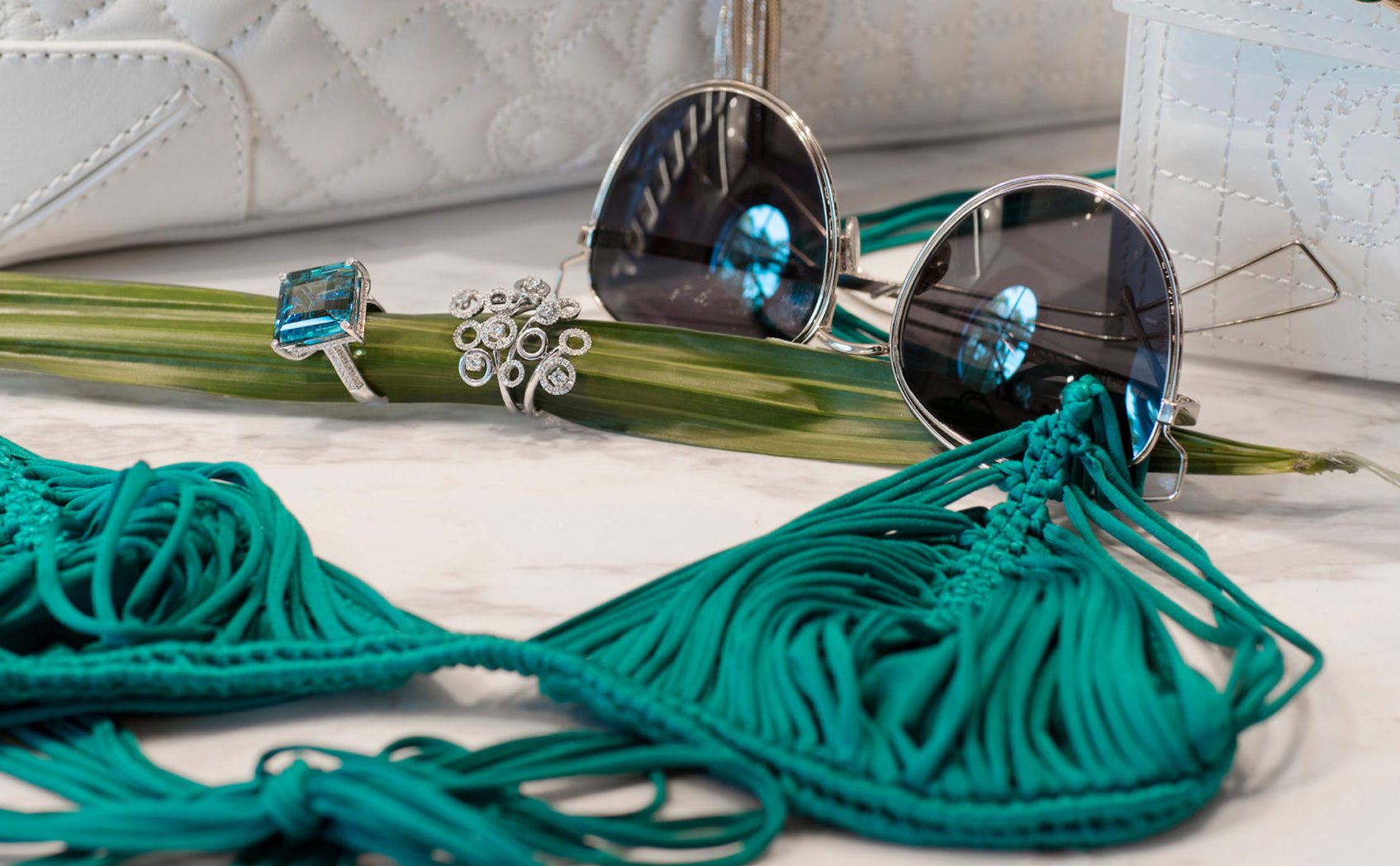 There is a beachgoer package (US$15,000 per couple) for “laid-out beach looks”; the weekender (US$30,000 per couple) for collections from the Versace Bahamas Boutique and the resorts own collection; and the Jetsetter, a collection of evening wear and accessories – including a timepiece from the Hublot Bahamas Boutique or a bracelet and ring from Carlo Milano’s own Into the Blue Collection. The Jetsetter is priced at US$100,000 per couple.
W Hotels took a different tactic at the end of 2019 and partnered with Run the Runway, a designer clothes hire company, to offer travellers the chance to wear the latest fashion while on the road as part of its "Closet Concierge" service.
The partnership launched in the US at the W properties in Aspen, South Beach, Washington and Hollywood. Those who book a room at one of its hotels can choose from four styles from Rent the Runway’s "Unlimited Closet" from US$69.
The selection is tailored to each W hotel and incorporate "Rent the Runway's proprietary data on trending colors, designers, silhouettes and the climate of each location" (particularly useful for skiers). To return their rented clothes, guests need just drop them back off at the welcome desk.
“Travelling without luggage has always been my dream. We are thrilled to partner with W Hotels to bring the RTR Closet Concierge to life, so travelers can simply show up and have their dream closet waiting for them in their hotel room,” said Jennifer Hyman, co-founder and CEO of Rent the Runway.
Anthony Ingham, global brand leader at W Hotels, said: “W is always looking for ways to give our guests new/next experiences that empower them to express themselves and upgrade their travel experience, and the RTR Closet Concierge does both.
"Collaborating with Rent the Runway – such a creative, conscious and trend-setting brand – allows us to reinvent the way our guests pack and dress as they travel. Skipping the packing process is a whole new level of luxury for our guests and is yet another surprising way continue to reinvent hospitality.”
Meanwhile, luxury travel, lifestyle and fashion concierge company Voyager Club is taking a different approach yet again, by offering jet-setters a My Vacation Stylist service that provides guests with a stylish holiday wardrobe, delivered directly to the door, hotel, villa or chalet. All they have to do is decide which items they want to keep and the rest will be taken away.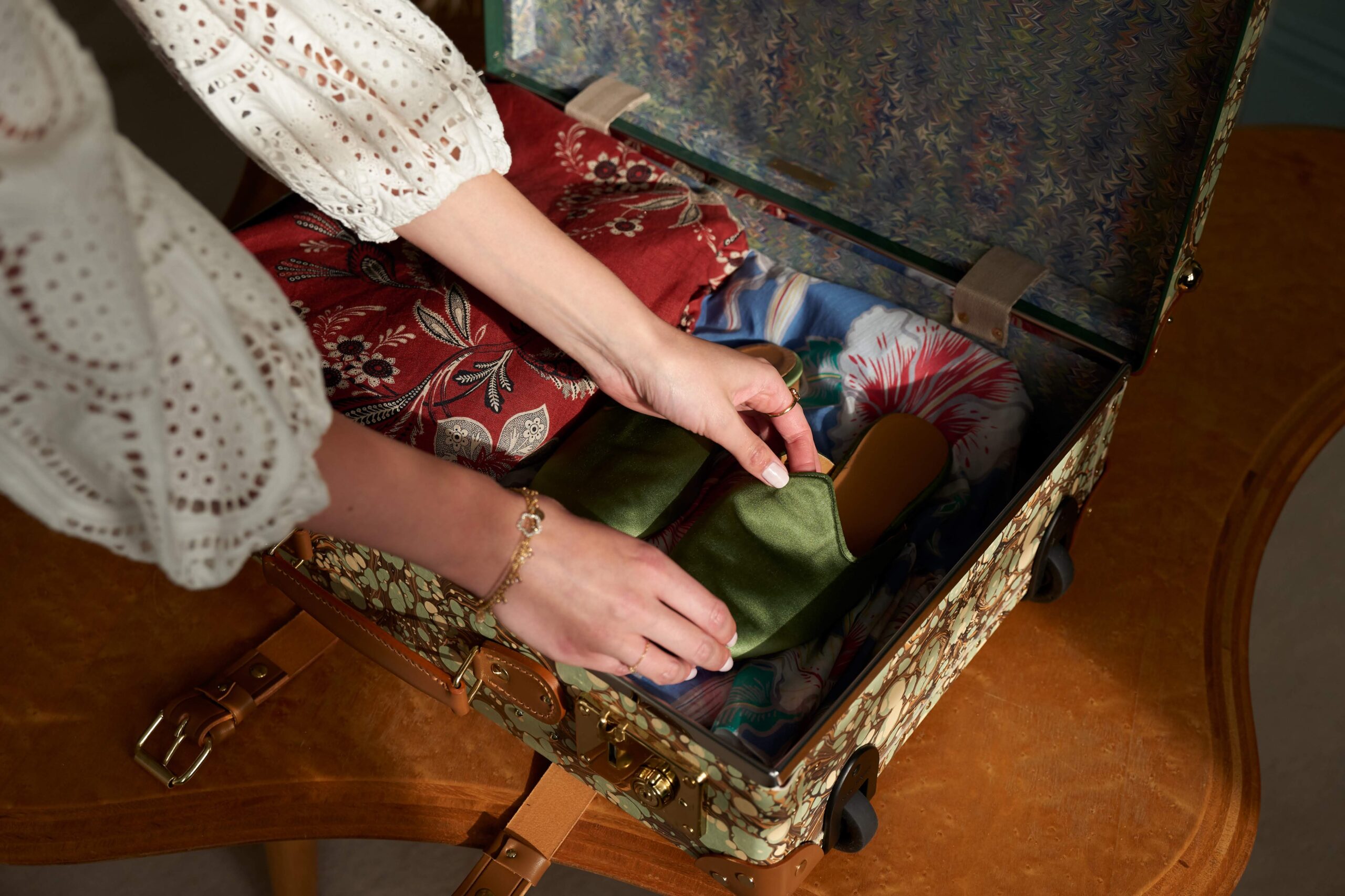 Voyager Club also recently introduced a Sustainable Wardrobe – a curated vacation wardrobe of clothes and accessories exclusively from brands with a strong sustainable and ethical ethos.
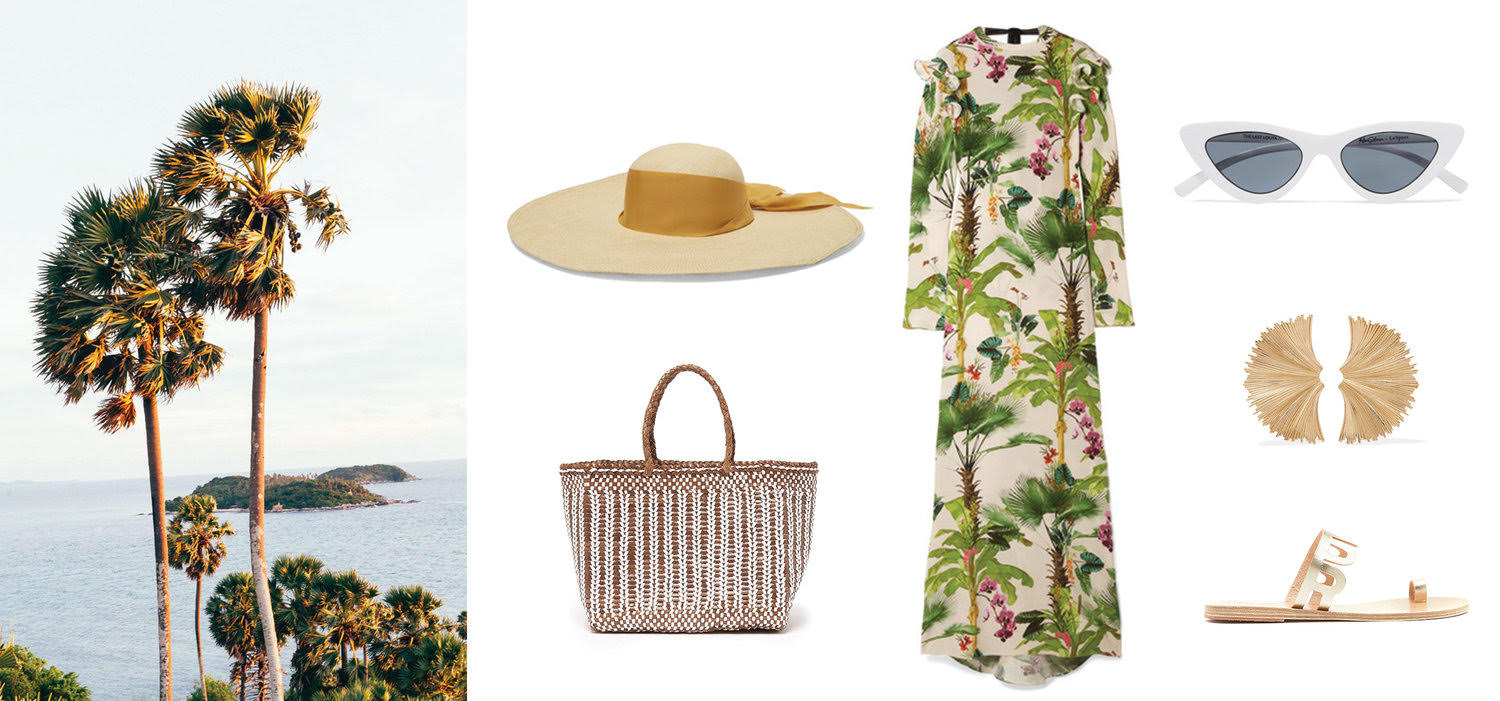 During lockdown, Voyager Club is offering a bespoke "Staycation Stylist" service to people at home, who will receive selections including cashmere, nightwear, active wear and scented candles, all personally curated and delivered without contact in a matter of hours.


We believe that the perfect holiday begins with the first spark of inspiration and doesn’t end until long after you return home. It’s about discovery, experiences and unrivalled enjoyment – it’s an investment in memories.
That’s why we created Luxury Bared – to pair technology when you want it with expert advice from real humans when you need it.
To gain full access to the site and its reviews and perks, travellers must become a member, which is free, unless you want to pay £24.99 for additional bespoke travel planning services, and a dedicated member services executive and travel advisor.
1. We have unique content (including specialist reviews on every hotel featured) that is focused only on the top-end of the luxury leisure market. Luxury Bared only features the very best hotels in any given destination.
2. Technology. Behind the scenes we connect with online hotel central reservations platform SynXis (Luxury Bared is one of the few companies globally that has it’s own dedicated Channel Connect to SynXis) and global distribution system Travelport through its Universal API, meaning that Luxury Bared can guarantee the best available prices and, most importantly, the last available room during peak periods.
3. Free perks. With every hotel booking clients receive a complimentary breakfast for two people, a room upgrade (subject to availability), early check-in/late check-out, a dining or spa credit and free wifi. This equates to about $380 at every hotel.
4. Flexibility. Clients simply provide a credit card guarantee at the time of booking and payment is made on check-out. The vast majority of Luxury Bared’s hotels allow 24-48 hours cancellation at no cost, with the exception of peak holiday periods. It’s the hotel’s booking and payment policy rather than a third party’s booking and payment policy. You don't pay for your hotel months ahead.
Luxury leisure travellers that stay at top-tier hotels such as Mandarin Oriental, Rosewood and Aman, as well as and cruise lovers that travel within the Luxury, Ultra-Luxury and Experiential Cruise categories.
We have more than 141,000 members globally.
We have a team of in-house and external reviewers. You can get the low-down on all our expert reviewers by clicking here.
So far we have reviews of 214 hotels with another 37 being added over the next four to six weeks. By the end of this year, we will have more than 350. By the end of April we will have reviewed ten hotels in London.
We’re not just a review site – we are an online booking site with unique content, reviews by industry experts and a raft of perks with a focus solely on the luxury travel consumer.
How bad can a five-star hotel be? Good question. The problem starts with "five star", which is a greatly overused and misunderstood term. A Hilton can be marketed as five-star just as the Ritz Paris is but there is a massive difference.
The question with luxury hotels is not whether it is good or bad (you’re right, it’s mostly never bad although there are a few nightmares out there) but rather, does a hotel deliver on its marketing promise for the amount of money you are going to pay?
That’s what we review. Did they deliver the luxury experience they promised to in their marketing. And with so many luxury brands ultimately “delivering the goods”, what makes one luxury hotel different from another and what’s the right one for any given traveller? Given the significant room rates charged by luxury hotels, these are the issues Luxury Bared addresses.
In my opinion, a review site (with no other value offering to the consumer such as on-line booking) that is not specialised in a particular area or lacks credible and verifiable information, will likely be short-lived. The days of generalisation, unverifiable content and a “one size fits all approach” are coming to an end.
In January, the launch of the Amanyangyun on the outskirts of Shanghai, proved the culmination of a 15-year conservation project (one of the biggest in China’s history) with the relocation of an entire forest of 10,000 ancient camphor trees, along with 50 Ming and Qing dynasty houses from Fuzhou, 800km away. These have now be carefully preserved and repurposed to form the walls and grounds of a peaceful Aman spa retreat (pictured below).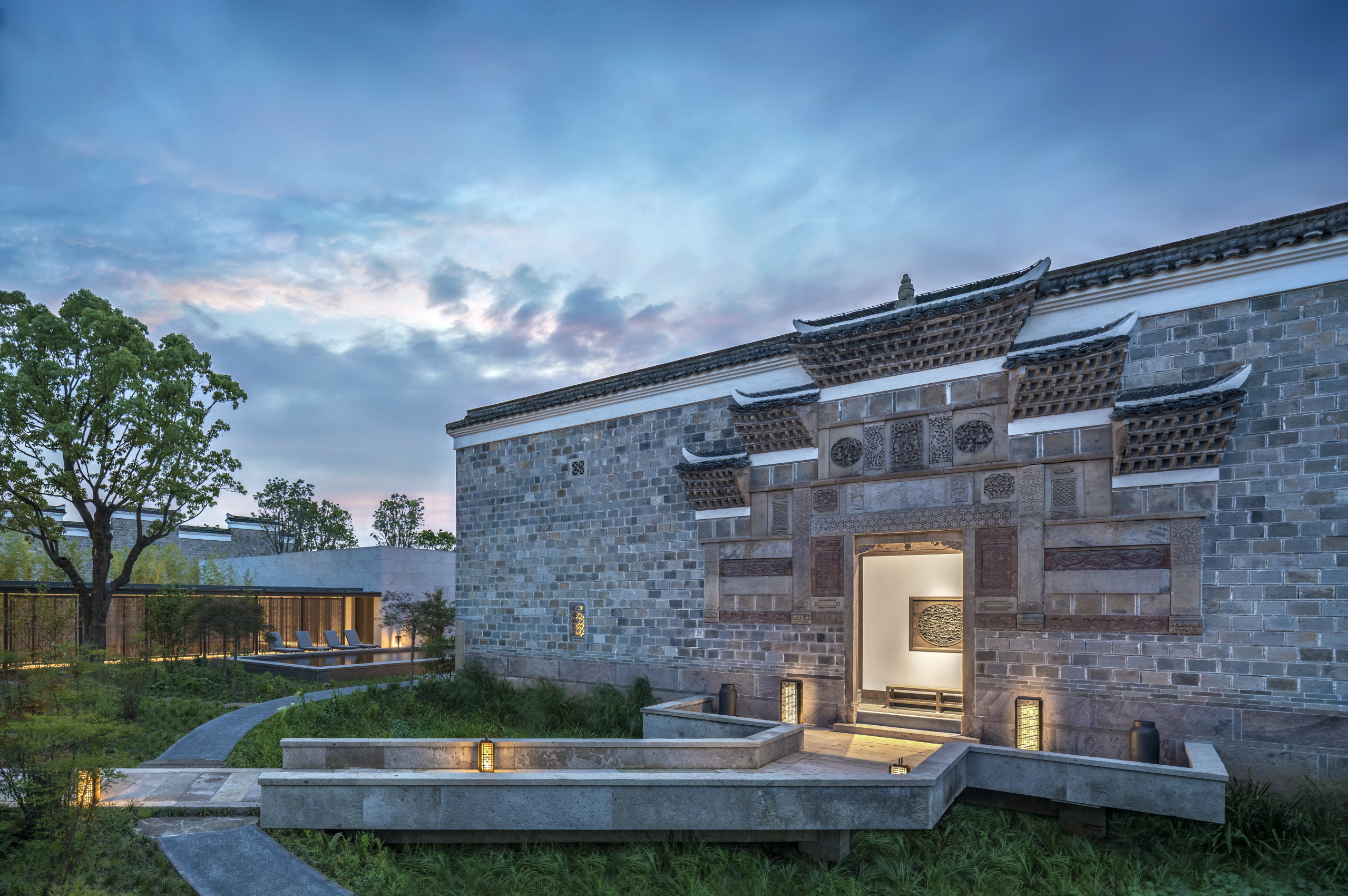
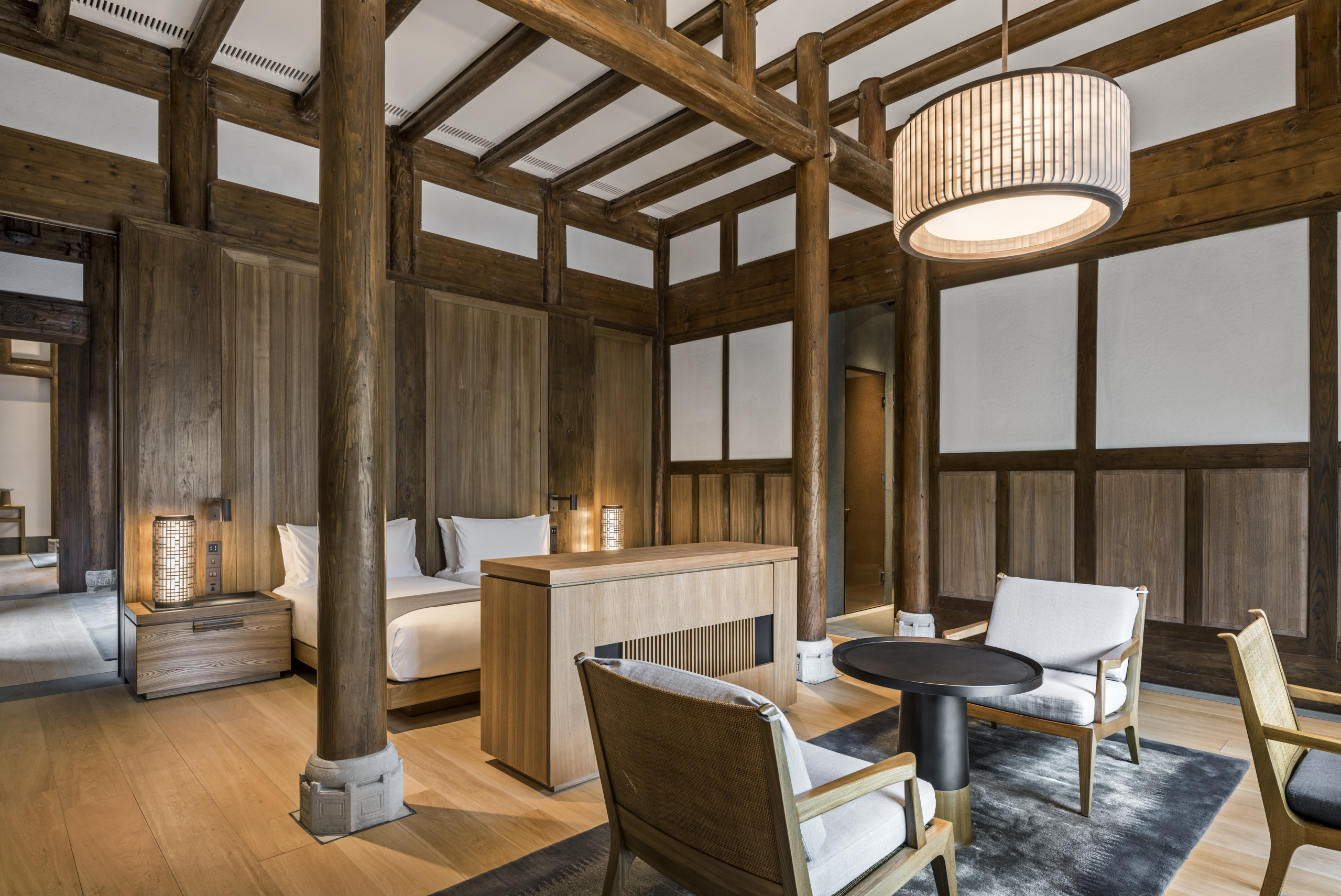 Coming up in 2020 will be another landmark venture for the hotel group with the launch of its third and biggest US property (after the Amangiri in Utah and the Amangani in Wyoming), the Aman New York. Situated in the heart of Manhattan at the crossroads of Fifth Avenue and 57th Street, overlooking Central Park, the hotel will occupy the iconic Crown Building, a retail and office block that's set to be transformed into an “urban sanctuary” with 83 guest rooms and 20 apartments.
Despite its imagination and ambition, Aman chain is understated as a brand – you won’t see its name on billboards in Las Vegas and you won’t see it advertised on TV with a woman in a flowing white dress, skipping along a sandy beach, because it’s got class.
As well as mastering the art of designing new-builds sensitive to the natural environments in which they are constructed (the Amangiri is a good example, below), it’s also at the forefront of a trend for the renovation and development of historic non-hotel properties, transforming them into exciting old-meets-new luxury.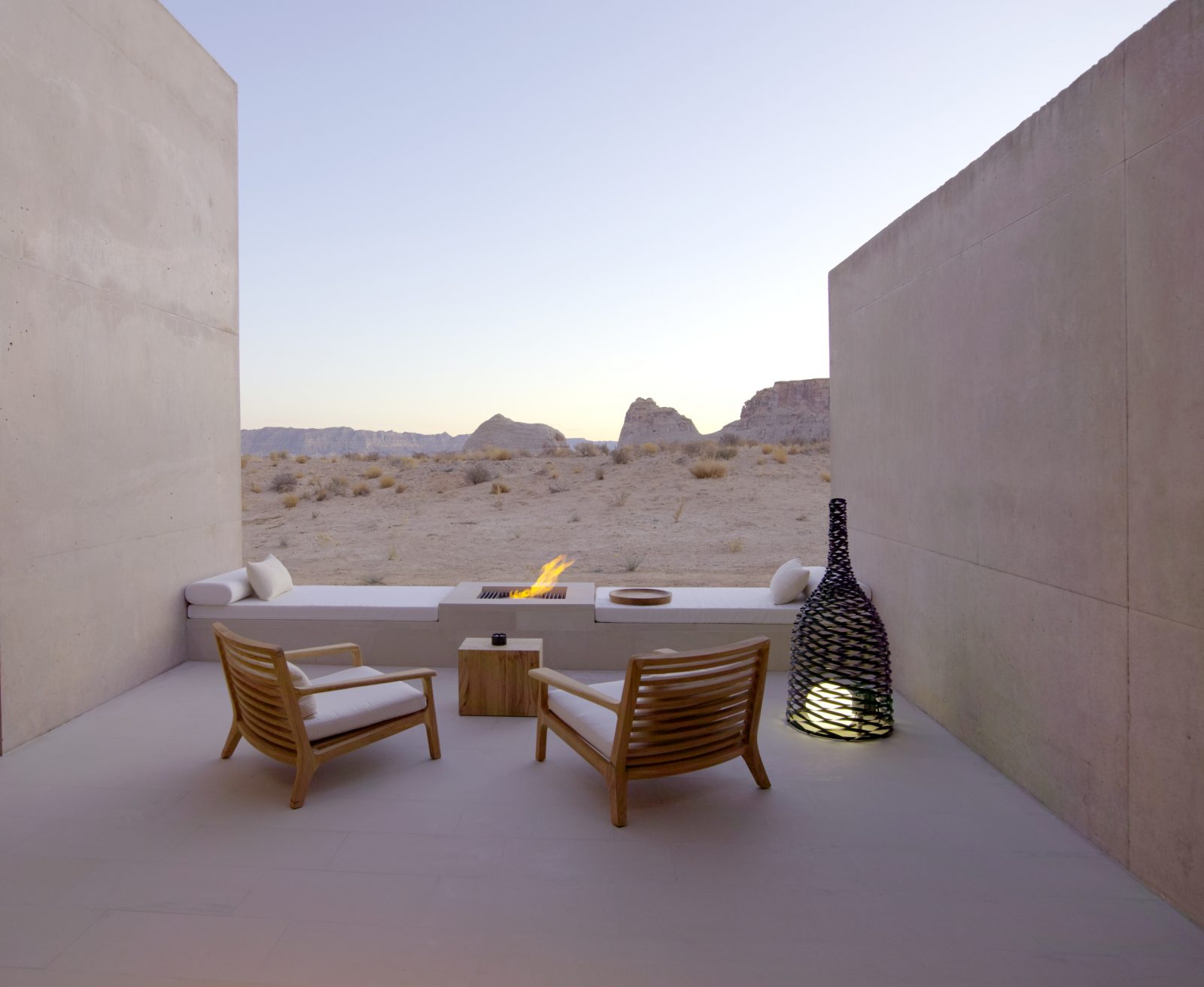
Vladislav Doronin, chairman of the Aman Group, says: “Our strategy continues to place emphasis on seeking out new and outstanding destinations, as well as a continued commitment to curate resorts of architectural distinction by commissioning new and up-and-coming architects.”
Adding: "The continued integration of Aman Wellness, as well as the introduction of Nama, a new culinary concept which celebrates the tradition of Japanese cuisine, known as washoku, are both natural progressions for our brand and further enrich our guests’ experience, which remains our number one priority.”
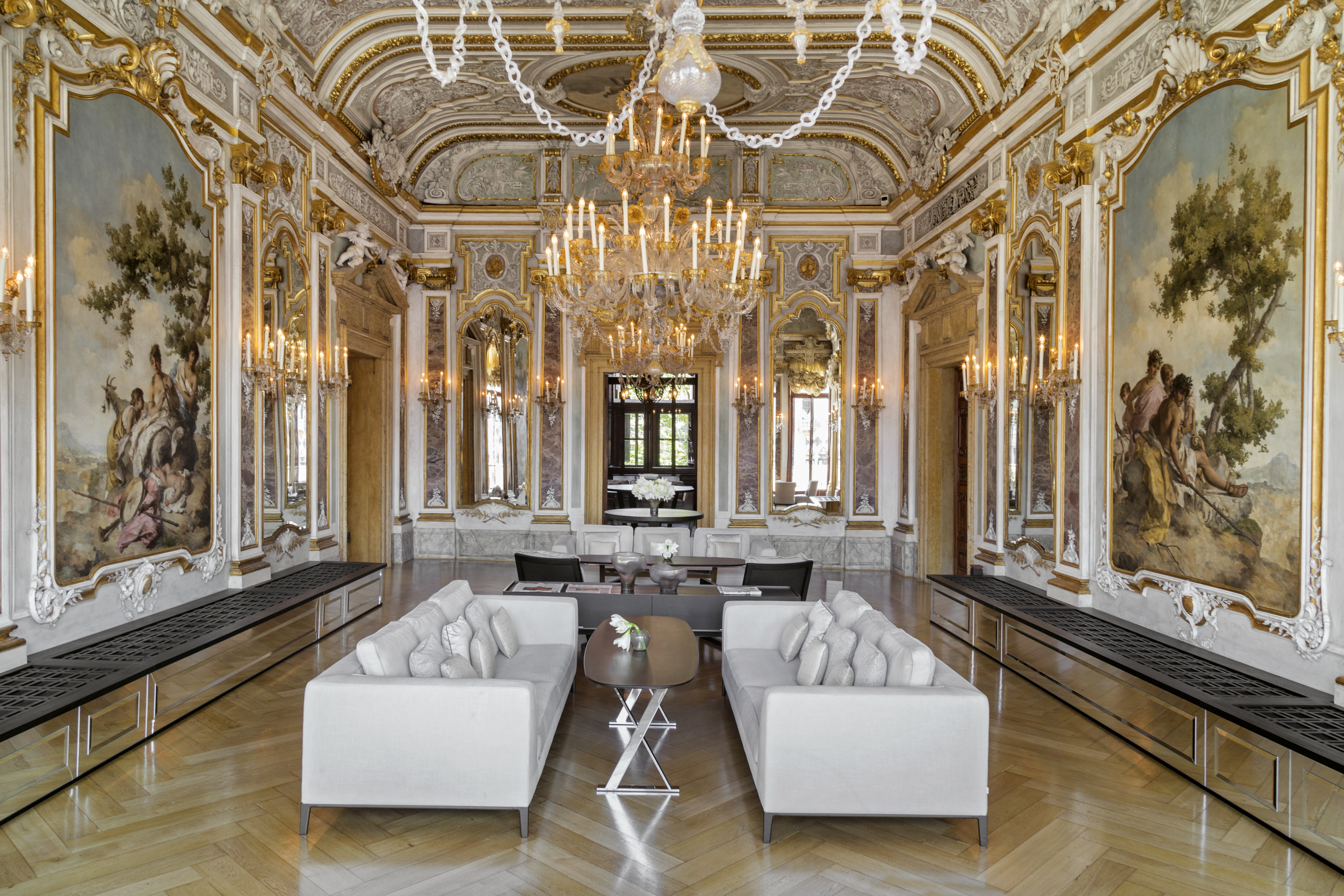 To get a taste of this first-hand, I visited the Aman Venice – Grand Canal, which opened in 2013, in the stunning 16th-century Papadopoli palazzo, complete with original frescoes by Giovanni Battista Tiepolo, making it one of just eight palazzi monumentali in the Italian city. Having handed over much of the property to Aman, the longstanding owners, the Arrivabene Valenti Gonzaga family, still own one wing, in which they continue to live.
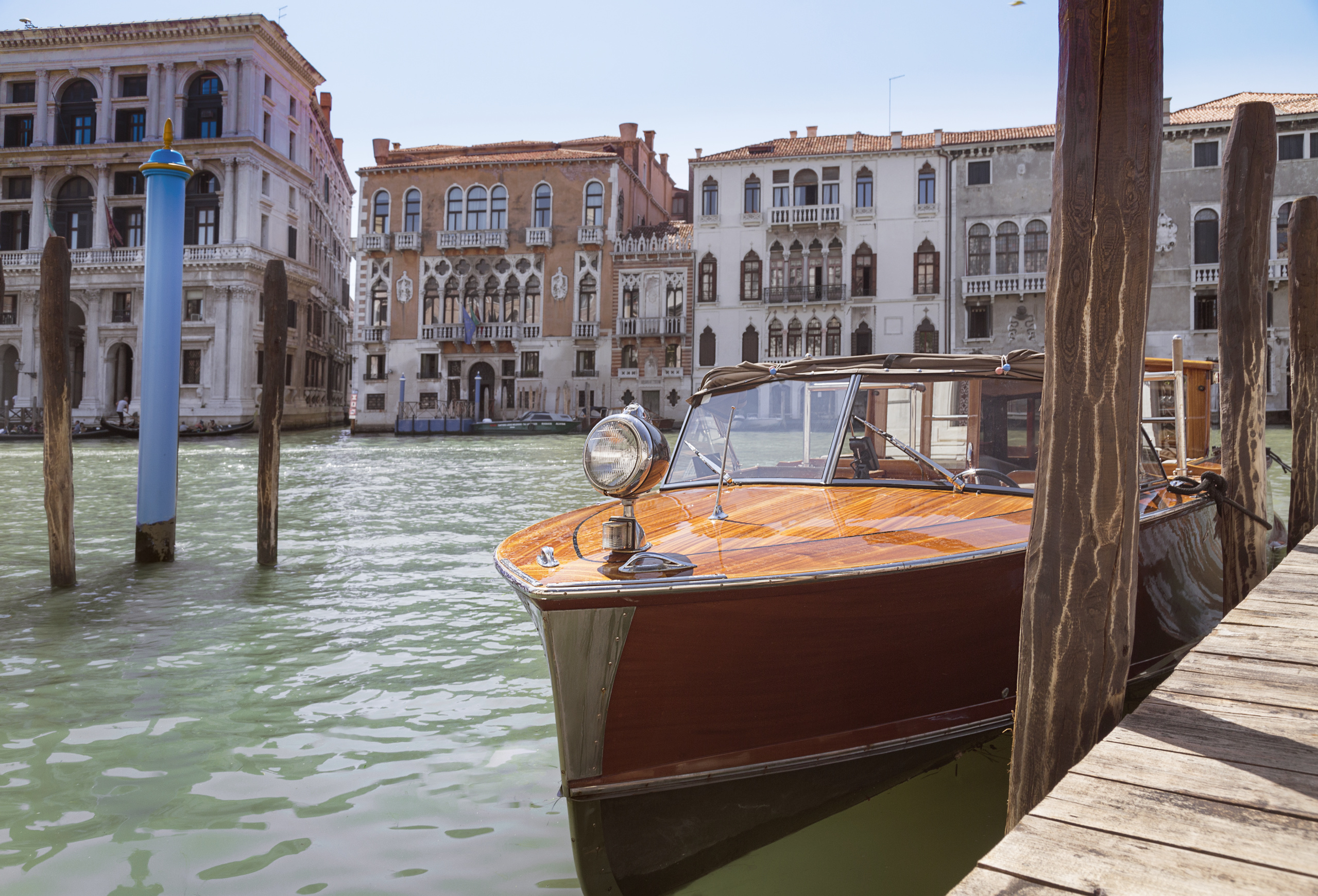
 The engine on my sleek, polished-wood speedboat slowed as we pulled up in front of the hotel. The water on Venice’s Grand Canal was a little choppy that day, so the boat bumped to and fro against the striped posts that protruded from the blue water in front of the magnificent palazzo. (You can also access the hotel from the street at the back but this is a far more cinematic way to arrive.)
 Stepping off, I turned to have a quick look behind me – the Grand Canal was buzzing with life and activity, glowing with Renaissance elegance and beauty. Gondolas drifted by, the sound of opera drifted across the water from an unseen stage, and throngs of tourists ate and drank all along the waterside. It was impossible not to be in awe of this spot, so as I turned back and headed inside the hotel through the old palace doors I needed to keep reassuring myself it was all real.
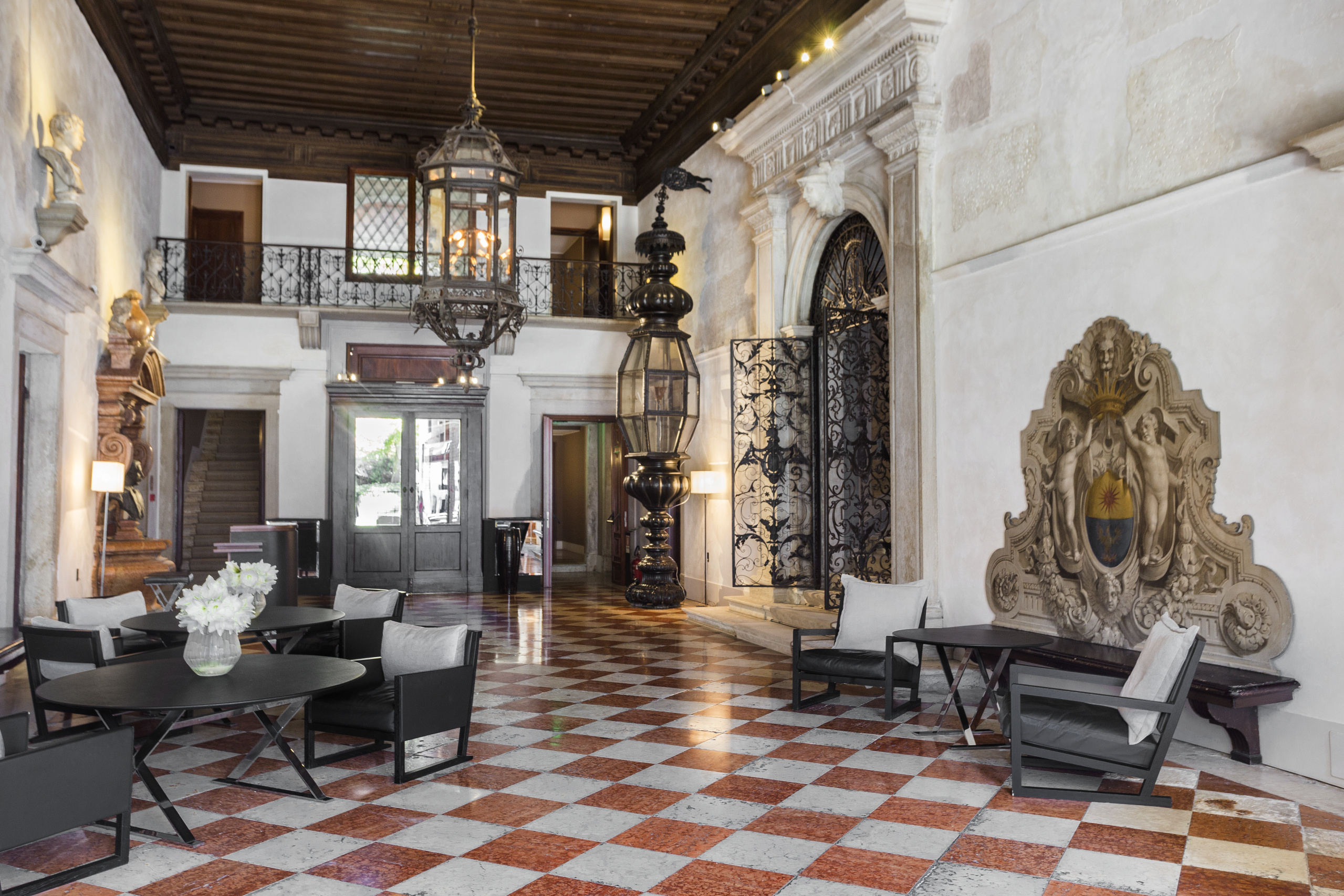 The palazzo in which the Aman Venice is housed was designed and built by Venetian architect Giacomo De Grigi, under the commission of the Coccina family of Bergamo. In 1864, the property was then sold to a wealthy Greek family, who entrusted a neo-Renaissance and Rococo restoration to Michelangelo Guggenheim, a leading designer of the time.
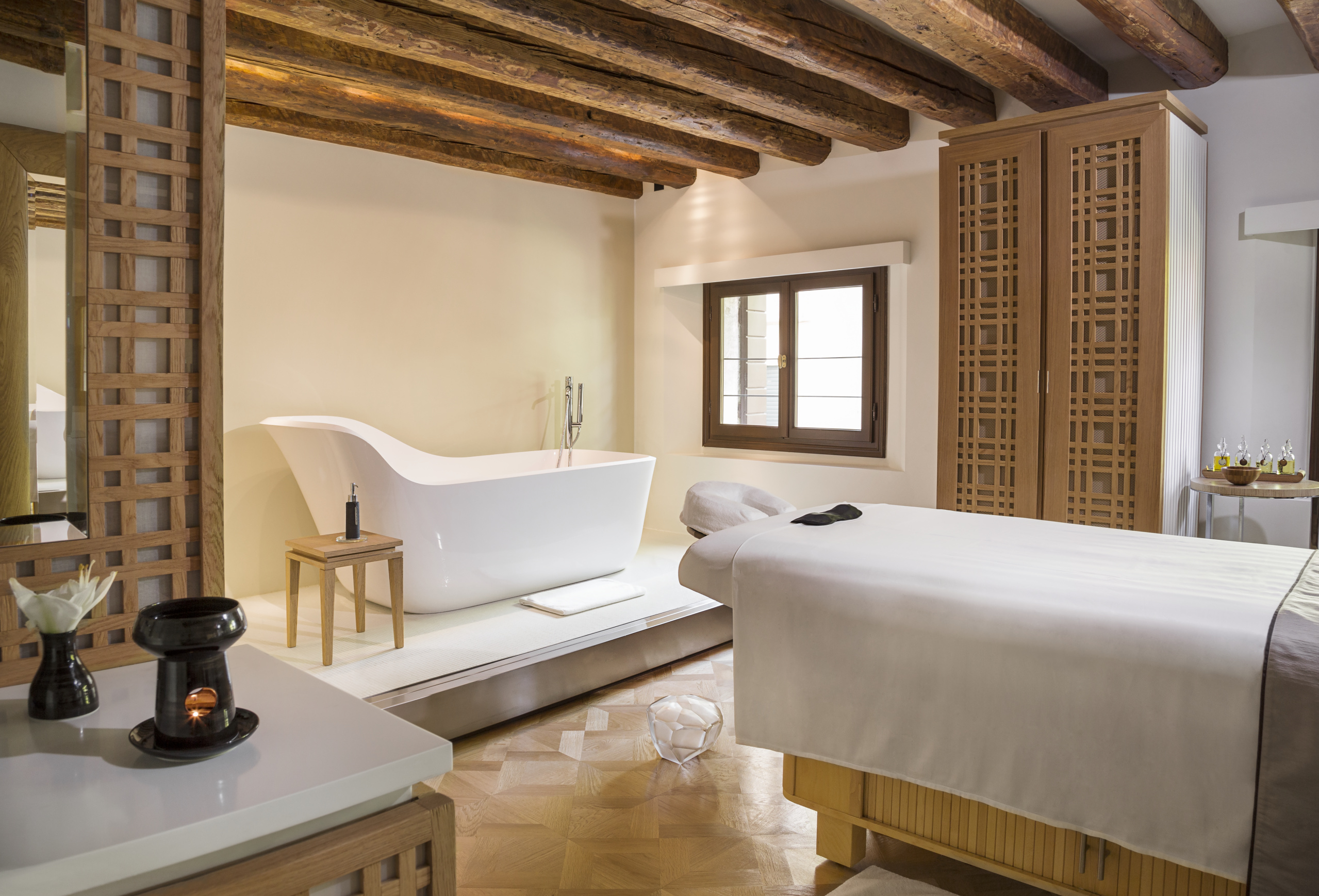
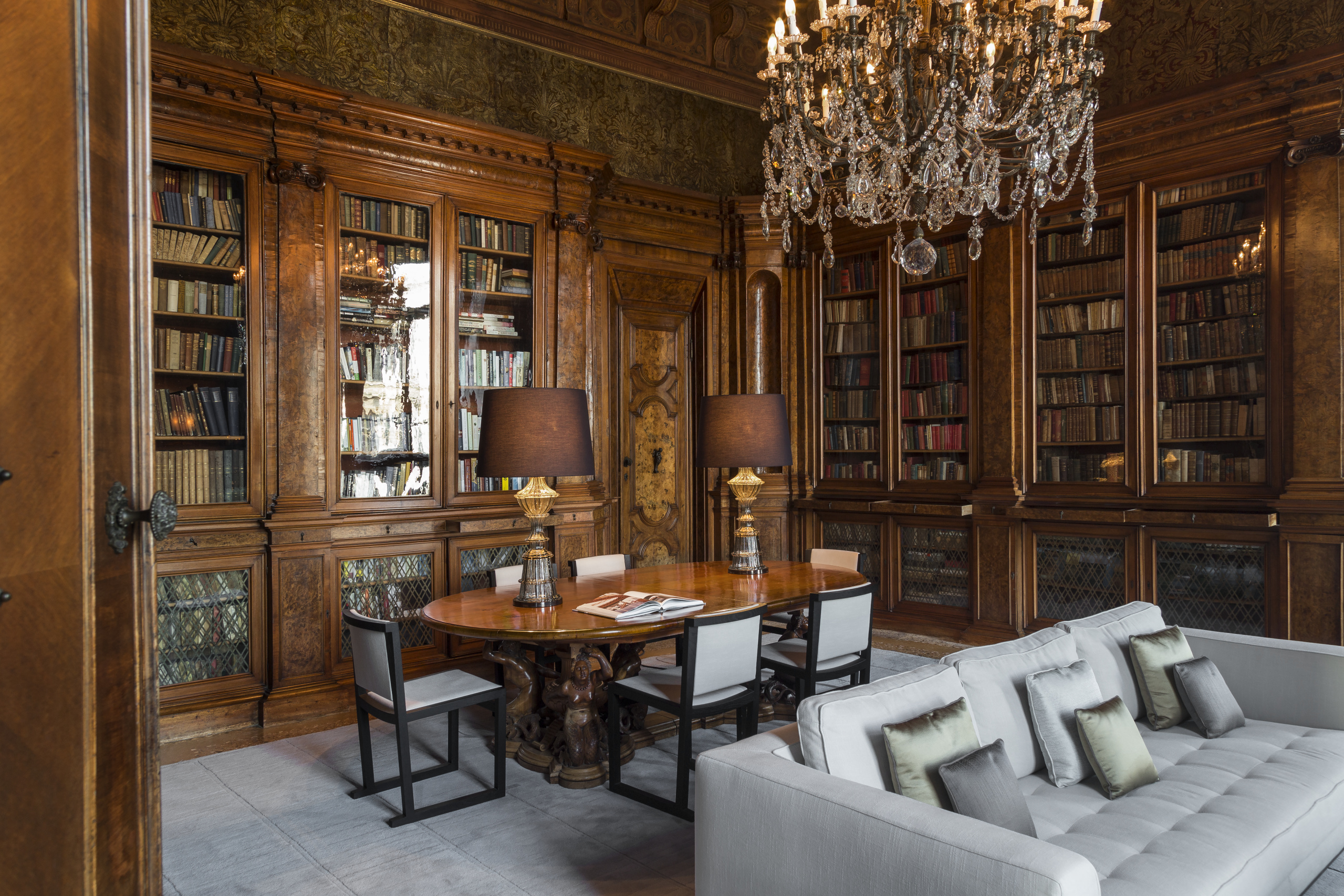 When it was rented by the Aman group (the residing family still own the freehold), it underwent an extensive renovation to bring it back to its former glory, whilst adding their Zen-like, minimalist style (thanks, in this case, to Jean Michel Gathy of Denniston Architects), which often lies just out of sight. (This is a picture of the spa.)
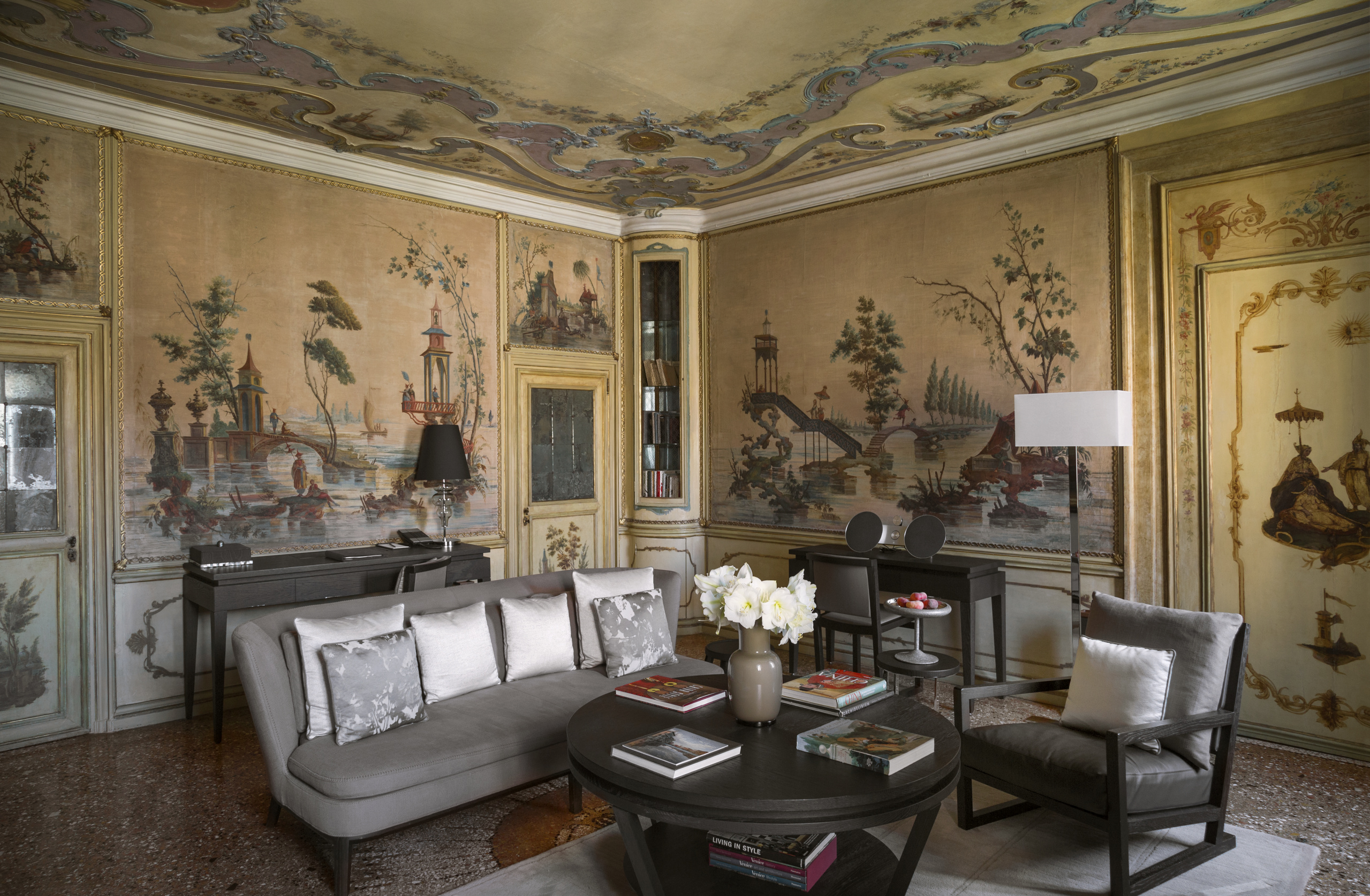
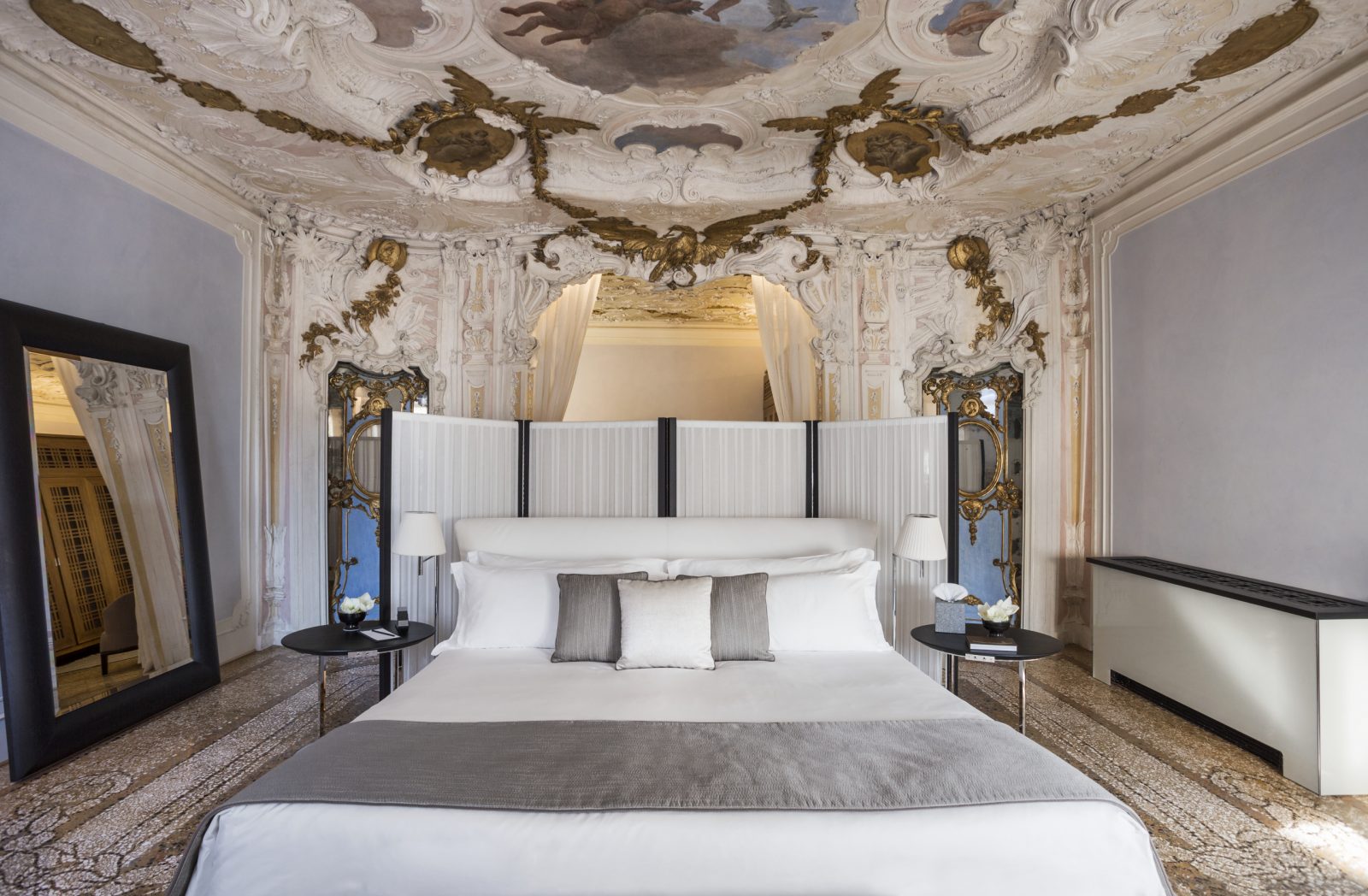
 Each of the Aman Venice's 24 rooms and suites are uniquely decorated and retain many of their original 400-year-old features. Some rooms in the building have stunning frescoes – including those by Tiepolo, who lived in the palazzo in the 18th century – as well as stucco, marble, wood carvings and terrazzo flooring that reflect the splendour of art and architecture of past centuries.
Although each of these private spaces have a heavy nod to the original Renaissance styling, there’s also fresh, cutting-edge design to be found, which makes them as exciting and forward thinking as any new-build hotels out there, if not more so.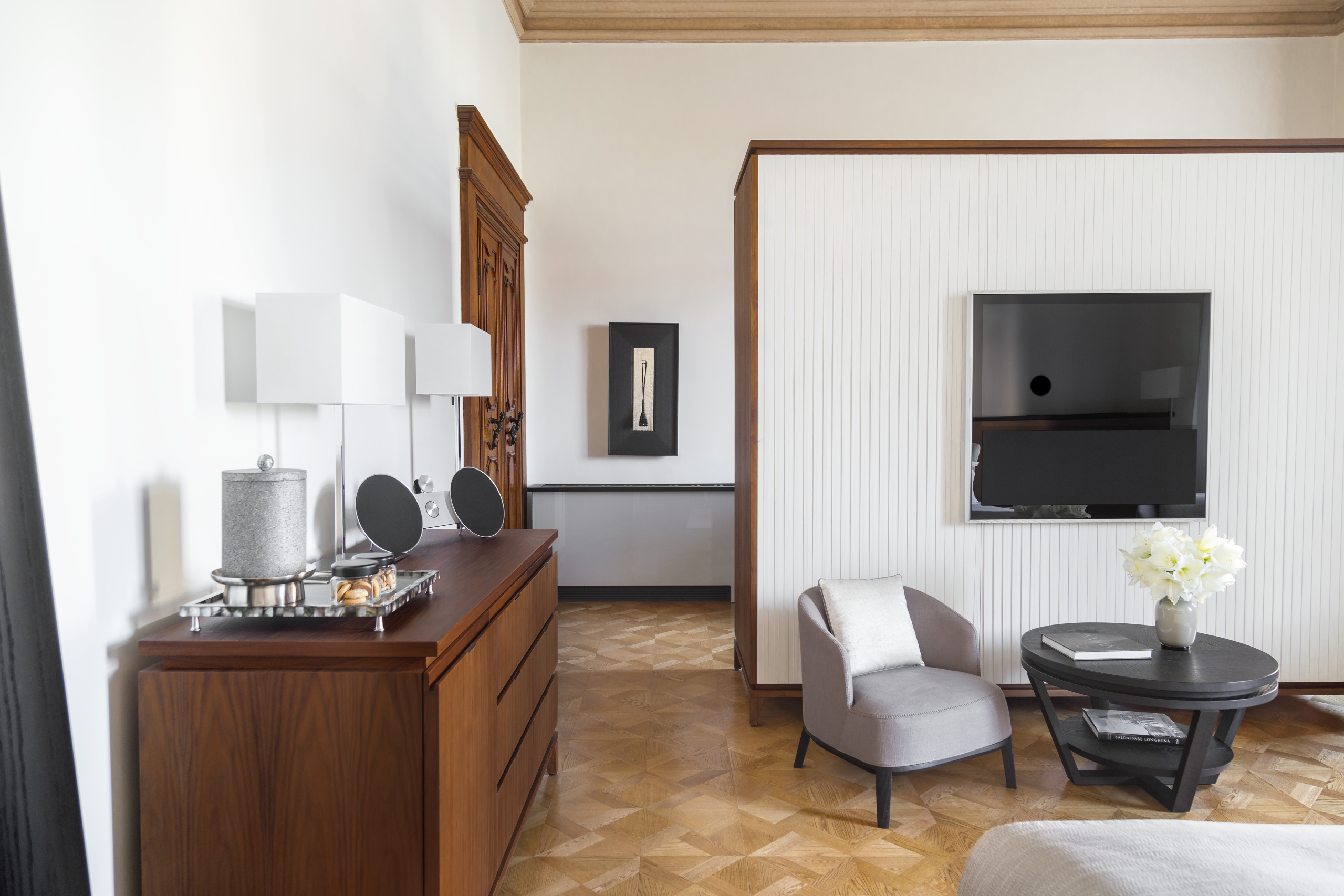
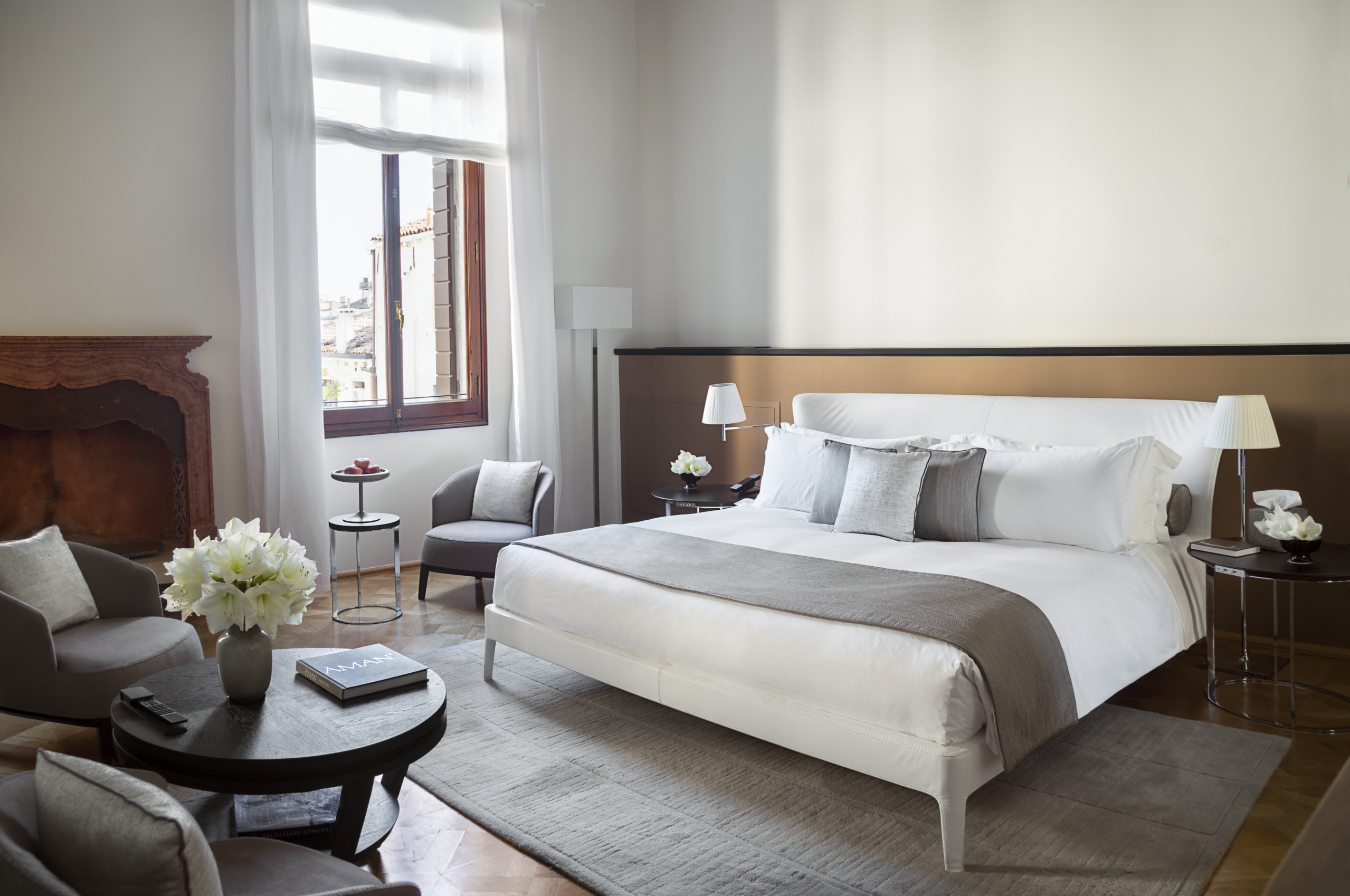 This palazzo hotel could so easily have been made into an homage to old-world opulence, which could have been stuffy and actually a little dull, but instead Aman has managed to balance the historic with the modern in perfect harmony (another great example of this is the Aman Sveti Stefan in Montenegro, as well as the Amanyangyun, of course).
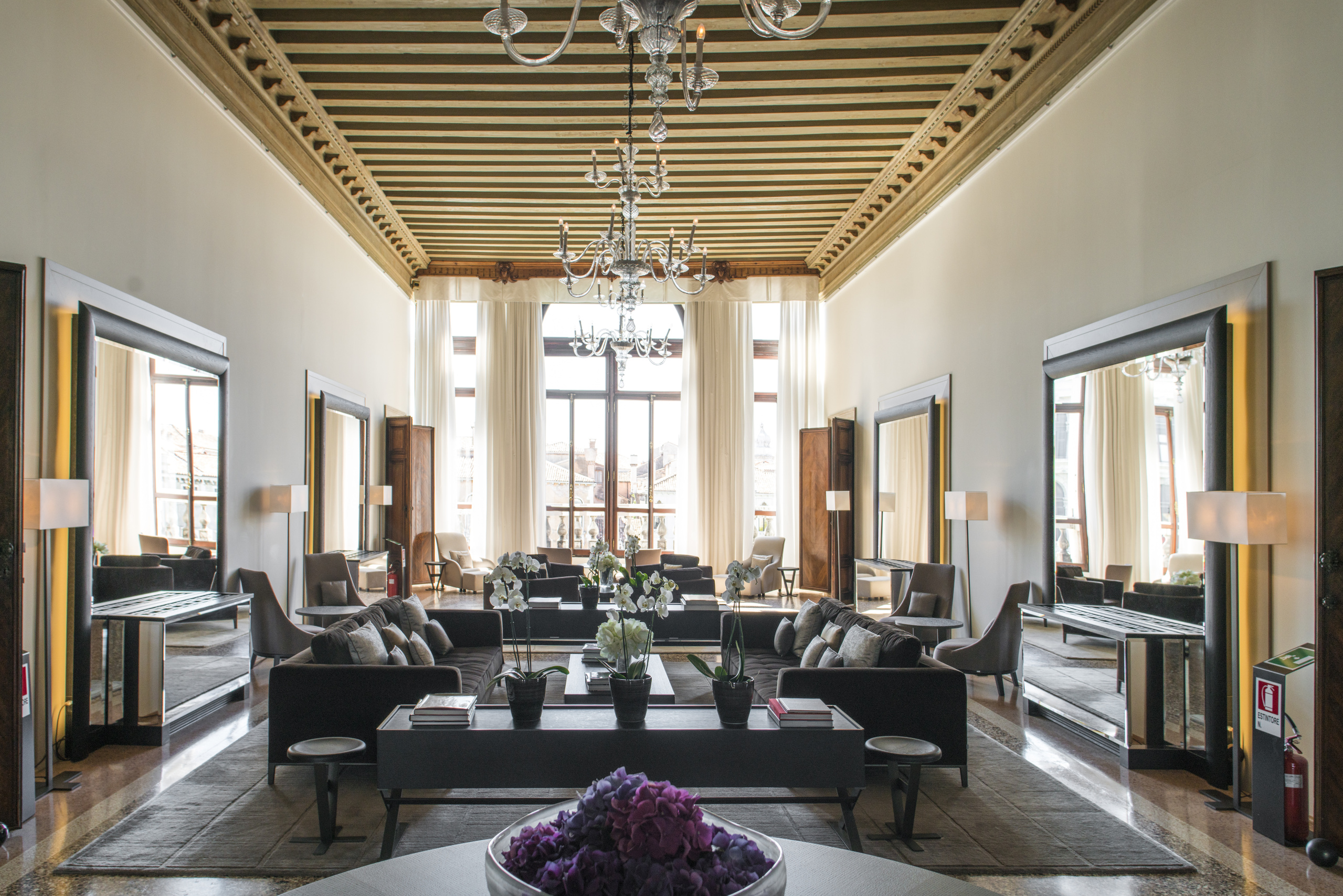 The walls and ceilings of the common spaces are flowing in gold and finery, enormous chandeliers sparkle in the subtle light and plush furnishings fill the gaps in between. It’s impossible not to feel like royalty here – probably why George and Amal Clooney chose this palace as their wedding venue above anywhere else in the world.
Aman is also pushing boundaries with its food and drink. The bar serves incredible custom cocktails, designed and made to your exact specification. The attentive bartender will start by asking your preferred flavours, favourite base spirit, lower tones and preference for sour, bitter or sweet. These drinks seem to be entirely customisable, right down to choosing the botanical infusions for your gin, or even which wood you’d like your Old Fashioned smoked with.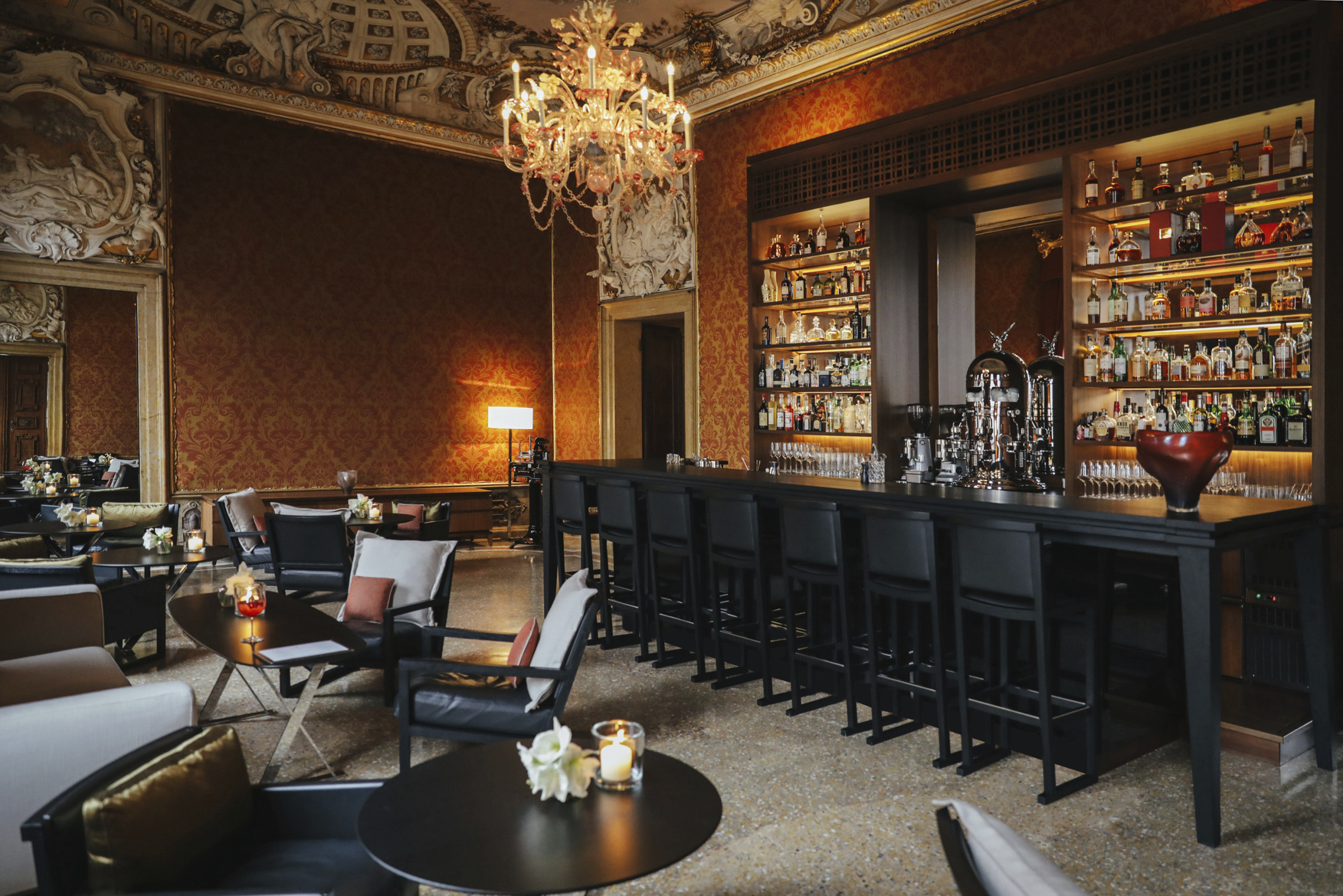 Spirit infusions are a really exciting aspect of this bar and something that only recently became a possibility in high-end cocktail bars. Choosing a base spirit (gin in our case), you can select any number of 15 botanicals to infuse your alcohol with.
The liquid is then vaporised with dry-ice and fed through enough glass tubes and beakers to make even the greatest mad scientist proud. The end product is a martini better than anything you’ve ever tasted. It’s a once in a lifetime experience, literally, as you really can’t make the exact blend twice – that’s a serious leap in cocktail-making ingenuity.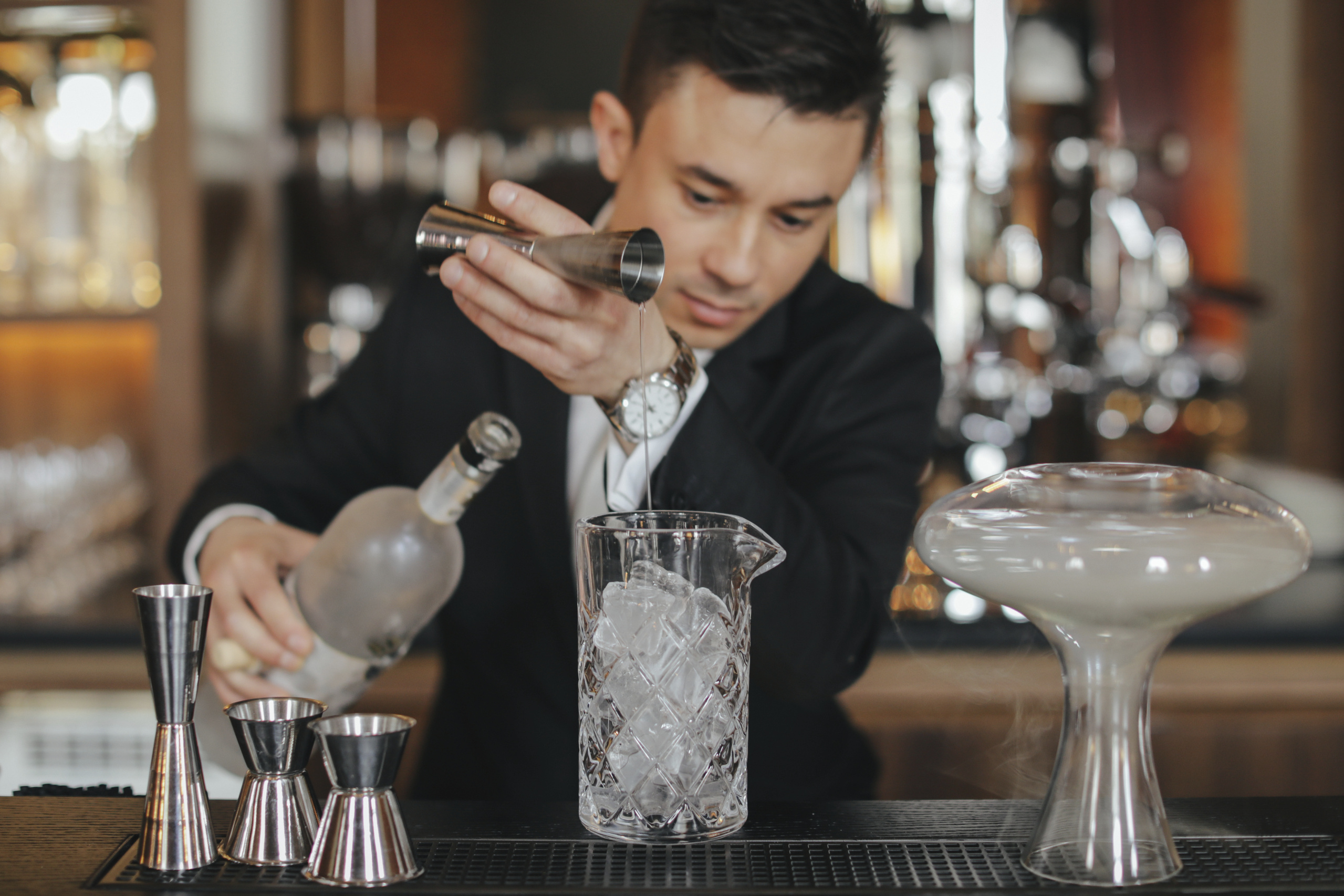 I was lucky enough to have a dinner reservation in the largest and most impressive room in the palazzo. It has views of the Grand Canal and a level of regal grandeur you really won’t find outside of a genuine royal residence.
The food was exquisite and some of the best I have tasted (and I eat in a lot of great restaurants), especially the beef carpaccio with summer truffle – that was something really special. The menu is designed by Italy's renowned Michelin-star chef Davide Oldani, who mentors the Aman kitchen team, led by executive chef Akio Fujita.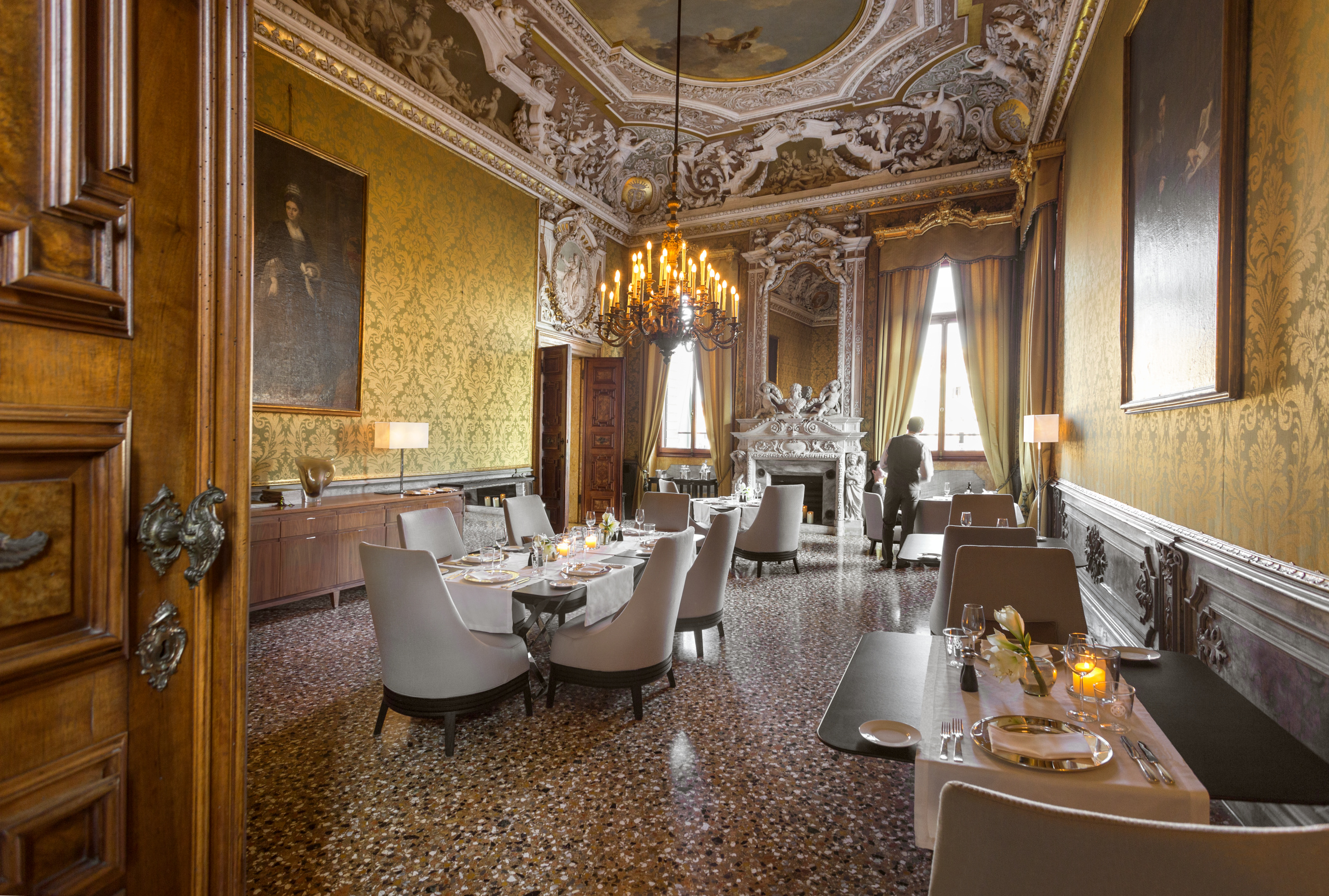 The cuisine is perfectly simple, unbelievably delicious and, above all, elegant. It is great to see a restaurant surrounded by such ostentatious extravagance lean away from nouvelle cuisine or overly fussy fine-dining and, instead, forging ahead with the growing trend for using simple, great ingredients to make superb, unpretentious food. This is my new favourite place in the world.
 What is Knomi and why is it innovative?
Knomi is an app that lets you find the best independent, designer fashion boutiques, and even which boutique sells a specific handbag, for example. It launched in 2016.
Most of our end users are high-spending tourists. We are changing the way offline shopping is done by making the process of finding boutiques and products in the offline space easy.
Many boutiques are located off the beaten track and are harder to find – especially for visitors.
Over 90 per cent of luxury purchases are made offline – that is in physical boutiques – and we realised that there was no established platform for convert online research into in-store visits and purchases. We built Knomi to fix this.
Users can search for specific products they wish to purchase and see where they are stocked nearby or use our area guides to find local shopping inspiration.
Knomi users can also plan ahead and add products to their wishlist to receive notifications when they are close to a boutique stocking any of the items. We provide directions, along with the store phone number and address.
Our partner stores all have iBeacons – this means that we can see how many Knomi users visit the stores. In addition, we employ some really cool machine learning methods to make it easy to extract and handle and classify our partner’s product inventory.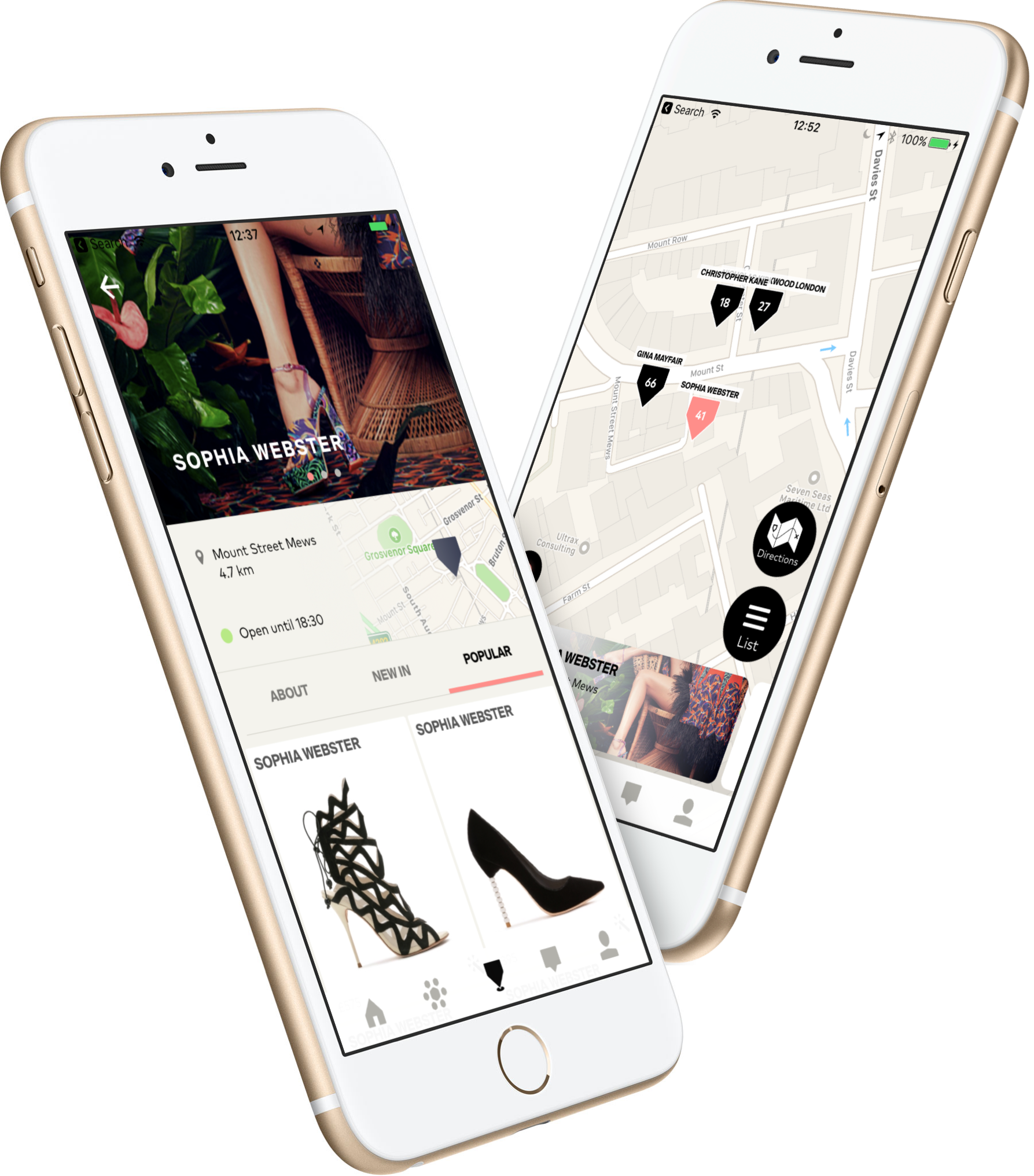
Our primary aim is to facilitate and encourage user visits our partner stores for them to purchase there. This said, we do allow users to purchase in the app as well.
Shopping is cited as one of the most popular activities for overseas visitors to Britain, with approximately 70 per cent of leisure visits involving retail. We simply make the discovery process easier, for both locals and tourists.
Just like Foursquare makes it easy to find a great café in a new city or a neighbourhood you aren't familiar with, or OpenTable makes it easy for you to find a free table at a restaurant and book it, Knomi makes it easy to find fashion boutiques and see what they have in store, without having to go there first.
Knomi is currently available in London, Paris, New York and Madrid.
Our international growth plans will see us expanding the number of stores and cities globally from 2018. For now, our key focus is on growing and "owning" the London market.
We have more than 80 luxury brands and boutiques on Knomi such as Vivienne Westwood, Victoria Beckham, Erdem, Emilia Wicksted and Christopher Kane.
There are many general travel and guide apps out there, as well as some really cool fashion apps. But to specifically find the best fashion boutiques, and in what boutique I can find a specific item, we don’t really have any competition.
We have had more than 20,000 downloads.
We firmly believe that there will always be a place for bricks and mortar, particularly in luxury retail. Admittedly there are some really big players in the world of luxury online shopping who are doing a great job, and online will probably keep growing quicker than physical stores for a while.
When it comes to luxury, however, experience is key and the relationship between the customer and the brand and is really important. That is difficult to fully replicate online. Just like face-to face business meetings are not going away just because video conferences are doable, we don’t believe that offline or bricks and mortar retail is disappearing.
“There is a difference between luxury and ultra-luxury,” Helen Beck, vice-president of international sales and marketing of Crystal Cruises, says. “It’s the little things.”
For example, while some luxury ships might have a cabaret lounge on board, Crystal has a full theatre, employing Broadway legends to direct and perform.
Where other ships stock up with pre-prepared food, Crystal Cruises invites chefs to buy fresh ingredients from port and prepare meals from scratch.
And where other cruise liners squeeze more passengers into their cabins, Crystal Cruises is reducing passenger numbers.
It’s this contrary approach to guest numbers that I’m most fascinated by when I meet Beck. After all, this is an industry where "mega-ships" with a capacity of almost 7,000 are considered the future.
Crystal Cruise's approach is different. “We’ve stripped out some of our standard verandah staterooms to make room for larger suites,” Beck explains. On board Crystal Serenity, which was refurbished in 2016, 12 staterooms are to be replaced with eight plush penthouses. These magnificent suites offer walk-in closets, Jacuzzi tubs and a personal butler service.
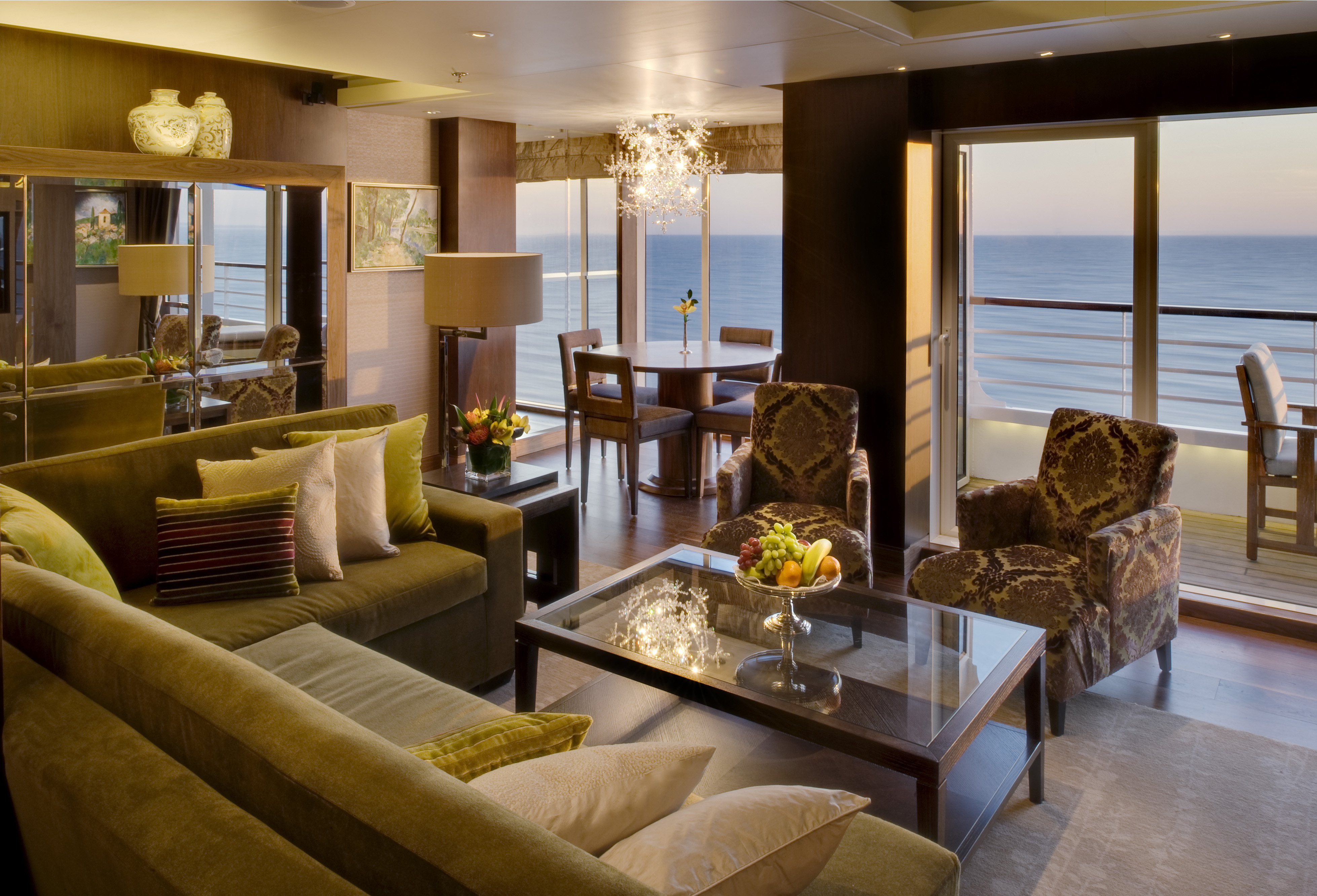 It means there are fewer rooms and lower passenger numbers, but each guest enjoys a larger, more luxurious area to themselves. In fact, space is one of the brand’s guiding "Four Pillar". On board Symphony, each guest enjoys 60.2 tons of it to themselves – one of the highest ratios in the industry.
What does "ultra luxury" look like? Let’s head aboard the Symphony to find out.
Before they embark, guests are invited to choose from a stunning array of staterooms and suites. Every room is resplendent with Egyptian cotton sheets and plush duvets. And for the discerning sleeper, there’s even a pillow menu, just as you will find in top-end luxury hotels.
In the penthouse suites, a butler will unpack your luggage while you dine on the verandah overlooking the sea.
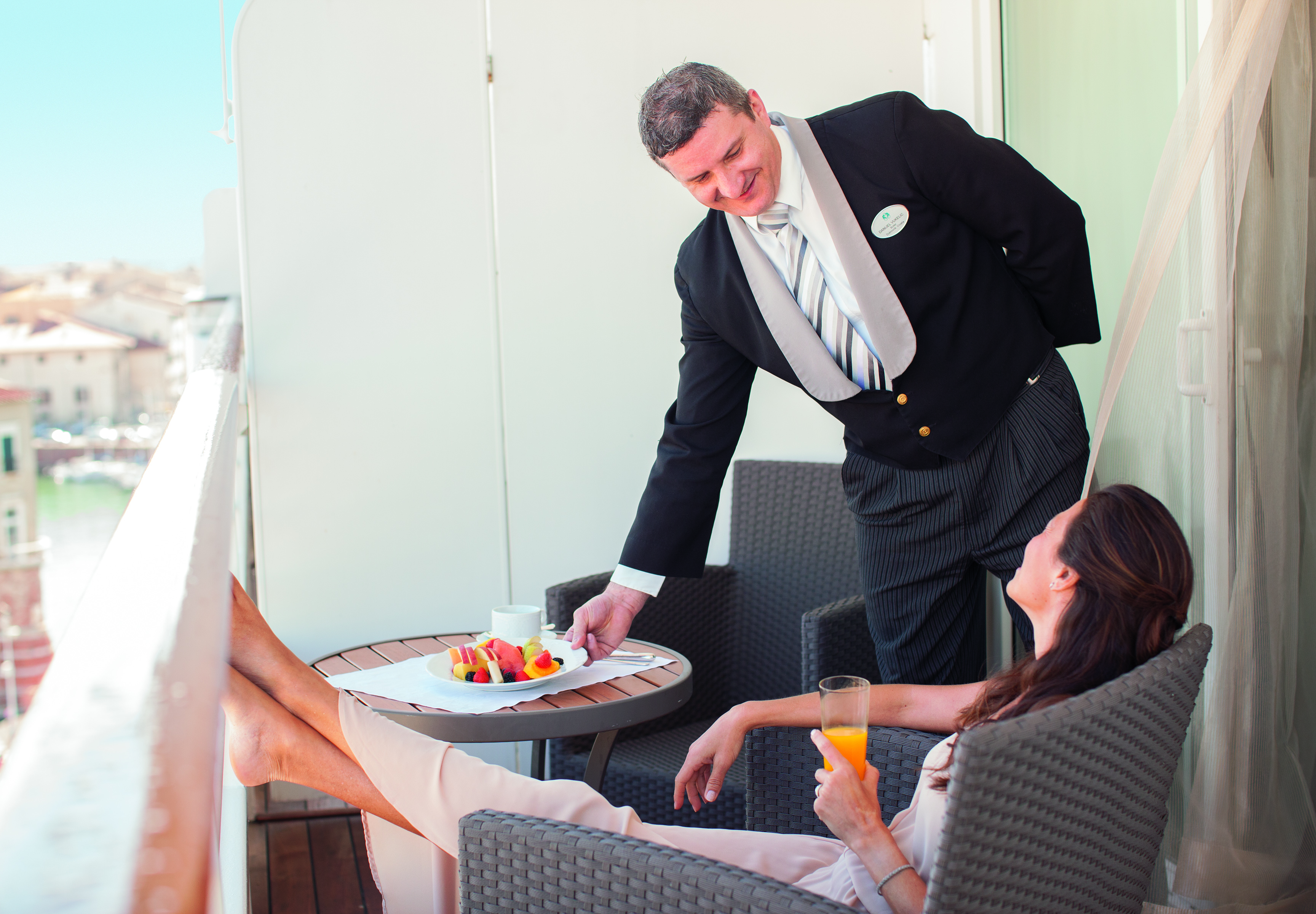 Crystal Cruises also has the highest staff-to-passenger ratio in the industry. Each member of staff is chosen for their expertise, and they don’t job share. In other words, you won’t find your cabin stewardess behind the bar later in the evening.
The menus are never repeated and chefs rustle up five-course extravaganzas every night, using local produce found along the way. They cater to both classic and experimental tastes (exploding caviar balls, anyone?)
During the day, you’ll relax with three-hour spa treatments or hone your golf swing with PGA golf pros. If you’re a guest on Crystal’s new yacht, Esprit, you can even board the Crystal submarine, which takes you deep below the ocean waves.
But it’s offshore that things get really interesting. Crystal Cruises has partnered with some of the most adventurous tour and excursion companies on the planet. In Russia, you can step off the ship and fly a MiG fighter jet. And in Abu Dhabi, you can strap on a VIP pass to the Grand Prix.
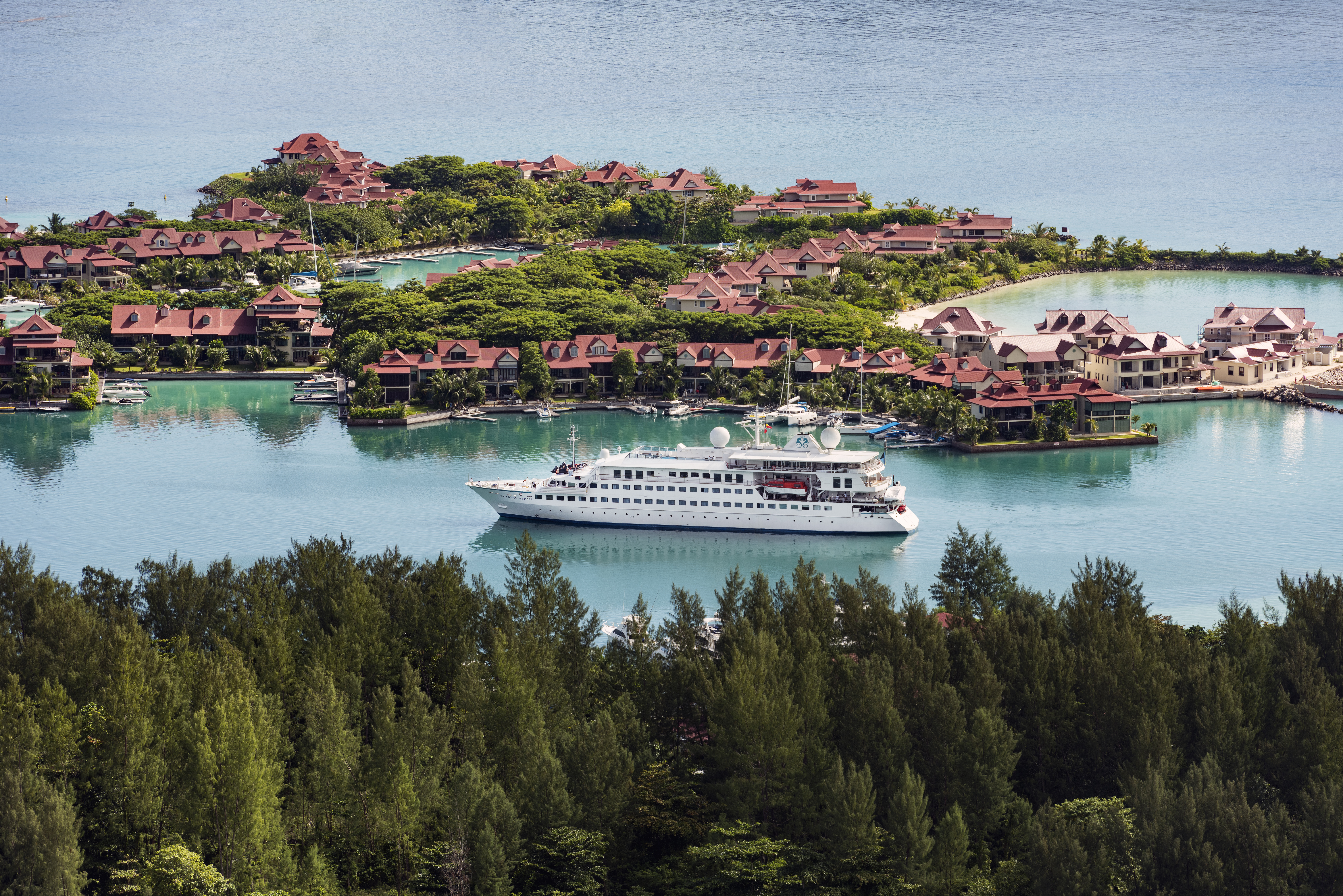 This, in essence, is ultra-luxury. A hyper-personal experience where guests can choose everything from their pillows their adrenalin fix. Where they can enjoy once-in-a-lifetime excursions and VIP experiences.
And they can do it all without sharing their space with 7,000 strangers.
Crystal Cruises hasn’t come this far without taking risks and evolving. The definition of luxury is constantly in flux, with new technology and changing consumer demands. It means that companies like Crystal must keep evolving. “Adapt or die” as Beck says.
On that, we agree. Globetrender recently spoke at the Connections Luxury Conference in Dublin to highlight three defining trends in the future of luxury travel:
Crystal has tapped into each of these trends over the last few years. It has partnered with celebrity chefs and Broadway stars. They’ve introduced extreme experiences such as submarine diving. And the staff are trained to remember your every preference, including how you take your coffee.
Crystal Cruises has already established itself as the premier name in ultra-luxury cruising. It has created a small, intimate brand with two landmark ships: Serenity and Symphony.
But now it is entering a new chapter. Following an acquisition by Chinese mega-group, Genting Hong Kong (GHK), Crystal is expanding.
The company is no longer a two-ship operation. Its fleet now includes five river boats, a yacht and a Boeing Business Jet. Crystal will also add a third cruise ship by 2022.
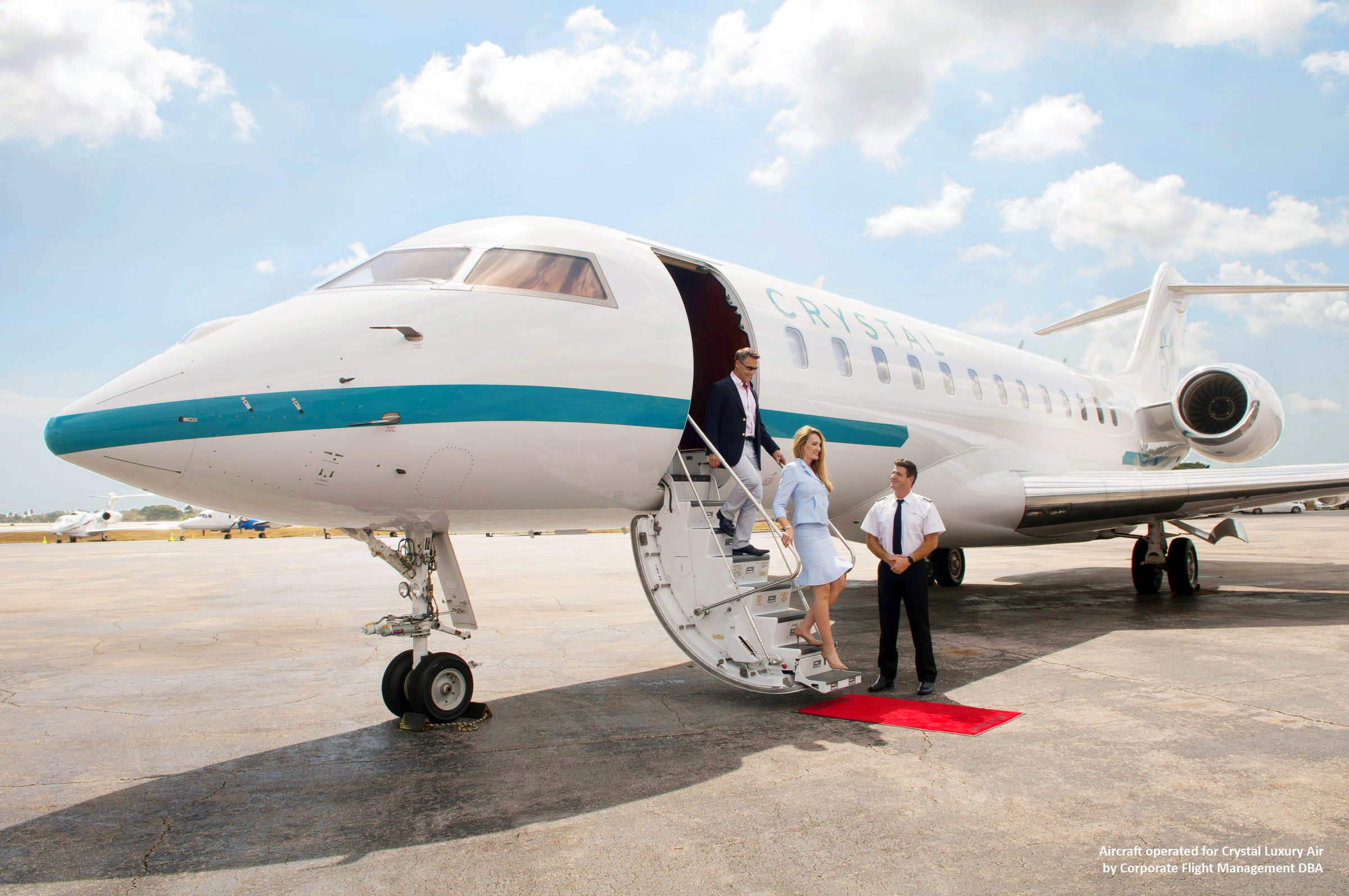 The question, of course, is whether the company can retain that pure, distilled essence of ultra-luxury across a larger fleet and more complex brand. The answer, Beck says, is a resounding "yes".
Even during this expansion and transition period, Crystal hasn’t lost an ounce of guest satisfaction (Beck excitedly shows me the statistics). Guest satisfaction sits unwaveringly at 90 per cent from 2014 through 2016.
Crystal Cruises continues to redefine the luxury experience. With every change, it sets the bar a little higher, and we’ll be watching closely to see what it does next.
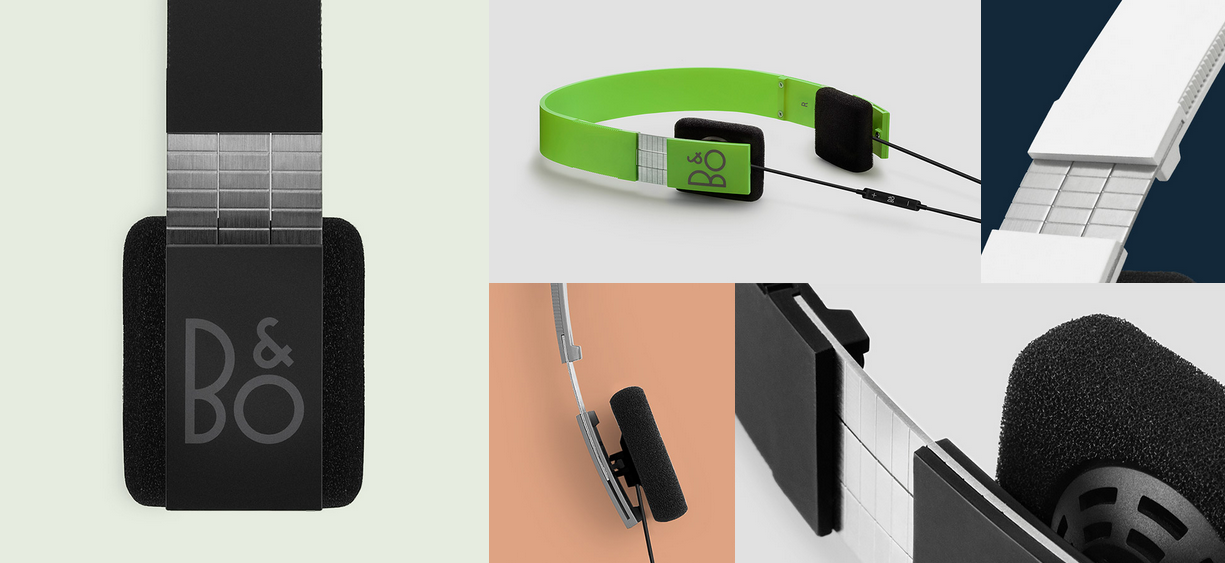
[dropcap size=big]H[/dropcap]arbouring fantasies of woodland retreats, the desire to go off-grid is a reaction to our increasingly urbanised existence.
The modern human feels disconnected from nature, their minds overwhelmed with noise from social media, work and city life. At the same time, the contemporary explorer is more intrepid, discerning and curious – they have more money, a greater desire for experiences rather than material possessions, and unparalleled access to affordable air connectivity. They are willing to travel further, in search of greater reward.
Here are five of the world' most remote hotels – ones chosen as much for their luxurious interiors as their architectural splendour and strong environmental approaches.
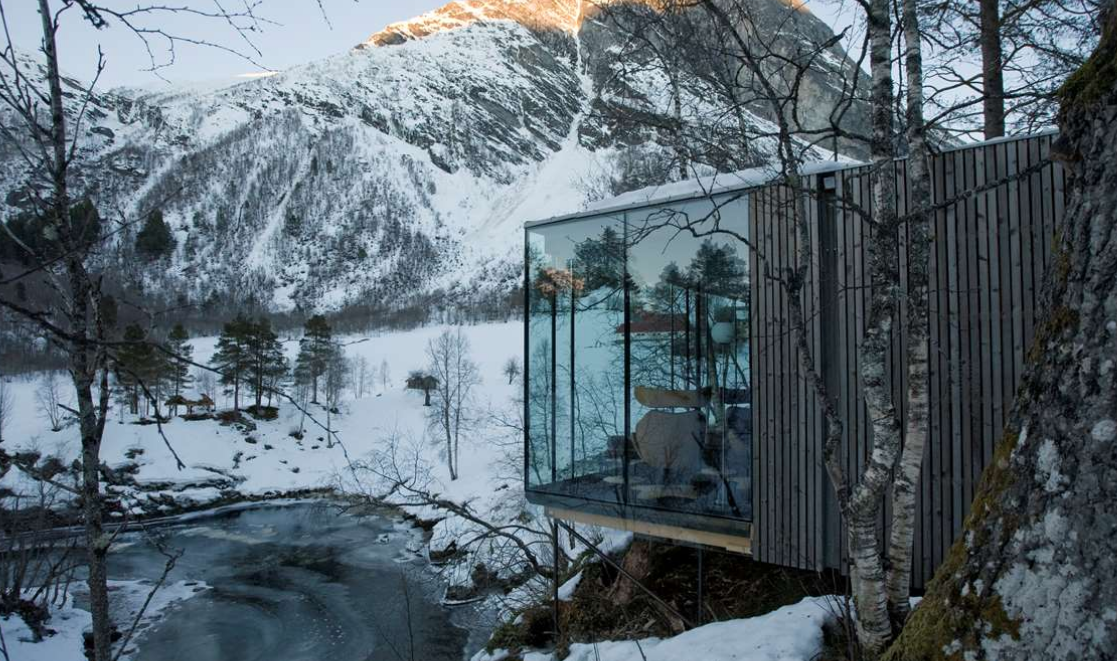 Built in 2008, and described as the first "landscape hotel" in Europe, the Juvet has set the trend for hyper-modern, minimalist architecture that is embedded sensitively into the wilderness. It had a budget of €1 million.
Although striking, it doesn't dominate the natural surrounds – it uses handcrafted timber, living roofs and mirrored glass to blend in with the forest, rendering it invisible from certain angles. Set on a cliff, windows overlook a fast-flowing river, and a green wall of birch, aspen and pine trees.
It has nine detached rooms in addition to the farm's mill, house and bar, where there are also rooms for rent. The seven "landscape" rooms occupy "glass cubes on stilts", and have dark interiors so as not to detract from the outdoors.
In the style of traditional Norwegian log cabins, the two new single-occupancy Birdhouses are all about simplicity, measuring 8 sqm, and with just a bed and bench on which to sit. The idea is to reconnect with nature and to realise how little you need to be happy. A spa with a 15-metre wide window has a steam room and outdoor hot tub.
The Juvet Landscape hotel has already caught the attention of the movie industry – it was turned into the star location for the 2015 science fiction film Ex Machina directed by Alex Garland. The hotel and the Valldal valley itself, have been written about by numerous publications including Vanity Fair, Dezeen and Business Insider.
The Independent wrote: "Designed by Norwegian architects Jensen and Skodvin and opened five years ago, Juvet Landscape hotel has won plaudits for its organic simplicity, modern design and tranquil setting.
It was built as part of a government initiative to develop 18 National Tourist Routes throughout Norway that would improve infrastructure and introduce modern architecture – viewpoints, rest stops and accommodation – to highlight the country's dramatic landscapes.”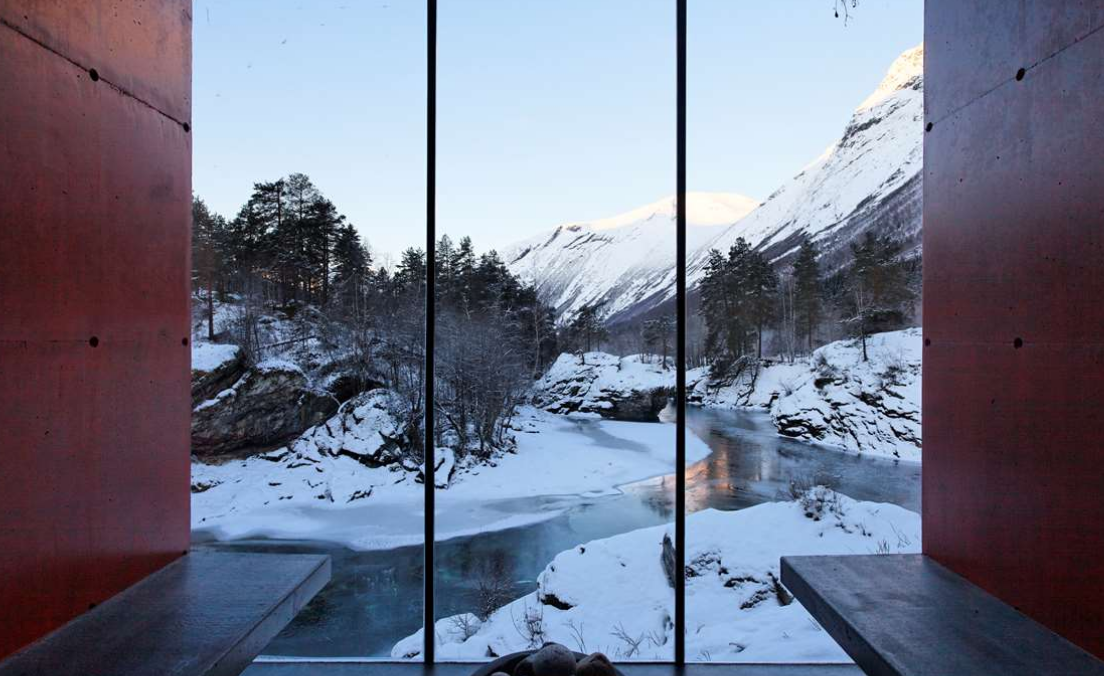 "Meals are eaten communally on a long table in an old red barn. The menu relies on local ingredients, such as bread baked by a 97-year-old lady and fruit grown on the shores of the nearby Norddals fjord.
"[Nearby there are] ski resorts with chair lifts, such as Stranda, around 40km away. It is in the magnificent Sunnmore Alps, with impressive views over Storfjord below. With 17 different pistes and some of the best off-piste opportunities in Scandinavia, there is plenty to enjoy.”
Situated in Burtigarden farm in Alstad, Valldal, it's seven hours from Oslo by car – so definitely counts as one of the more remote hotels here. Rates at the Juvet Landscape hotel are about £300 a night for a double room.
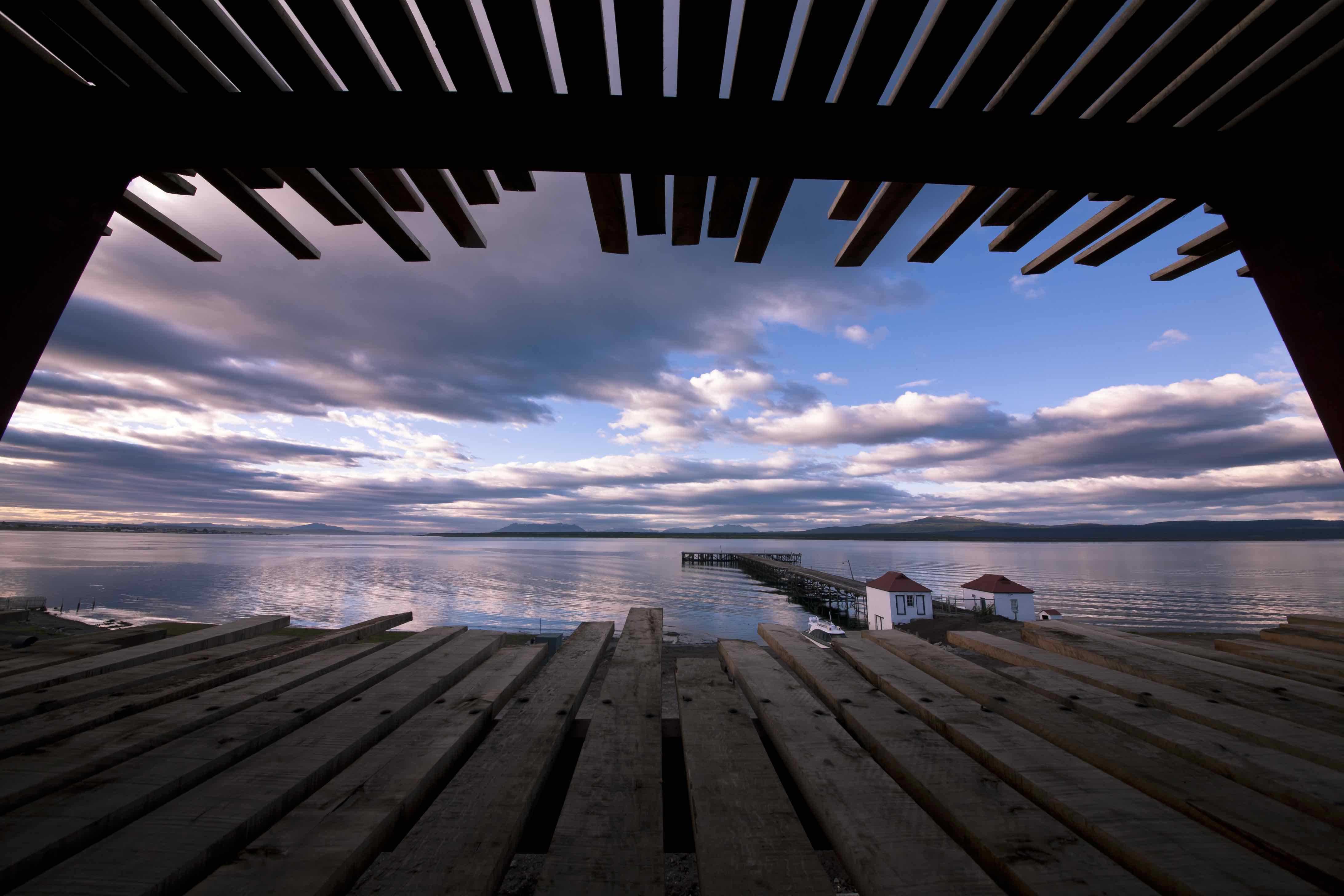 The five-star Singular Patagonia hotel is located outside Puerto Natales in Chile, on the shores of the Last Hope fjord, near Torres del Paine National Park. It is a three-hour flight from Santiago, followed by a 2.5-hour drive.
Although not a new-build, the property takes the form of a magnificent converted red-brick cold storage plant from 1915, surrounded by windswept grassland and snow-capped mountains.
Since opening in 2011, the interiors have become the ultimate in industrial chic with exposed beams, double-height ceilings, battered leather Chesterfields, concrete floors, free-hanging metal lamps and old factory machinery.
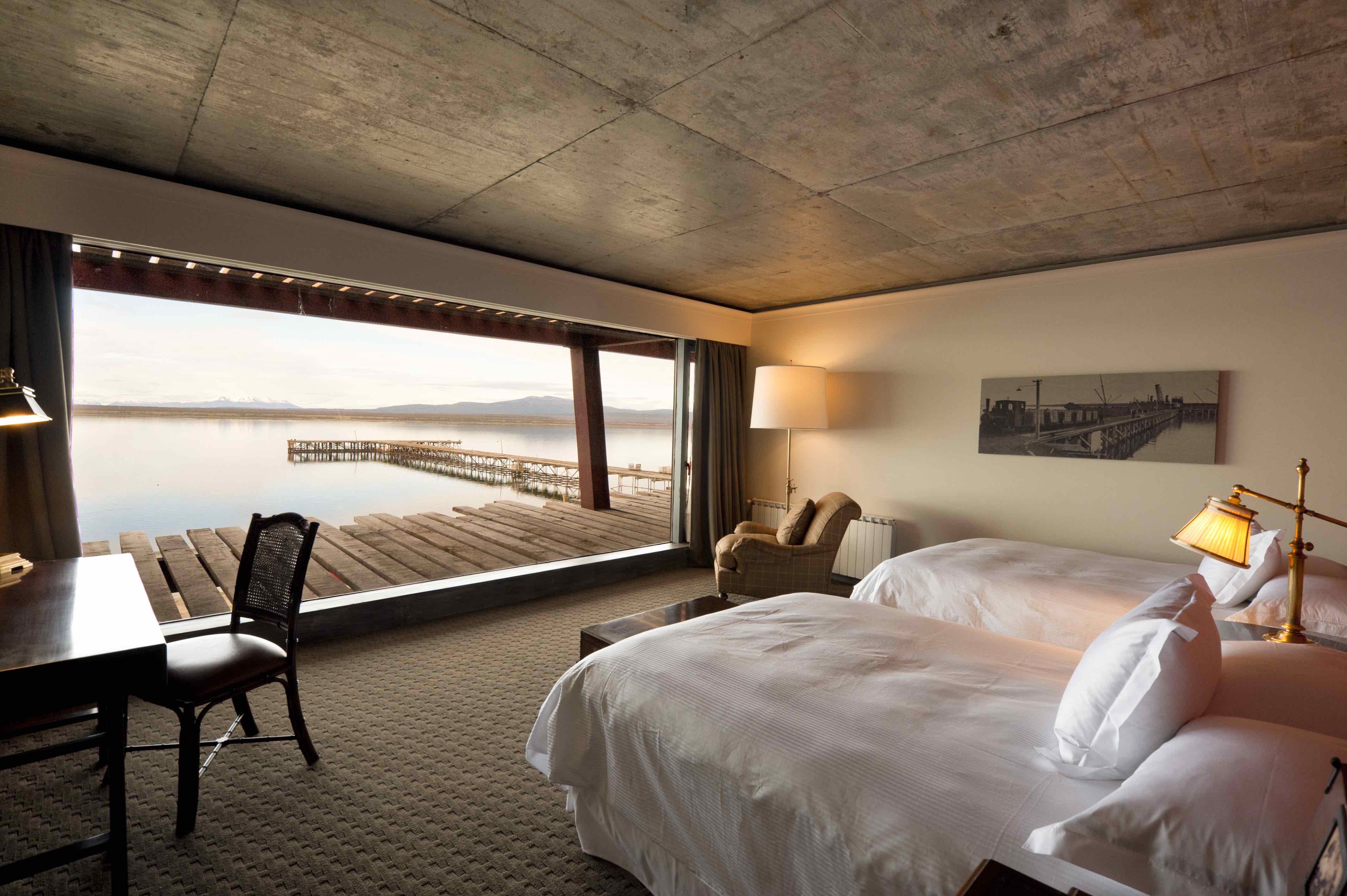 There are 54 rooms and three suites, from US$400 a night, each with six-metre wide picture windows, custom furniture, plush beds and free high-speed wifi.
The property offers unparalleled access to wilderness – guests can take boat trips through the fjords, go horse riding, kayaking, bird watching, trekking and fly fishing. Local Chilean wines and Patagonian barbecue are served in the former blacksmiths. There are also heated indoor and outdoor swimming pools.
Forbes says: "The Singular Patagonia occupies a onetime sheep-processing factory, looks like a barn at first approach, and requires guests to traverse intact machine rooms and tannery facilities on their way to their rooms or to dinner.
"The austere exterior can be deceiving: The Singular is one of the most indulgent hotels anywhere, all the more so for being under the moody clouds and brilliant slanted sunshine at the end of the world."
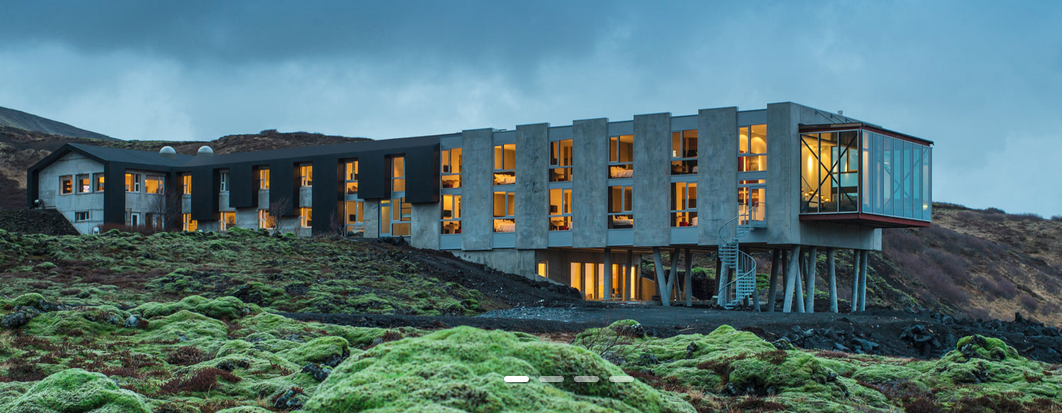 With easy access from the UK, the US, Canada and Northern Europe, Iceland has seen tourism surge from 300,000 in 2003 to almost 1.3 million international visitors in 2015.
Despite a reputation for being expensive, the rugged island of Iceland has become a stalwart on every traveller's hotlist. It's natural landscape provides the big lure – with other-worldly thermal springs, glaciers, black beaches, waterfalls, ice caves, lava fields, volcanoes and geysers.
When it comes to the "experiential" travel trend, seeing the Northern Lights has become one of the must-see phenomena for the traveller of today. And despite not being guaranteed, travellers are willing the take the gamble. A recent survey by totallymoney.com found that it was the number-one "bucket list" activity across the world.
Although just 40 minutes' drive from Reykjavik, the Ion feels extremely remote – it has stark, modern architecture, which is juxtaposed with a lunar landscape, extended periods of light and dark, extreme climate and magical atmospheric conditions. The property was unveiled in 2013.
Equally, the wealth of outdoor pursuits will appeal to the same kind of consumer. As travellers become more intrepid, the trend has shifted away from returning to places you love, to the discovery of new places. For every tourist who has "done" Iceland, the Norwegian Arctic Circle will be the logical next step.
The four-star Ion is a member of the Design Hotels collection, which was taken over by Starwood Hotels and Resorts, and which is now, of course, part of Marriott International. The hotel's tagline is "Where everything meets nothing."
Close to Thingvellir National Park, the property is on the Golden Circle route, which also takes in Gulfoss waterfall and the Great Geysir. Tapping into the trend for sustainable, responsible travel, the property is built on recycled and renewable materials and draws its heat and power from surrounding hot springs.
The hotel has 45 rooms. However, it should be noted that when you find hyper minimalist architecture in equally barren landscape, guests will be looking for warm, inviting interiors. The hygge factor is essential – so popular has this Danish concept become, it has was shortlisted by the Oxford English dictionary as "word of the year" in 2016. The word has its roots in the 16th-century Norwegian word hugga, which is related to the English word "hug".
A review in The Telegraph reads: "This oblong-shaped hotel, jutting out from the base of a long-dormant volcano, affords striking views of the other-worldly landscape. Inside the look is stylish, contemporary and minimalist, with exposed concrete walls and wooden furniture (think Scandinavian-chic).
“Wire-framed chairs draped with animal throws dot the lobby, which in turn is decorated in subdued colours and lit with hanging lamps. The interiors will no doubt delight lovers of design but those in search of cosy character will be disappointed." Rates are from £380 a night.
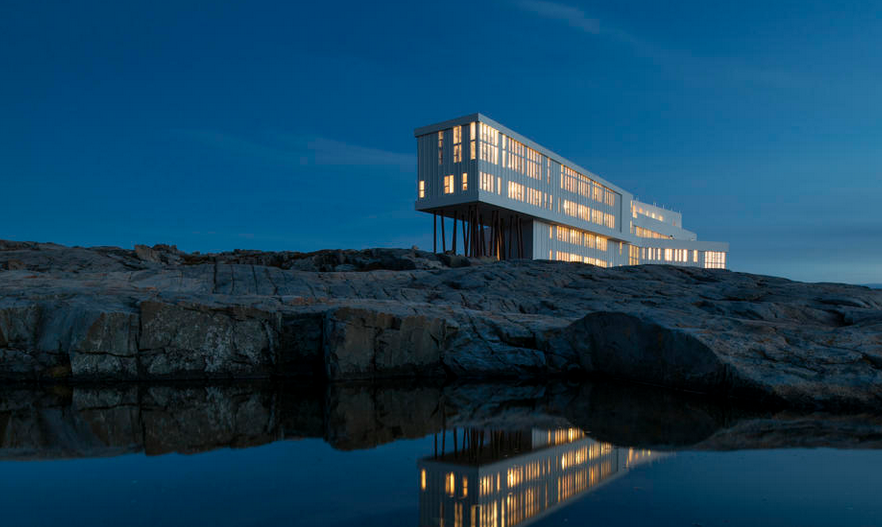 Designed by Norwegian practice Saunders Architecture and built in 2013, the Fogo Island Inn is distinctly reminiscent of the Ion in Iceland. "Find yourself at one of the four corners of the Earth", its website reads. The white, X-shaped structure is supported by stilts, lifting it just above the craggy rock and roiling surf beneath it. Located just off the north-east coast of Newfoundland, in Canada, the hotel describes its positioning as "remote yet accessible".
Newsweek writes: "The Fogo Island Inn is the largest, whitest rebuttal to man’s vanity seen in this part of the world since the iceberg that sank the Titanic."
Forbes Life writes: "If the place is gloriously dislocating at first, Fogo Island Inn immediately grounds you with its indigenous beauty. The restaurant deftly uses forage-to-table ingredients – a shoreline leaf that tastes like an oyster and the surprisingly good caribou moss – to demonstrate that the rock-ribbed landscape seen through the double- height dining room windows is not quite as barren as it seems.”
All around is the wild North Atlantic ocean. Fogo Island is just 35km from east to west, and has a population of just over 2,000 people. "Although located just over halfway between the equator and the North Pole, the Labrador Current passing by Fogo Island's doorstep brings with it the makings for a subarctic landscape and a temperate maritime climate.
"The Island's boreal forest plays host to herds of caribou, beavers, foxes, mosses, grasses, and wildflowers. Migrating whales and icebergs visit in the spring, and fall’s berry season finds Fogo Island carpeted in at least two dozen varieties of edible berries," says the Fogo Island Inn.
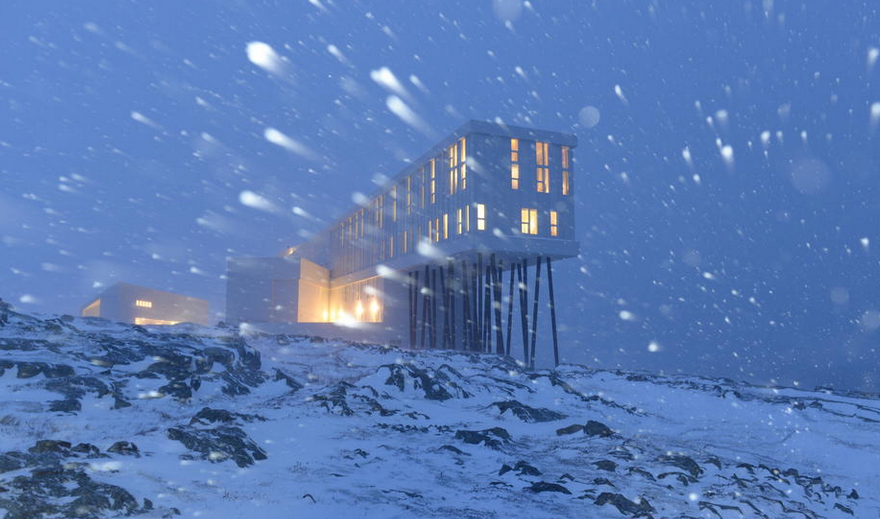 The closest international airport to Fogo Island Inn is Gander, Newfoundland. Travellers can fly from Halifax and St John's with Air Canada or United, with connections from Toronto, New York, Boston and London Heathrow. A passenger and vehicle ferry serves Fogo Island several times a day. The crossing takes about 45 minutes.
After the collapse of the fishing industry (something the Norwegians can relate to), millionaire Zita Cobb returned to her home of Fogo Island in the noughties determined to create a reason for people to visit it. She said: "We saw an opportunity to use architecture as a way to preserve some of the things we were afraid of losing in terms of traditional knowledge. To not just hold on to the knowledge, but actually extend it another 100 years."
First she employed Canadian architect Todd Saunders to build a series of cutting-edge artists' studios; then she set to work on the Fogo Island Inn, which showcases their work and pulls in tourists.
Cobb said: "We invited designers to come in for a residency and paired them up with local craftspeople, whether they be textile people or boat-building people, and asked them to come up with the objects that were needed. We don't need to sell millions of anything, but selling 100 quilts makes a difference to Fogo Island's economy."
The design of the hotel is "radically contemporary". It has 29 suites decked out in exclusively natural materials (wool, cotton, linen, wood); there is no plastic except for the phones. There is also first-floor art gallery and a library of both fiction and non-fiction books (tapping into the "IQ economy" trend), a 37-seat cinema, wood-fired sauna, al fresco hot tubs and a dining room from which you can gaze at icebergs at breakfast. Rates are from US$1,170 a night.
 Featuring seven tree houses each designed by a different Scandinavian architect, the famous Tree Hotel is an excellent example of the tantalising combination of imaginative modern building with pristine landscapes. It also scores points for being in ever-popular Sweden.
It might not be easy to get to – Harads is 50km south of the Swedish Arctic Circle (a 90-minute flight from Stockholm) – but it's on many people's bucket lists of places to stay. (You only have to look at the trend for "cabin porn" to see how much British people fantasise about the idea of an isolated hideaway.) There is even a spin-off hardback coffee table book on it. The most popular social media tags associated with this trend are "Norway", "Rustic", "Snow" and "Modern".
The Tree Hotel is entirely unique and highly Instgrammable, but also the kind of place that appeals to people's desire to switch off from the outside world and the technological trappings that come with it. The peace of a snowy pine forest is a gift for burnt-out city dwellers. The Tree hotel proves that if you build something amazing, and they will come.
Created by wife-husband Britta and Kent Lindvall in 2010, the Tree hotel is built into the canopy of the forest, with futuristic tree houses connected by gangways.
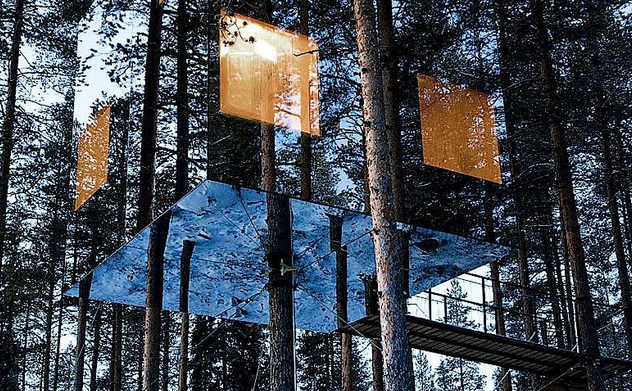
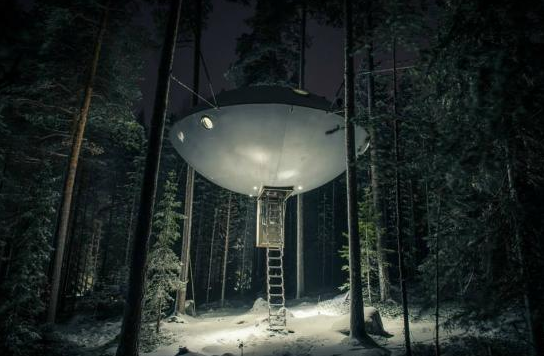 One residence, the MirrorCube, which was designed by Tham & Videgard, takes the form of a seemingly floating mirrored box but inside has a double bed, bathroom and living, as well as a roof terrace on top. Designed by Inrednings Gruppen and Bertil Harström, there is also the UFO and the Bird's Nest, and the Blue Cone by Sandell Sandberg.
Sustainability and a sensitivity to nature are integral to its philosophy. A stay at the Tree hotel is about simplicity, harmony and rediscovering your sense of self. Meals are served in a nearby hostel so in winter guests have to trudge through the snow to get fed (unless they order room service) – but that's the joy of it.
Luxury isn't always about making people feel so pampered they become lazy, sloth-like, jaded and entitled; today's travellers also like to feel they've worked for something, had an authentic experience they can talk about with friends.
The most recent addition to the woodland complex will be delivered by Snøhetta early this year (2017). With exteriors clad in charred timber, it will be the largest cabin at 55 sqm, and will even have a net for stargazing and observing the Northern Lights. As remote hotels go, this is one of our favourites. Rates from £450 a night.
[dropcap size=big]F[/dropcap]rench hotel group Accorhotels announced in April that it has bought luxury peer-to-peer home rental platform Onefinestay for €148 million.
Essentially Airbnb for the rich, Onefinestay launched in 2010 and today let's people in five cities – London, Rome, Paris, New York and LA – rent their homes for as little as a one-night stay. (All the pictures shown in this article are available to book via Onefinestay.) Apartments, of which there are about 2,600 currently listed, are put up for short-term rental by their owners, and (unlike Airbnb) hotel-style amenities, cleaning and concierge services are offered by the Onefinestay support team.
 Accorhotels, which is Europe's largest hotelier by room numbers (brands include Pullman, Sofitel and Mercure), plans to invest a further €64 million in expanding Onefinestay's reach around the world to 40 cities.
 Sébastien Bazin, chairman and CEO of Accorhotels said: “Onefinestay has successfully captured a sweet spot: a combination of needs that neither traditional hotels nor new actors of the sharing economy can meet.
 "With the acquisition of this exceptional brand, unique operating model and outstanding management team, Accorhotels is developing as the worldwide leader of the 'serviced homes' market.
"Today, together with our recent investments, we are accelerating the transformation of our business model to capture the value creation linked to the rise of private rentals and also strengthening our presence in the luxury market with a complementary offer”. The "sharing economy" as it is known, was born a few years ago when listing spare rooms or flats for rental on Airbnb started to become a popular source of secondary income for people. Launched in 2008, Airbnb now has over 1.5 million listings in 34,000 cities.
 Over the years, apps and websites have been developed to enable people to hire out anything from someone's garage (via justpark.com) to their own labour (taskrabbit.com). People even began turning their own kitchens into restaurants, selling dinners in their own houses to paying strangers (eatwith.com).
 Back in 2013 I wrote a piece for Business Traveller magazine in which I described how it was going to change not only the way we travelled, but the industry as a whole.
"The principles at its heart are efficiency, democracy and trust – the last cemented by online reviews. Not only is it creating a new generation of micro entrepreneurs, but providing consumers with cheaper, more personalised services, products and experiences." Not only has Accorhotels purchased Onefinestay, but bought a 30 per cent stake in competing high-end Argentinian rental company Oasis Collections, which has about 1,500 listings in 18 cities including Miami and Barcelona. The plan is to increase this to 70 cities by 2019.
The sharing economy has officially gone mainstream.
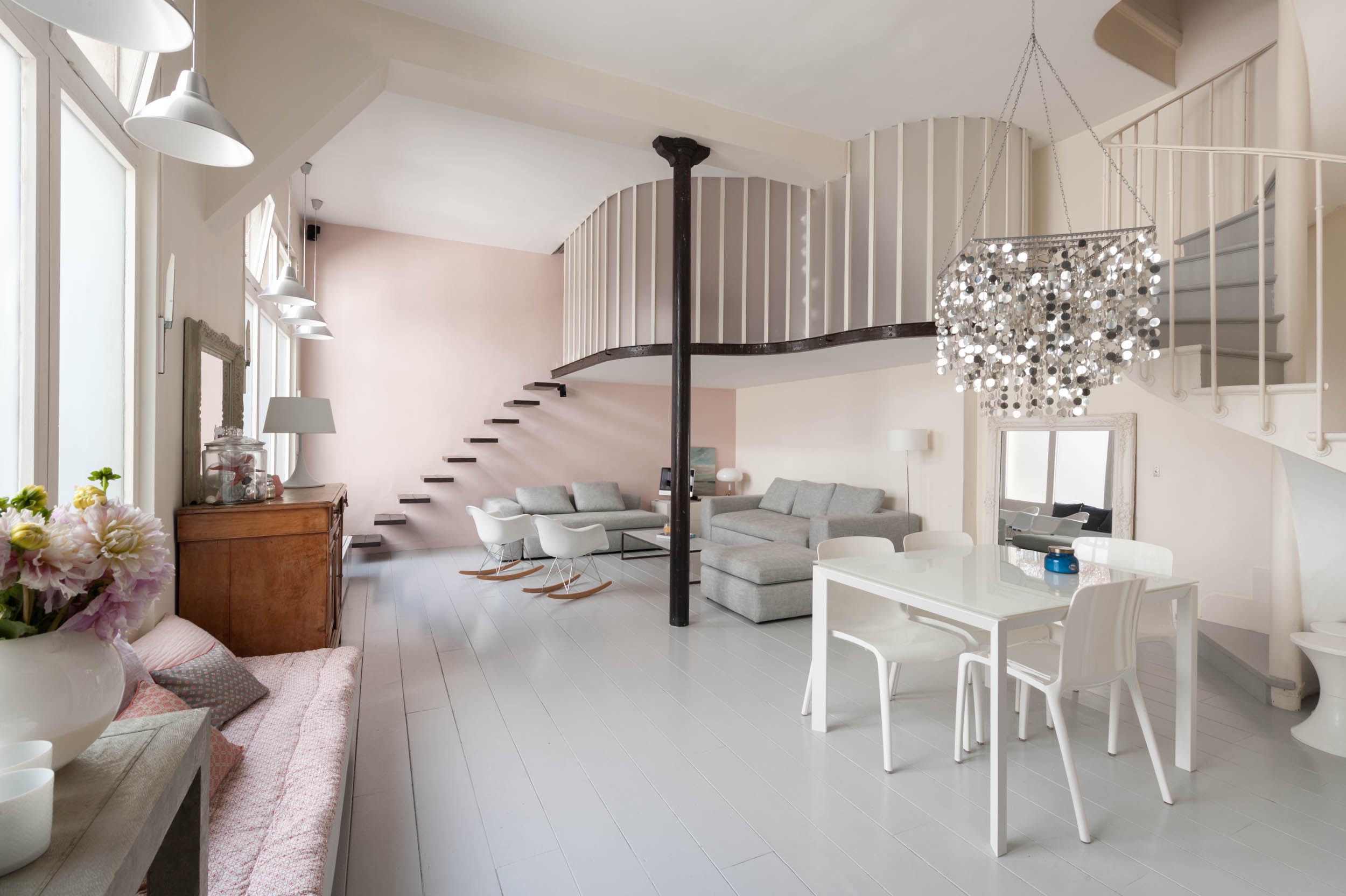
[dropcap size=big]F[/dropcap]rom Langham's Ginger Flower to W's Lemon Spritzer, hotels are working hard to invest in "subliminal environments", using signature scents to help lock in memories of people's stays.
Tapping into the trend for "scent branding", owner and creator of Calming Park, Switzerland's Olivier Rohrbach, has developed a line of organic bathing amenities for hotels – shower gel, shampoo, conditioner, body lotion and soap.
Known for his luxury scented candles, he has incorporated the the same woody fragrance and ingredients (water flowers, aloe vera and sage) as in his iconic Cactus candle, which arrived in 2006.
Since then he has produced candles such as Fig-Bamboo, Sequoia, Cashmere and Spa de Provence. The design of the new line of hotel amenities is based on the Black Edition candles Rohrbach launched last winter.
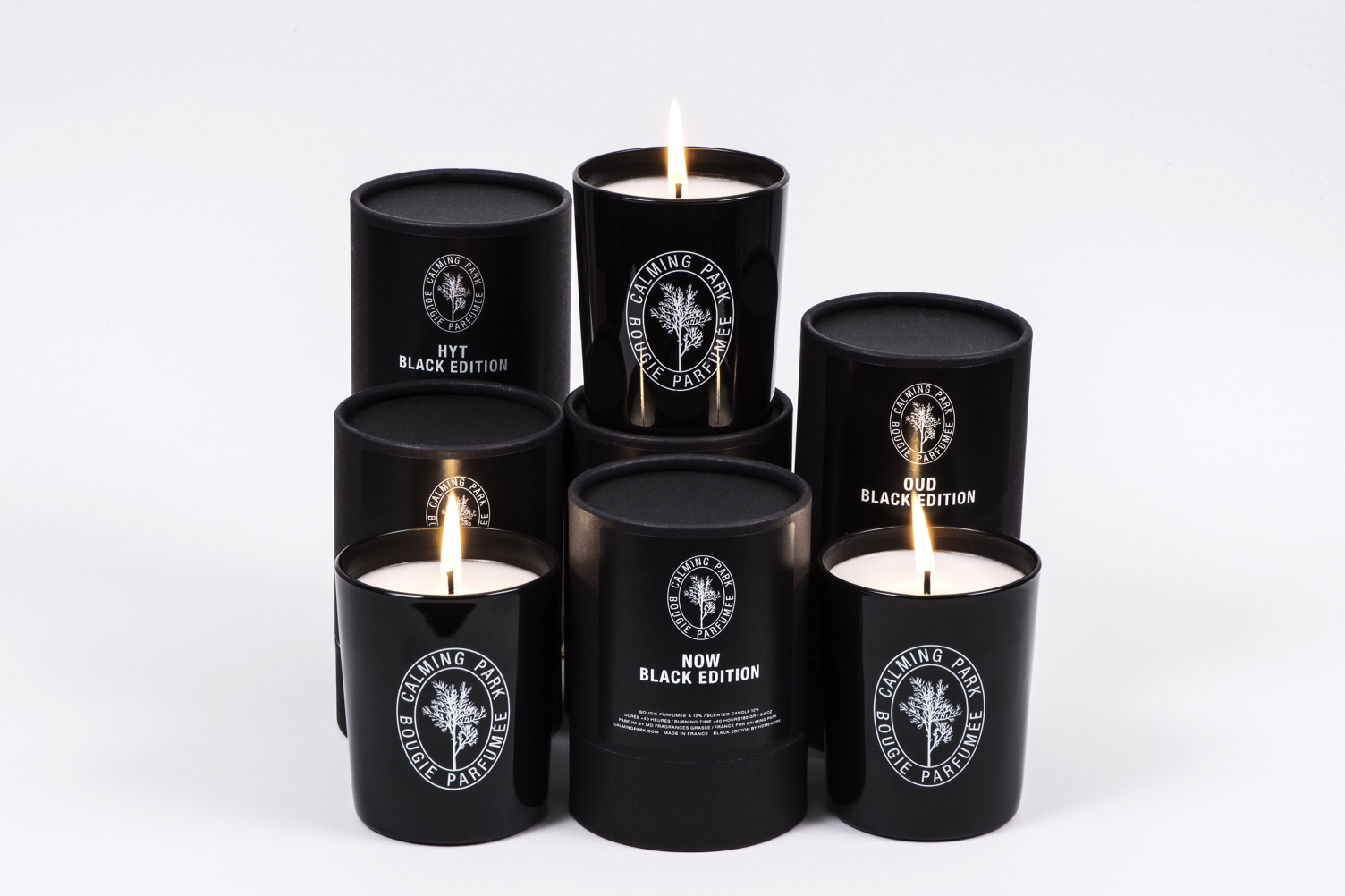 The body-care line will be distributed by Spanish cosmetics partner Lande across four- and five-star hotels in Europe, the US, Canada, Latin America and the Middle East from next year, with the unveiling at the Hotel Experience trade show in New York from November 8 to 10, 2015.
Rohrbach is also planning a "weekend travel kit" based on these skincare products so travellers can take them away with them. These will be available to buy next spring.
Rohrbach debuted Calming Park in 2000 with an audio compilation series in association with Universal Music, but it was his adventures as a jet-setting travel journalist that motivated him to delve into the world of signature scents.
He says: "The hotel line is the result of my way of life, which involves a lot of stays at high-end hotels around the globe. Many stock the same brands so I thought it could be wonderful to create something new."
He adds: "With Lande, I have found a partner with a strong vision, who has had experience in this business since 1985."
Meanwhile, Sophie Beresiner, beauty director of Elle magazine, is bringing the world No. 22, a candle for the home. There will be three scents – Bookshelf, Woodstove and Centrepiece. They will be available for £38 exclusively at Liberty.
[dropcap size=big]E[/dropcap]ncased in Italian Carrara marble and hand-crafted in Germany, these state-of-the-art "electrostatic" headphones are said to be the best in the world. They are also likely to be the most expensive.
More than 6,000 components including gold-vaporised ceramic electrodes and silver-plated copper cables were combined by craftspeople to create this luxurious listening device.
According to arstechnica.co.uk, they "combine an electrostatic set of cans with a valve pre-amp clad in solid marble, resulting in a claimed 8Hz to 100KHz frequency response – far beyond what human ears are capable of hearing."
A press release says pushing the on/off-volume control brings the headphones to life. "The control elements, each of which are crafted from a single piece of brass and then plated with chrome, slowly extend from the marble housing, before the vacuum tubes enclosed in quartz glass bulbs rise from the base and start to glow.
"Finally, a glass cover is raised, allowing the headphones – with ear cups finished in leather – to be removed." 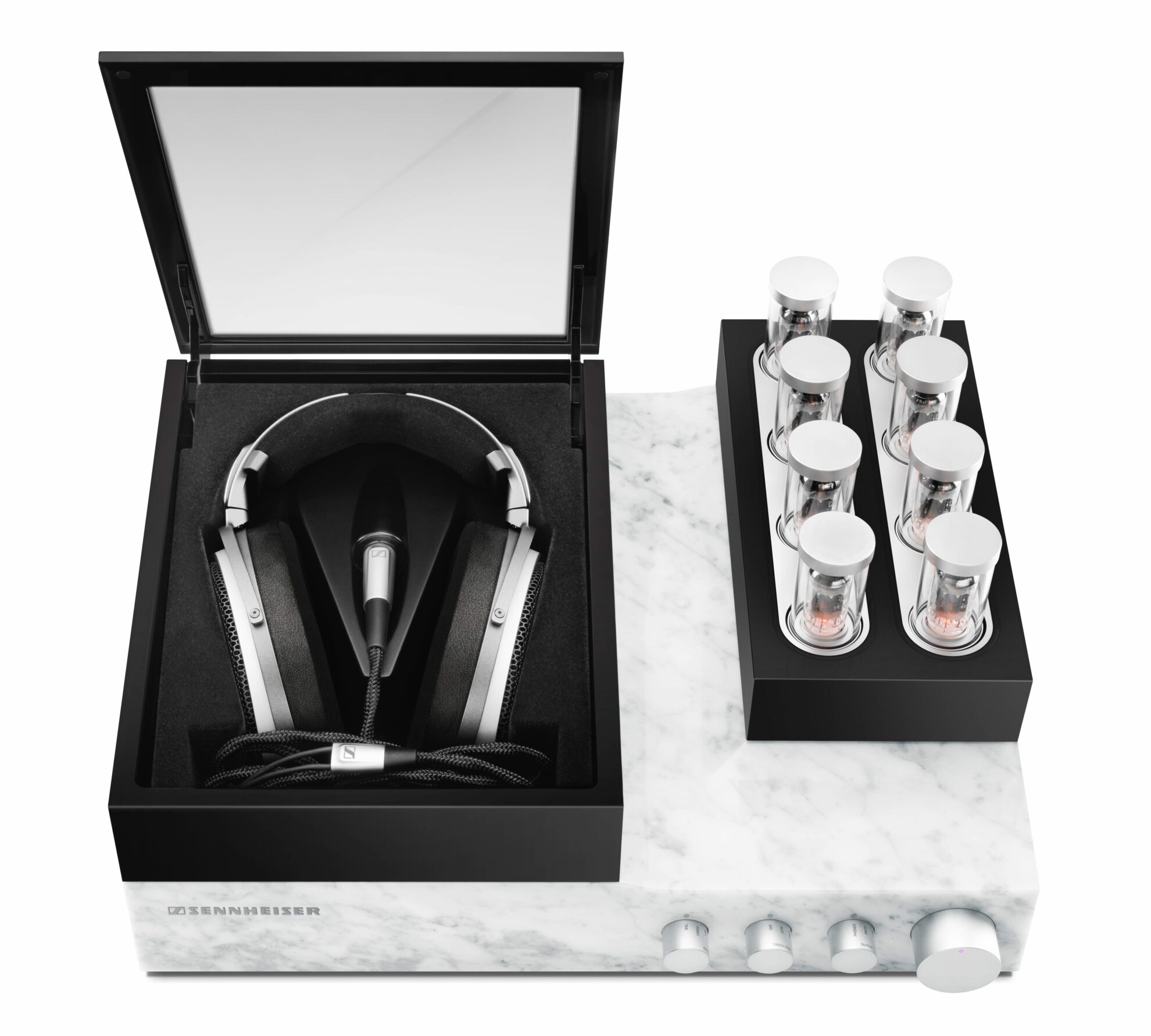 Going into production next year, the Orpheus HE90 headphones emit sound that "makes you feel like you are in a concert hall". They are the second model in the series, which saw the original pair released in 1990.
Arstechnica.co.uk says: "Electrostatic headphones work by placing a static electric charge on an extremely thin film that floats between two metal plates. The voltage of an audio signal passing through the plates causes the lightweight film to oscillate and produce sound.
"Because the film is so light, and there's no physical contact required to get it to move, it doesn’t have its own resonances or damping issues, and thus produces extremely clear sound."
Sennheiser CEO, Daniel Sennheiser, said: “With the new Orpheus, we once again push the boundaries and show that we can repeatedly set new benchmarks in excellence and with that shape the future of the audio world."
Grammy award-winning jazz musician Gregory Porter was one of the first to try them out. He said: “When I record my own music, I always try to convey my emotions. I don’t know how exactly, but these headphones really do succeed in getting those emotions across."
 Learn more about Orpheus here.
[dropcap size=big]T[/dropcap]he Aloft hotel in Manhattan has launched "Text it, Get it", a service for guests who are too lazy or hungover to call reception to order room service.
"TiGi", as it's known, allows people to use their smartphone to text special sequences of emojis (plus your room number) from a menu of six packages. After a confirmation message, a member of staff will deliver your order.
For "the Hangover" package, just text the water droplet, pill and banana emoji to receive two bottles of Vitamin Water, some Advil and two bananas (US$10).
 Text the bath emoji, followed by head massage and shower, and you will get "the Re:Fresh", an amenity pack containing a toothbrush, toothpaste, razor, shaving cream and deodorant (also US$10).
You can also get "the Munchies" (Coca-Cola, Doritos, Snickers, brownie) by texting chocolate bar, lollipop, cookie, or "Phone Charger" for US$25 by using the handset plus adaptor emojis, and stating "iPhone" or "Android".
Unfortunately, you can't come up with your own requests but if you could, this is what Globetrender would order.  If you are heading out for the evening, you can order "the Sightseer" (simply click the Statue of Liberty icon) and for US$30 you will get a US$10 MetroCard, a city map and two drinks at the hotel's W XYZ bar.
If you are bored, you can text the present emoji and, for US$25, will be sent a swag bag full of surprises.
Brian McGuinness, senior vice-president of Starwood's specialty select brands (of which Aloft is one), said: "At Aloft, we're always looking for ways to shake up the hotel stay.
"We look to consumer behaviour and think about how to integrate these trends into the Aloft experience. The rise of emoji was a logical next step, the perfect new wave of guest communications.”
Last summer, the forward-looking brand became the first in the world to employ a robotic butler called Botlr, so it may not be long until your room service is delivered by machine as well.
While New York's Aloft Manhattan Downtown – Financial District was the first to introduce emoji room service in October, it will be rolled out across other properties in Europe and Asia in the coming months. There are currently 100 Aloft hotels in 16 countries.
[dropcap size=big]F[/dropcap]ollowing the lead of Soho House, which puts on regular events, talks and workshops for the members of its private clubs, high-end London hotels are recognising the demand for enrichment programmes.
London's Shangri-La at the Shard hosts monthly cultural salons under the theme of "East meets West", with speakers including fashion designer Paul Smith, and ceramicist and author Edmund de Waal.
Tickets costs £20, with the next lecture scheduled for November 11. "From Exile to the Heart of the Khmer Cultural Heritage, the Sacred Dancers of Angkor Wat" will be presented by Lady Ravynn Coxen.
Meanwhile, the Rosewood is partnering with food and design magazine Toast to put on Slow Motion, "a series of intimate, supperclub-style brunches and workshops that celebrate slow living".
A menu of sharing plates and cocktails will incorporate Slow Food ingredients from the hotel's Sunday market in the courtyard outside, while workshops will be hosted by craftspeople, writers and industry experts.
"Each workshop will focus on a different craft, exploring mindfulness and Slow Living by returning to traditional techniques, while each host will teach guests how to make an item to take home – think spoon whittling and monogrammed leather tray making."
With tickets from £40, the Slow Motion autumn/winter schedule includes brunch with food writer, stylist, presenter and recipe book author Rosie Birkett; supperclub hosts Laura Jackson and Alice Levine; and Claire Ptak, food stylist, writer and owner of the Violet Bakery in East London.
Over in Shoreditch, the trendy Ace hotel has a calendar of inspiring events – upcoming sessions include "TED X Hackney: the Future of Food", "Dazed X Future Artefacts" on the future of media, and a "flint knapping" workshop by Will Lord where you will learn how to make neanderthal-style arrowheads.
The nearby Hoxton hotel also curates weekly ticketed talks such as "Retail Robots" on the future of shopping, "Botanic Boutique" on how to make your own miniature plant eco-system, and "Jamie Oliver's Food Tech Group", on how to turn your offline business into a multi-million pound online venture.
In Mayfair, Rocco Forte's Brown's hotel organises monthly masterclasses such as a £185 session with chef Mark Hix on how to carve meat, as well as weekly art tours of local galleries for £60 including lunch.
[dropcap size=big]D[/dropcap]esigned for wealthy “aviation geeks”, the itinerary begins with boarding a Gulfstream G650 private jet from London to the Caribbean island of Saint Martin, where you will experience its famous low approach over Maho beach.
Here you will have an exclusive private tour of St Martin’s Princess Juliana International airport (SXM), by the airport’s managing director, Regina la Bega.
There will then be a private charter flight to St Barts, where the aircraft will descend just feet above a steep slope to the runway.
Once on the tarmac, you will meet the president of St Barts, Bruno Magras, and have lunch with the managing director of St Barts airport, Fabrice Danet.
Next up there will be a landing on the shortest commercial runway in the world, on the tiny island of Saba. Once safely on the ground, you will have a meal with the pilots.
The package includes seven night’s accommodation in five-start hotels, meals with airport staff and crew, fine-dining in the evening and chauffeur-driven cars between all venues.
Maho bay in St Martin, West Indies
Adam Twidell, CEO of PrivateFly, said: “Aviation tourism is a growing trend amongst luxury travellers who seek out the world’s most extraordinary flying experiences.
“For an ‘Av Geek’ the joy is as much in the getting there, as it is in the destination. And the Caribbean offers an unbeatable collection of simply breathtaking landings.”
The trip costs from £190,000 for a group of four, or £48,000 per person. PrivateFly can also arrange the itinerary without the long-range G650 flight, at a cost of £12,000 per person.
Bespoke activities include flying lessons on St Barts and Saba, sightseeing tours, and flights the beaches of Anguilla.
Videos of the landings are available via PrivateFly’s You Tube channel .
[dropcap size=big]B[/dropcap]ased on a study of more than 2.25 million public reviews on TripAdvisor, creative agency Luxury Branding has revealed the world's most-loved luxury hotel brands.
The report says: "Commentators and customers are challenging the value of hotel star ratings and travellers are questioning which sources of information they should trust in the face of the numerous alternative lists that purport to evaluate luxury hotels.
"Travellers are developing a more sophisticated set of references and an opinionated view of the world upon which a truer assessment of the hospitality industry is emerging and shaking up conventional perceptions.
"This quest for authenticity and the rise of peer-to-peer influence also explains the phenomenal success of Airbnb, which relies solely on visitor reviews and ratings."
Derived entirely from customer opinion with the help of some intelligent algorithms, Luxury Branding "has been able to reveal a fresh and unexpected ranking of the world’s most popular high-end hotel and resort brands".
Founder Piers Schmidt says: “A more reliable assessment of luxury hospitality is emerging. These findings may rattle some in the industry but it’s the guests that have spoken and now they’re going to be heard.”
The report states: "The sample of luxury hotel brands in this study has an average portfolio size of 29 hotels, from which it is possible to estimate that there are more than 2,800 hotels and resorts operated by luxury hotel brands in the world today."
TripAdvisor, meanwhile, has 375 million monthly visitors, and 250 million ratings and reviews of 5.2 million establishments around the world.
Out of 59 luxury hotel brands, here are the top ten:
[dropcap size=big]U[/dropcap]ltraVilla is a new "little black book" of five-star holiday homes, listing just the top five per cent of independent villa specialists from around the globe.
Not a booking engine in itself, UltraVilla – which launched in July – is a portfolio of more than 30 independent rental companies, whom customers can contact to arrange stays.
UltraVilla added three new members in September: the Small Maldives Island Company, which has a collection of four to eight-bedroom residences on the island of Baa Atoll; Ultimate Luxury Chalets, which features 100 top-end ski chalets in the Alps; and Luna2, an exclusive-use private hotel in Bali with five bedrooms and support from a team of chefs, waiters, barmen and drivers.
UltraVilla is tapping into an emerging trend dubbed "selfish catering", which is seeing a rise in demand for luxury holiday home rentals, often with added hotel-style perks, facilities, technology and services.
According to a poll published in January of 3,000 people in the UK, booking site uguest.com found that 60 per cent of respondents would be more likely to book an independent property than they were five years ago.
They would also spend up to 120 hours searching online for the perfect place to stay.
Co-founder of UltraVilla, Ileana von Hirsch, said: “We created UltraVilla because we could see there was a genuine need for a website that brought together the very best of the world’s villa and lodge specialists.
"This is not a website with a million listings, but a refined directory that offers remarkable properties from companies we trust and who we can confidently declare are ‘the best’ at what they do.
“It used to be that there was a lack of content for consumers looking for special properties; now we are finding that people simply don’t have the time to search and sift or visit multiple sites for inspiration.
"By creating UltraVilla, we are not only giving very special operators another way to reach people but providing consumers with an easy ‘one-stop’ solution for finding a truly special holiday rental.”
[dropcap size=big]F[/dropcap]or most people, flying first class is a dream but for those who can afford it, some airlines are taking the experience to a whole new level.
Nowadays, business class (which tends to cost about £3,000 return) tends to feature seats that convert into fully flat beds, as well as gourmet menus, fine wines and even onboard bars, so first class has to work harder to differentiate itself.
In May, Singapore Airlines (SIA) announced a new generation of first class suites to be installed on its new A380 superjumbo from 2017, although details of the design have yet to be revealed.
SIA, however, set the trend for ultra-luxurious in-flight experiences, with the launch of its first class Suites on existing A380s, with separate cabins behind sliding doors that house an independent bed (a double can also be created) and an armchair. So whatever comes next will have to trump this.
China Eastern also offers a double bed on its B777-300ER, while Lufthansa's B747 has a fixed single bed positioned next to a seat, which is innovative.
British Airways unveiled its state-of-the-art first class "pods" this year on board its new B787 Dreamliners, but with seats that slide down to create a bed and not as much privacy. There is no doubt it looks pretty slick, though.

BA first class B787-9
Last year, Abu Dhabi-based carrier Etihad took it to the extreme with the unveiling of the world's most extravagant first class concept. Called the Residence, it's an entire suite in the nose of the double-decker A380.
It has its own set of doors opening into a living room with two couches, a 32-inch TV screen and a minibar. You also get your own chef and personal butler trained by the Savoy hotel.
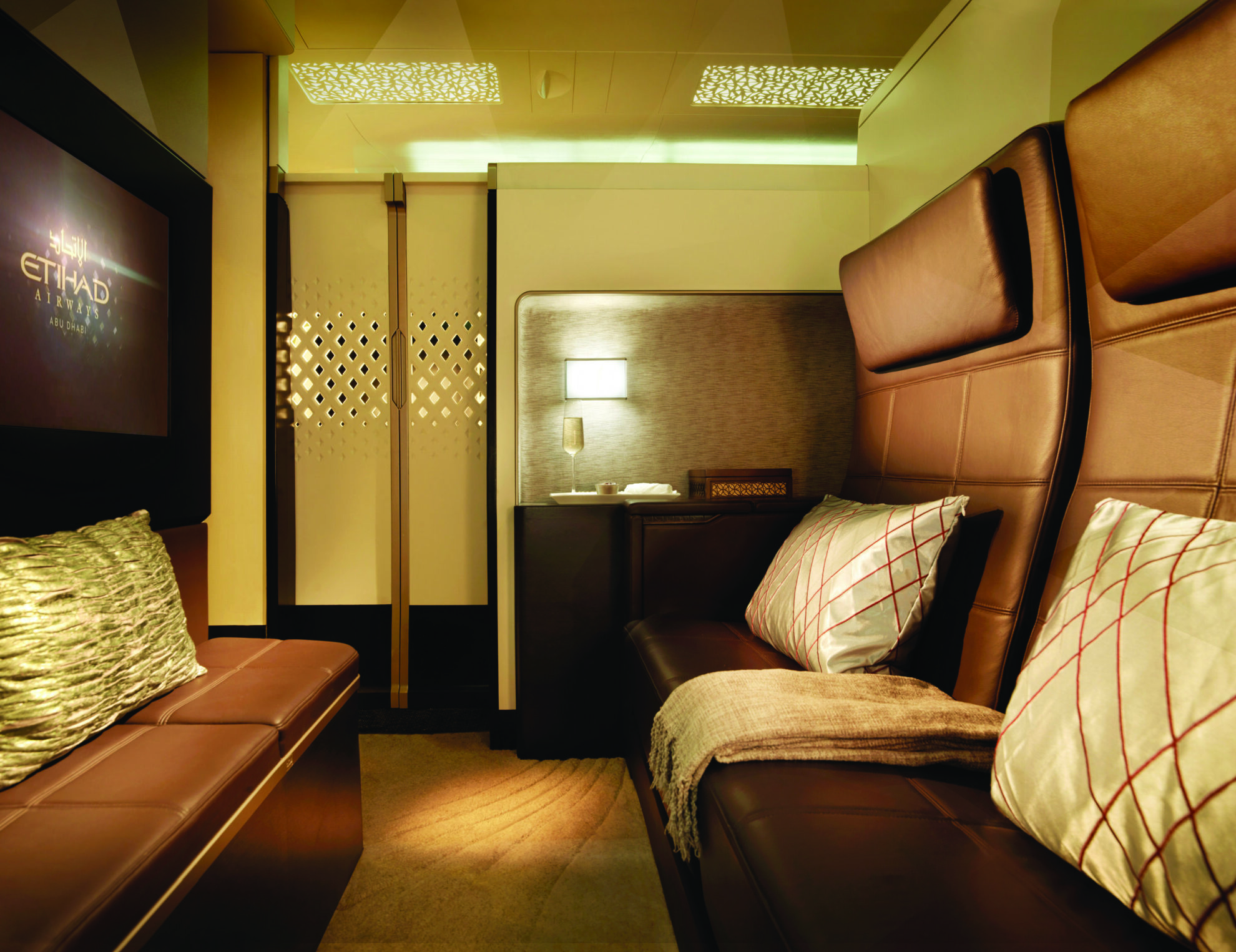
Living room in Etihad's the Residence
A narrow corridor connects to a bathroom with a sink, shower, bathing products, fluffy robes and towels.
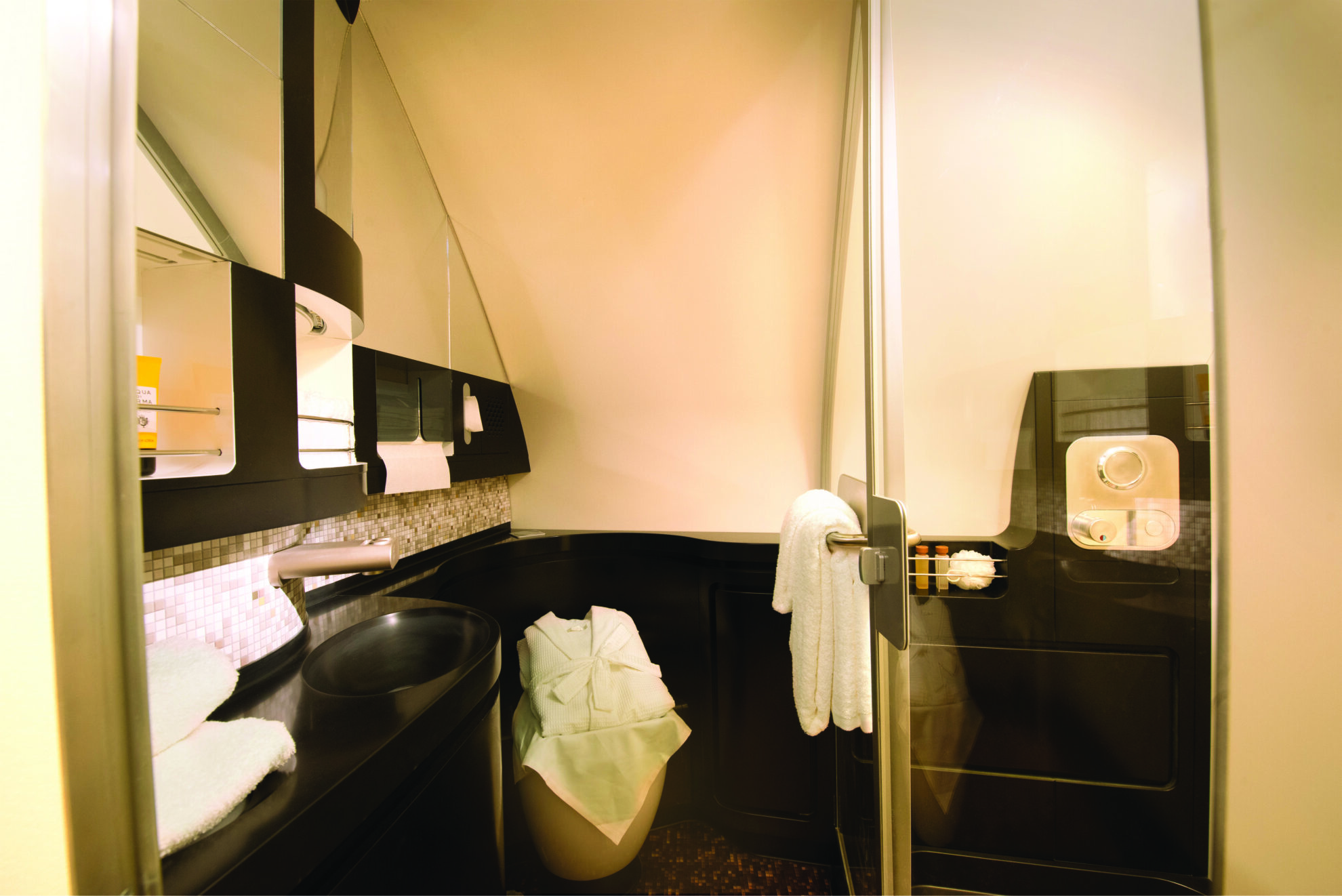
Bathroom in Etihad's the Residence
At the end is a bedroom with a double bed made up with sheets and pillows, just like in a hotel, except you can look out of the window on to clouds.
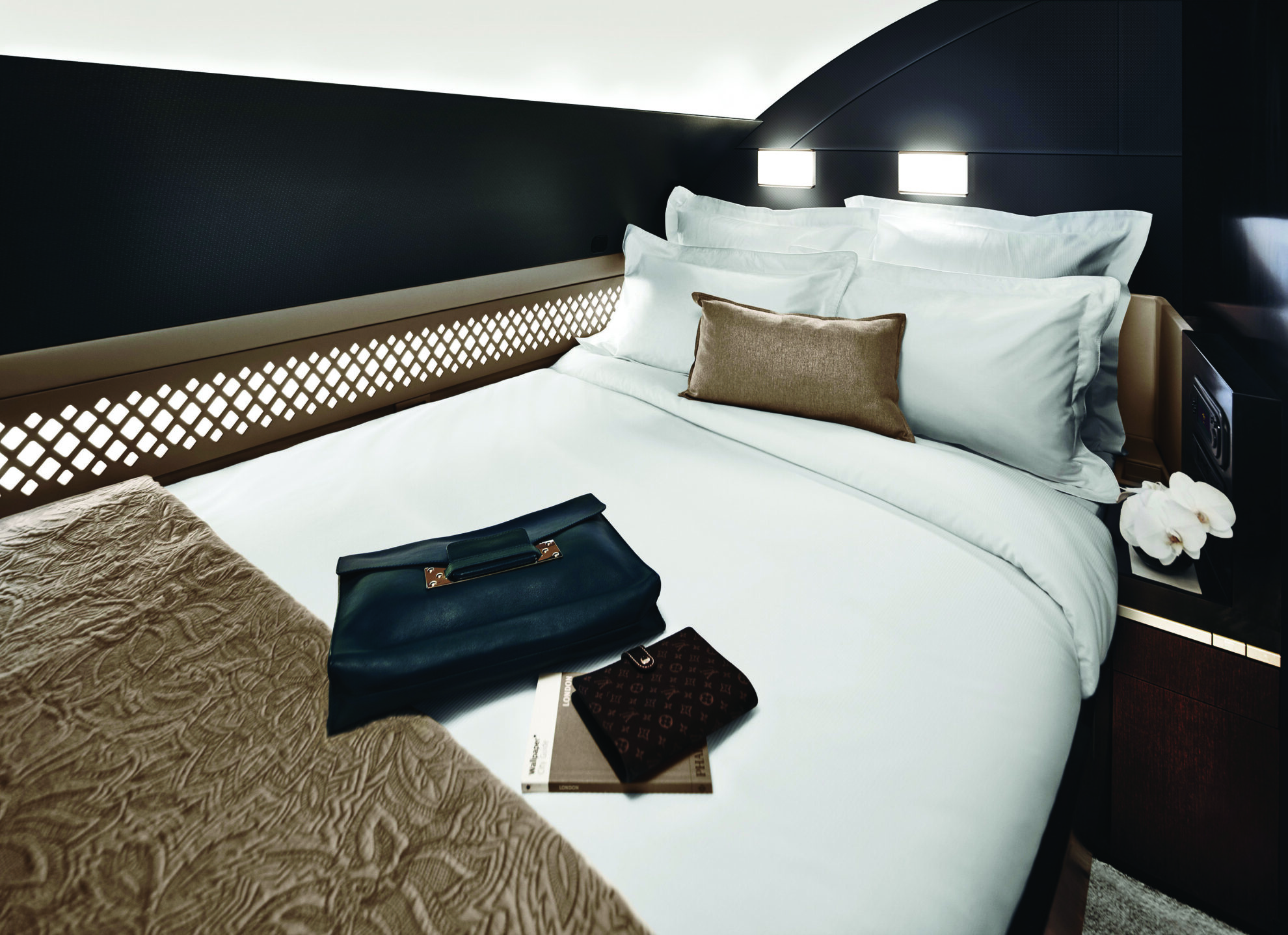 The Residence accommodates two people and costs about £12,500 for a one-way flight.
Etihad also has a (slightly) less outlandish new first class Apartment as well, of which there are nine on the A380 superjumbo. These private 3.6 sqm units come with an armchair and an ottoman bench that folds into an 80-inch-long fully flat bed.
They also offer a 24-inch entertainment screen, minibar, vanity cabinet, wardrobe and access to a hot shower in the communal first class bathroom. A return flight in an Apartment costs about £3,885 return.
Not to be outdone, Dubai-based Emirates, recently announced that it too would be introducing an improved "fully enclosed" concept for first class "similar to a railway cabin" – no mean feat when it already provides flyers with seats behind doors and a shower at 35,000 feet on its A380s.
[dropcap size=big]T[/dropcap]he five-star Healthouse Las Dunas resort in Spain has created a quit smoking retreat for people looking to improve their lifestyle.
The seven-day Anti-Tobacco programme will see guests undergo a blood pressure check, tests for lung functionality, tobacco levels, nicotine and carbon monoxide levels, and electrical activity in the heart.
This information is then used to help tailor the course to each person's needs and to motivate them in giving up smoking.
Aside from medical analysis, each guest will experience treatments to help relax and feel healthier.
These include oxygen therapy to increase the O2 levels in the body's tissues, acupuncture to reduce cravings and alleviate withdrawal symptoms, massage and yoga. They will also have four sessions with a psychiatrist.
Following a one-on-one consultation with a nutritionist, a menu will be created by head chef Tim van Buchem and Michelin-starred consultant Andoni Luis Aduriz, using ingredients believed to help suppress nicotine cravings.
Vitamin-rich, detoxing alkaline foods will help support the immune system – dishes range from lemon chicken with yellow beetroot and almonds, to scallops with cauliflower purée and daikon cress.
Between meals guests will consume herbal teas and natural supplement drinks to "flush out unwanted toxins".
Guests also have access to the Healthhouse's extensive spa facilities, which include Turkish baths, snow cabins, salt rooms, hydrotherapy pools, swimming pools and a gym. The hotel has 55 suites.
With help from UK pharmacies, a personalised after-care programme is also in place to help guests avoid slipping back into old habits when they get home.
The seven-day Anti-Tobacco retreat costs £2,880 per person.
[dropcap size=big]D[/dropcap]esigned by German artist and cosmonaut-in-training Michael Najjar, the cutting-edge Space Suite will be open for stays from October 1.
The concept aims to “immerse guests or ‘crew members’ in the atmosphere of a Space Station”.
Situated on the fifth floor of the hotel, the luxurious black and white room will feature a “zero gravity bed” that is made to look as if it is floating, and a steam bath with views of Earth and Space.
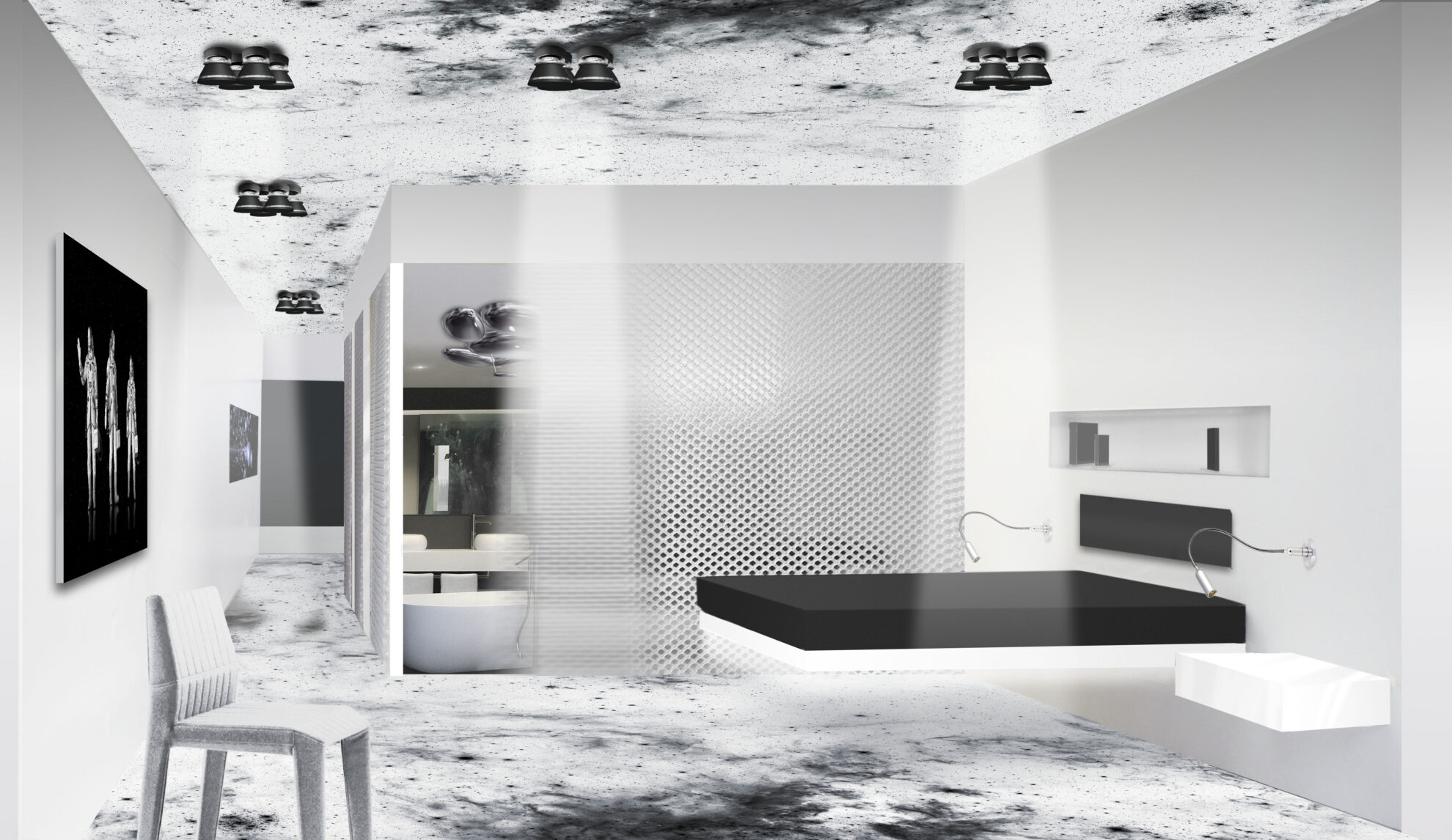 An automated female voice in eight variations will welcome you on arrival (inspired by John Carpenter’s Dark Star film), while spotlights are inspired by rocket engines and “space gloves” are there to place key cards or phones on.
There will also be a Space themed library, use of an iPod for music and Apple TV loaded with information about the Universe.
The 115 sqm suite is made up of a separate living and sleeping areas, a bathroom with a rainshower and a kitchenette.
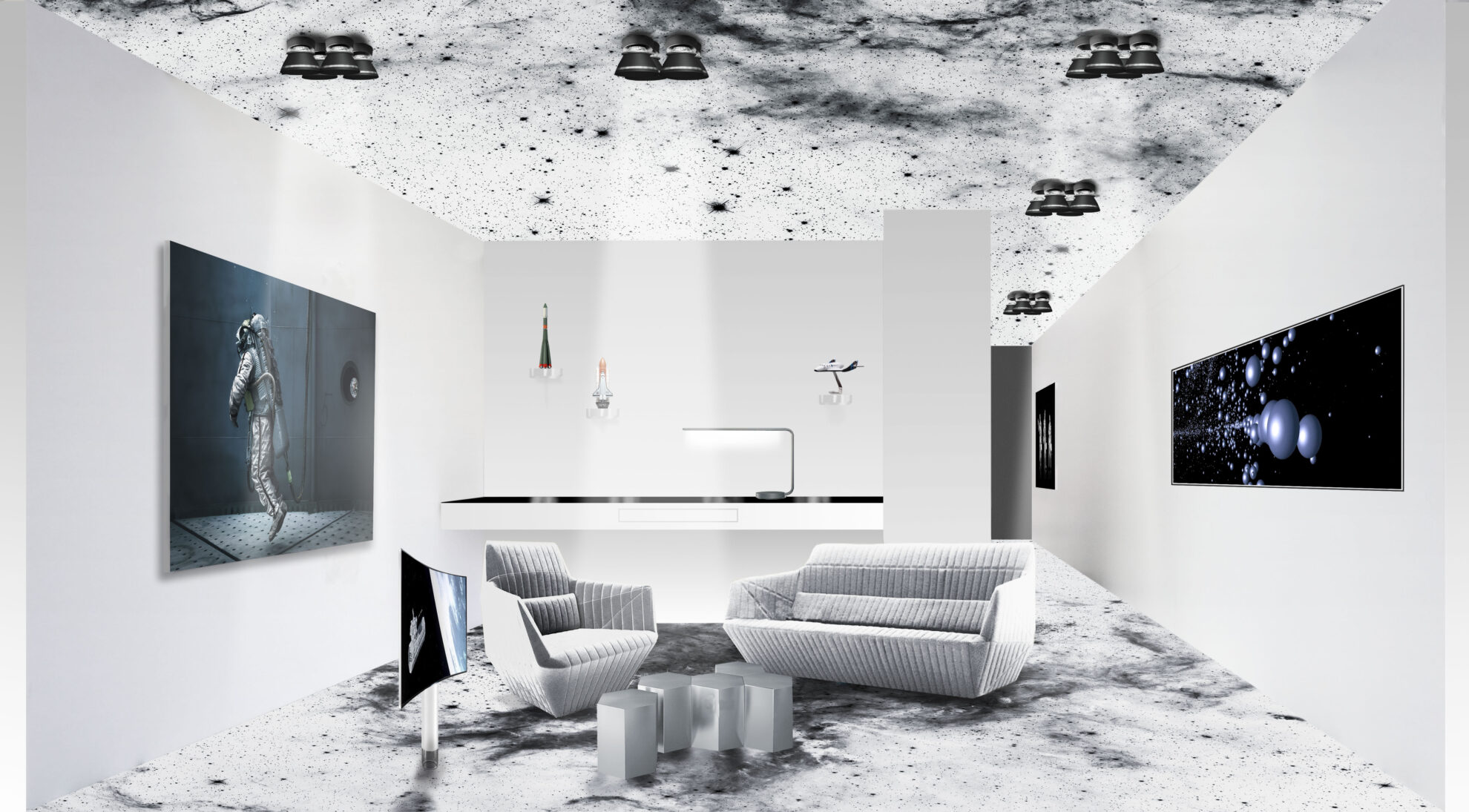 No ordinary designer, Najjar is taking his love of Space far beyond the confines of the suite, having undergone intensive extra-planetary training in Russia in preparation for being one of Richard Branson’s Virgin Galactic pioneer astronauts. (Tickets cost US$250,000.)
The hotel is offering a two-night “Galaxy getaway” package from £1,282 per night. including B&B accommodation in the Space Suite, “space amenities” on arrival, 1.5 hours bodyflying or a one-hour flight simulation in an a A320, a personalised Future in Space book by Michael Najjar, and opportunity to visit Najjar’s Berlin studio to meet him in person.
The Kameha Grand Zurich hotel is the first in Switzerland from Marriott International’s Autograph Collection. It opened in March with 224 rooms including 11 other themed suites.