

What's your humanoid hospitality strategy? Robotics professor weighs in
Hospitality has long grappled with labour shortages – a pain point that humanoids promise to solve. Globetrender talks to Stefan Leutenegger, a robotics professor at ETH Zurich, about the tech's transition from marketing gimmick to core hospitality infrastructure. Robbie Hodges reports
Hotels already have an AI strategy, but what of humanoids? In Asia, properties such as Traders Hotel Shanghai are beginning to experiment with humanoid robots – human-shaped machines designed to streamline operations, reduce overheads and augment staff. What was once futuristic is now alarmingly contemporary.
Even so, uncertainty remains around where these technologies will deliver the most value. While prototypes are proliferating and forecasts predict billions of humanoids could walk among us in the coming decades, today’s models are largely designed to be molded to their owners demands through code and persistent training, rather than built for fixed roles.
Hospitality is widely seen as a natural testing ground. The sector continues to grapple with persistent labour shortages post-pandemic, while recent moves, including Amazon’s acquisition of robotics firm Fauna Robotics, signal growing interest in service-oriented humanoid applications.
As innovation accelerates, the question is no longer if humanoids will enter hotels, but how. Should hoteliers already be laying the groundwork for integration? Globetrender speaks to Stefan Leutenegger, professor at ETH Zurich, to explore what “humanoid hospitality” might look like in practice.

What are humanoid robots actually better at than humans today, and where is the hype outpacing reality?
I can maybe go back to robotics in the first place, and automation, which has, of course, had a very long history of success over the last few decades where robots really excel at being very precise and performing very specific steps.
They have been engineered to that level, right? That they carry out very specific actions and you can have your cars assembled or whatever, at a level of efficiency and precision that is absolutely unmatched if you were to try and do it with humans. And I guess now the hope is that with this new generation of robots in the form of humanoids, that this would extend towards much more general applications of robots that can have this level of efficiency across a much wider range of tasks. And that you can repurpose these robots for different steps in whatever tasks you might want to use them for.
In fact, you can have these robots carry out any task a human could carry out, but faster, more precise, and ultimately, of course also cheaper.
And that also includes natural language processing?
So in a way, that is something that we already see without an embodiment in the form of, say, a humanoid robot. With the new kind of gen ai, large language models and so on, we have seen a real step change in these sorts of natural language interactions and the hope is that this can be now also connected to physical actions that robots can carry out.
I guess the huge promise, that seems tempting to believe, is that this can all come together. We have hardware [robots / humanoids] that seems promising and we have this new level of AI that is also really very promising.
View this post on Instagram
Social media abounds with comical videos of humanoids misfiring right now: Why does it feel like humanoid robots have suddenly moved into the spotlight?
It’s really a convergence of several things. On the hardware side, we now have powerful and affordable components such as high-resolution cameras, LiDAR sensors, mass-produced actuators, and significantly improved compute power, especially GPUs.
At the same time, machine learning has advanced enormously. Convolutional neural networks improved perception about a decade ago, and now generative AI and multimodal models have transformed how systems can reason and interact. Put together, it creates the impression that we’re just one step away from making humanoid robots truly work.
Now, whether that happens on the timelines some people expect? I’m more cautious. Real-world physical interaction is still very hard, especially when safety and robustness are critical.
We’re seeing humanoid robots in hospitality, often as entertainment. Is this creating a false sense that they’re ready for everyday use?
That’s a very important question, and I think you’re right. Many of the demonstrations we see are impressive, but they’re also highly scripted. These systems don’t yet adapt well to new environments or unpredictable situations.
For entertainment, that might be perfectly fine. A robot show can be valuable in its own right. But that’s very different from a robot that can respond dynamically to customer needs or perform useful tasks in real-world conditions. That kind of adaptability requires true embodied intelligence and that’s where we’re still some distance away.
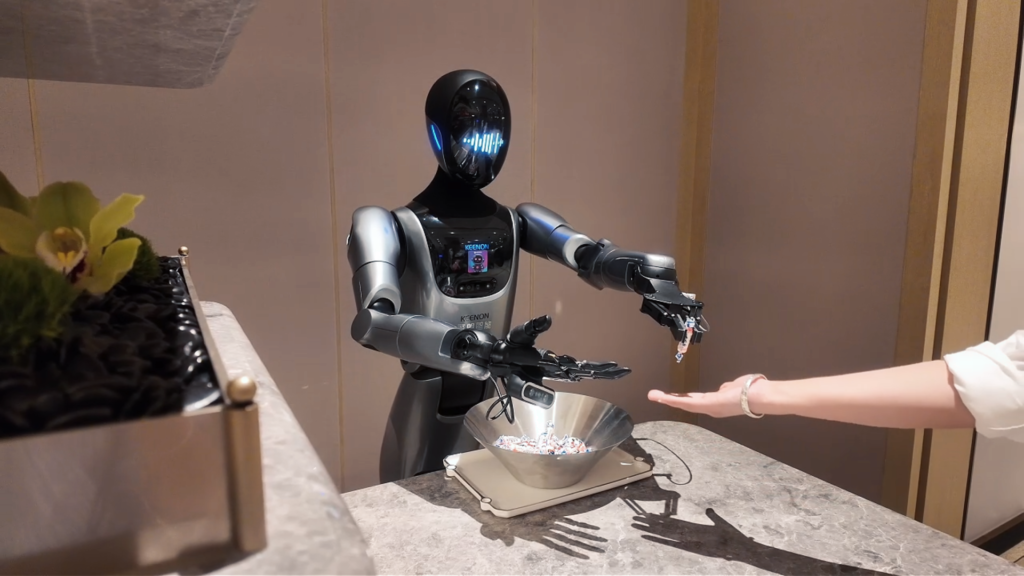
The XMAN R1 greets guests visiting Traders Hongqiao Airport and Shangri-La Hongqiao Airport, Shanghai
Will environments need to change to accommodate robots – hotels, cities, interiors?
Interestingly, the idea of humanoids suggests the otherwise, that they should work in existing human environments. But in reality, robotics has historically succeeded by doing exactly the opposite: creating controlled environments tailored to machines.
We see a similar challenge in autonomous driving. Trying to operate perfectly in complex, human-designed environments is incredibly difficult because it requires replicating human-level judgment and adaptability. So in the short term, it may actually make sense to adapt infrastructure, perhaps separating robots from people in certain contexts, or designing robot-friendly environments.
For example, robots could clean hotel rooms or handle logistics when guests aren’t present. That’s much easier and safer. At scale – say, large hotels or cruise ships – this could become economically viable. But it’s a significant investment.
How are humanoid robots trained today?
Traditionally, robots were programmed with explicit instructions. That still works for simple tasks, but it doesn’t scale well to complex environments. Now, machine learning plays a central role. Robots learn from data – examples of actions in different situations.
There are several approaches. Either they learn from humans by analysing video data, or they learn by doing through trial and error, often in simulated environments, or through teleoperation with a human controlling the robot to generate training data. In practice, it will likely be a combination of all these methods.
A key challenge is that robot-specific data is scarce. Unlike text or images on the internet, there isn’t a huge repository of robot-specific sensing and action data so gathering that data is a major bottleneck.
In hospitality, who will actually train these robots?
That’s still an open question. You can buy robot platforms with some pre-trained capabilities, but they’re not specific enough for real applications. Someone needs to adapt and train them. That could be the manufacturer, or a third-party, or potentially the hospitality brand itself.
There’s an opportunity here. A company could train robots according to its own service standards and potentially scale that across locations. But it’s important not to underestimate the complexity. This requires deep expertise in robotics, not just hospitality, and it’s a long-term investment.
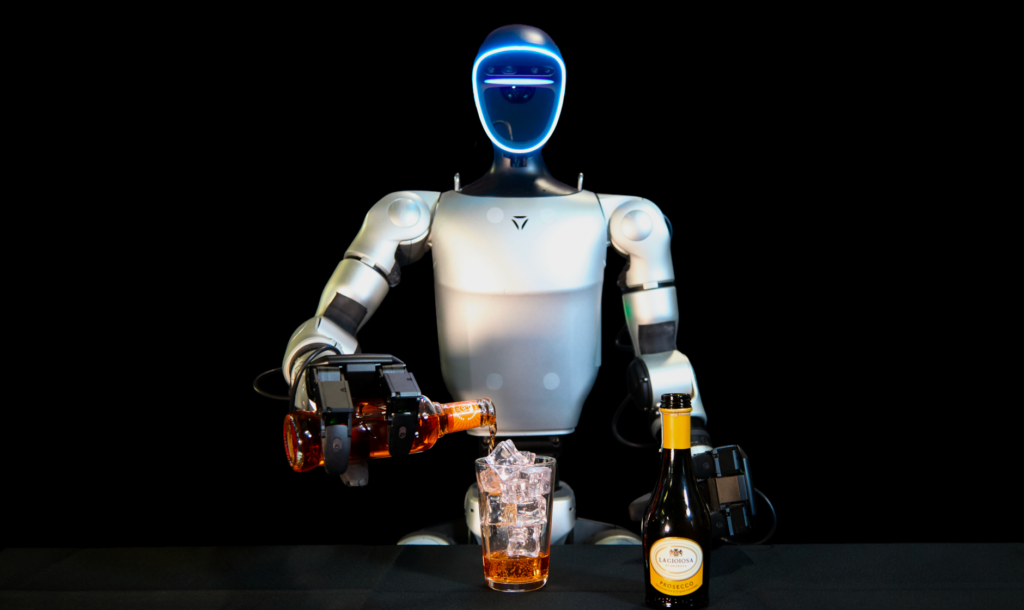
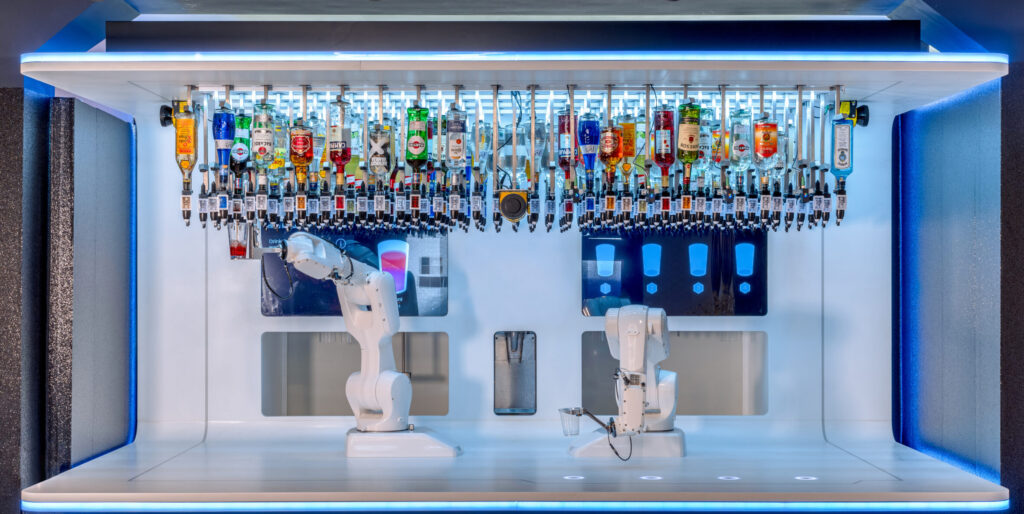
Makr Shakr recently unveiled humanoid bar staff
If a hospitality company started today, how long before humanoid robots are viable?
It depends on what you want them to do. If tasks are highly controlled, environments are structured, and robots are separated from people, then we’re quite close. Those applications could emerge soon. But if you’re imagining a general-purpose humanoid that can act as a waiter, cook, or housekeeper in dynamic environments, then we’re talking more than 10 years.
A study reported in Scientific American found that people assigned different roles to robots based on skin tone, with darker-toned robots more often chosen for manual tasks. How do you approach this?
Your example says a lot about people – probably more than about robots, and that’s something we have to take seriously. In robotics and machine learning, we’re very aware of issues like bias in data. There are ethical frameworks and advisory boards that help guide this work. But many of these questions are broader societal issues that technology brings to the surface, rather than problems unique to robotics. So it’s ultimately something society as a whole needs to engage with.
What needs to happen for humanoid robots to move from gimmick to indispensable?
There are probably two parallel paths. One is more pragmatic: developing robots for specific tasks and environments, where they can already be useful. That’s a continuation of what has worked in robotics so far.
The other is the longer-term goal: achieving general-purpose humanoid intelligence. To get there, we need major advances in robustness, safety, and adaptability. The expectations are extremely high – often higher than for humans. We already see impressive demos, but they’re not yet general or reliable enough for widespread deployment.
So I think we’ll see both short-term progress through specialization and long-term breakthroughs aimed at true generality. The latter will take time and likely continued work in academia and long-horizon industry research.