While much has been written about private aviation’s rebound, particularly in North America where flying is approaching 70 per cent of pre-Covid-19 levels, there are at least six distinct trends driving the increased demand.
And while being 30 per cent below last year’s figures may not normally seem like a good result, keep in mind that airline passengers as measured by TSA are still tracking at a shocking 85 per cent decline.
Here's what’s driving private jet travel…
McKinsey recently indicated prior to the Covid-19 pandemic that only 10 per cent of those who could afford to fly privately were doing so. In other words, the traditional private aviation sales pitch of efficiency, privacy and ease-of-travel wasn’t compelling enough for the vast majority of the addressable market.
Two round-trip first class tickets from New York to Miami could be had for around US$2,000, and there were dozens of daily flights and multiple airports to choose from. Pre-Check and CLEAR eased the time spent waiting in security lines.
By contrast, chartering your own jet runs from US$25,000 and up. Saving a few hours and a more pleasant experience wasn’t enough to justify the greater expense for many. Even filling a six-seat light jet would mean paying twice as much. In the US, it's estimated there are between one and two million affluent households and businesses who are in the addressable market for private aviation.
While the airlines argue that it’s not necessary to social distance onboard their aircraft – in other words, they plan to sell every seat, and internet images of crammed planes abound, private aviation providers from the outset have been proactive in selling health-safety advantages.
Face masks for flight crew and staff at the private jet terminals – FBOs [fixed-base operators] – is de rigueur. Operators that typically use airlines to reposition pilots are using their own private jet fleets to minimise exposure.
Flight crews take multiple daily temperature checks and major providers are testing crews for Covid-19. Most operators have applied special anti-bacterial treatments to aircraft interiors. There is extra intensive cleaning before and after flights. Magazines and newspapers have been removed from terminals and planes. Private jet companies are also vetting their ground transportation partners.
In other words, the industry quickly understood that fear sells, and reducing exposure to a virus without a cure was a compelling sales pitch. They’ve back it up by investing in cleanliness. A study by one operator showed potential exposure to Covid-19 is 30 times lower when flying privately.
Private aviation was also impacted, at its nadir, seeing flights drop by as much as 80 per cent in April. That has meant in some cases previously unseen low prices for on-demand charters coming from fleet operators.
While most private aircraft you fly on when you charter are owned by individuals or companies that rent them out when they don’t need them, there are also a number of significant owned fleets. Many owners didn’t want their planes used by others during this period, but for those operators with their own airplanes, with lower fuel prices, and fixed costs that don’t go away when planes are on the ground, the idea was to keep them in the air at steep discounts.
At the same time, more companies launched pay-as-you-go membership programs where you pay a joining fee, and are then guaranteed flights at a fixed rate. Others reduced the typical buy-in for jet cards from 25 hours to five or 10 hours. That meant for newcomers, instead of having to wire US$150,000, they could get started for under US$10,000.
As businesses reopen, more business travel is again becoming necessary. Of course, with airline schedules at skeleton levels, getting where you go has become more difficult. Missing a connection often means overnighting at a hub. Fewer trips can be done in a single day, and clients are still formulating policies about accepting visitors who arrive by airlines as part of their duty-of-care requirements.
At the same time, companies expect to save on trade shows, conferences and other marketing expenses. They are also expanding the number of team members who qualify for private travel. The combination has meant companies that used private aviation are expanding its usage and others that hadn’t are now giving it a try, using savings from other budget items.
For assistance with visas, Evisa Express provides assistance with electronic visas to dozens of countries worldwide, from Mexico and the US, to Russia and Saudi Arabia making business trips that bit easier.
As airlines have reduced schedules, and parents are concerned about unknown impact of Covid-19 on children, those visits to second homes – both by driving or flying commercially – are being switched to private aviation. In some cases, it just isn’t possible to get away for that long weekend with the airline schedules. In other cases, affluent households are concerned about having to stop while driving.
Many of these new Second Home private fliers are also older, retired and partially retired consumers. The kids are now running the business day-to-day, or as chairman emeritus, there is no need to be at an 8 am Monday staff meeting. For these wealthy travelers who fall in the high-risk segment, they want to visit their second homes, but don’t want to risk exposure to the potentially deadly virus.
Whether its children with asthma – the Asthma and Allergy Foundation says there are 6.2 million children under the age of 18 with the condition – taking the kids to see grandparents, or having a high-risk loved one at home, flying privately will be priceless for those who don’t want to risk infecting those dear to them.
Most newcomers will be low-frequency travellers, expecting to use private aviation for a few trips per year. Common wisdom is that once you fly privately, it’s hard to go back.
Still, it’s a false promise to believe you can fly the same number of trips privately for close to the cost of the airlines. The average number of passengers on a private jet is four, and private jets typically seat between six and 14 passengers.
In other words, to figure out cost compared to airline travel, you need to divide by the number of seats you are filling, not number of seats on the plane. Jet sharing may see a boost, but in the past, jet sharing has worked best when there was high activity during short periods, like flying to the Super Bowl.
Whether or not private aviation companies can keep newfound customers in part is probably out of their hands. If airlines, already under huge financial pressure, decide to use the crisis to prune routes and frequencies, further reduce in-flight services for the long-term, keep lounges closed and can’t keep their planes clean, new private flyers will likely be inclined to stay away.
Doug Gollan is founder and editor-in-chief of Private Jet Card Comparisons, an independent buyer’s guide comparing over 250 private jet membership programmes.


Private jet charter company VistaJet is offering its well-heeled clients a solution to getting on board their yacht without having to risk coming into contact with anyone that has coronavirus.
To use VistaJet’s jet-to-yacht transfer, guests must be able to travel to Malta and have their vessel waiting for them there. Passengers will have their temperature take before boarding and crew will provide masks and gloves for use during the flight.
The operation is designed to run smoothly – once clients arrive in Malta on their private jet, they will go straight into a private customs area and VIP lounge. A pre-sanitised car will be waiting to transport them directly from the aircraft to the marina.
 Ian Moore, chief commercial officer for VistaJet, says: “With a number of restrictions still in place during this time of uncertainty, those who own a yacht or are planning to charter one may be concerned about how they will reach it.
“There can be challenges with access and most importantly in traveling to them safely. Business jets are the safest mode of travel under current circumstances. Our VistaJet-to-Yacht service is a unique offer to keep these customers moving, providing a seamless experience from air to sea.”
Those who do not have a yacht waiting for them in Malta are able to charter one through VistaJet’s approved local agents.
According to London based private jet broker Colibri Aircraft, there are as many as 680 fewer person-to-person touch points when flying privately as there are on commercial flights, significantly reducing the chances of catching Covid-19.
Oliver Stone, managing director of Colibri Aircraft says: “The coronavirus crisis has had a devastating impact on both commercial and private aviation. However, when the recovery comes, it could be private aviation which bounces back first.
“Thousands of commercial flights have been cancelled and many may not return when the skies open again because they will be unprofitable to run. In addition to this, many people will be worried about the possibility of contracting COVID-19 whilst flying, and those that can afford to fly privately may feel it reduces their chances of catching the disease.
Globetrender’s Future of Luxury Travel Forecast 2020-2025, published before the Covid-19 outbreak, predicted that private jet holidays would be an hot trend for the new decade.
“Abercrombie and Kent charters jets for various adventurous global tours. Often with a focus on wildlife, National Geographic Private Jet Expeditions typically accommodate up to 75 passengers aboard a specially configured Boeing 757 and include among the staff Nat Geo-approved experts.
"With its hallowed name carrying similar heft, the Smithsonian Institution’s travel programme Smithsonian Journeys also offers extended round-the-world tours by private jet. Excursions might include tours of Easter Island and the Lost City of Petra.”
Globetrender also recently reported on the rise of private jet travel by wealthy people who want to avoid flying on a commercial airline.
Jet charter company PrivateFly says that compared to 2019, it has seen an 85 per cent rise in inquiries over the past two weeks, as “Germaphobia” (a trend identified by Globetrender in its Travel in the Age of Covid-19 report) grips the travelling public.
Hannah Needs, PrivateFly’s head of partnerships, says: “With travel restrictions easing in much of Europe from June 15, we are very busy indeed with inquiries from travel agents, concierges and yacht brokers.
“They are telling us their clients are desperate to get away but are reluctant to fly on airlines until the risk of Covid-19 has reduced significantly – particularly those with families, or those who are older or in higher risk groups. Agents are increasingly looking at private aviation as a solution, so holidays can go ahead safely and with peace of mind.”

Jet charter company PrivateFly says that compared to 2019, it has seen an 85 per cent rise in inquiries over the past two weeks, as "Germaphobia" (a trend identified by Globetrender in its recent report) grips the travelling public.
According to PrivateFly, the Covid-19 pandemic is set to see more travel companies arranging private jets for clients in the coming months, with a surge in requests from travel trade partners such as Virtuoso, Advantage Travel, Black Tomato and Ten Group.
Hannah Needs, PrivateFly’s head of partnerships, says: “With travel restrictions easing in much of Europe from June 15, we are very busy indeed with inquiries from travel agents, concierges and yacht brokers.
"They are telling us their clients are desperate to get away but are reluctant to fly on airlines until the risk of Covid-19 has reduced significantly – particularly t
Sentient Jet in the US has observed a similar trend. Of the more than 5,000 private jet hours the company sold since the beginning of April, over 50 per cent came from new customers. At the same time, inquiries for flight quotes have risen by 241 per cent since the March low point thanks to the "readiness of new clients to commit to private aviation as a trusted resource".
 Needs says: “Private jet travel is obviously more expensive than airlines but for clients prepared to spend more, it offers far greater control over your environment, both in the air and on the ground. You share the cabin only with your own group; and avoid the busy main airport, moving through a small and uncrowded private terminal instead.
"Additional measures are in place to protect private jet passengers even further, including deep cleaning and disinfection before every flight, and new service protocols such as avoiding handshakes with crew.”
PrivateFly’s prices start from £6,500 to £7,000 one-way for a six-seater light jet such as a Nextant 400XTi, on a short trip such as London to Nice. Or from £18,500 for a 13-seat Legacy 600, from London to Ibiza.
Needs says: “At PrivateFly we've worked with the travel trade for many years, as our technology and 24-hour expert team make it much easier for agents to provide rapid and transparent quotes for accredited private jet charter, with full support and account management.
"We work mainly wit
“We’re predicting a growing proportion of our flights to be referred by travel partners in the months ahead. With travel now a more complex consideration for many people, the role of the travel agent as a trusted adviser has never been more important.”
KinectAir is following in the footsteps of other on-demand private jet companies such as Surf Air and Jetsmarter, which have not really taken off in Europe despite catchily being described as the "Netflix of private jets". (The idea is you pay a monthly or yearly fee and fly as much as you like.)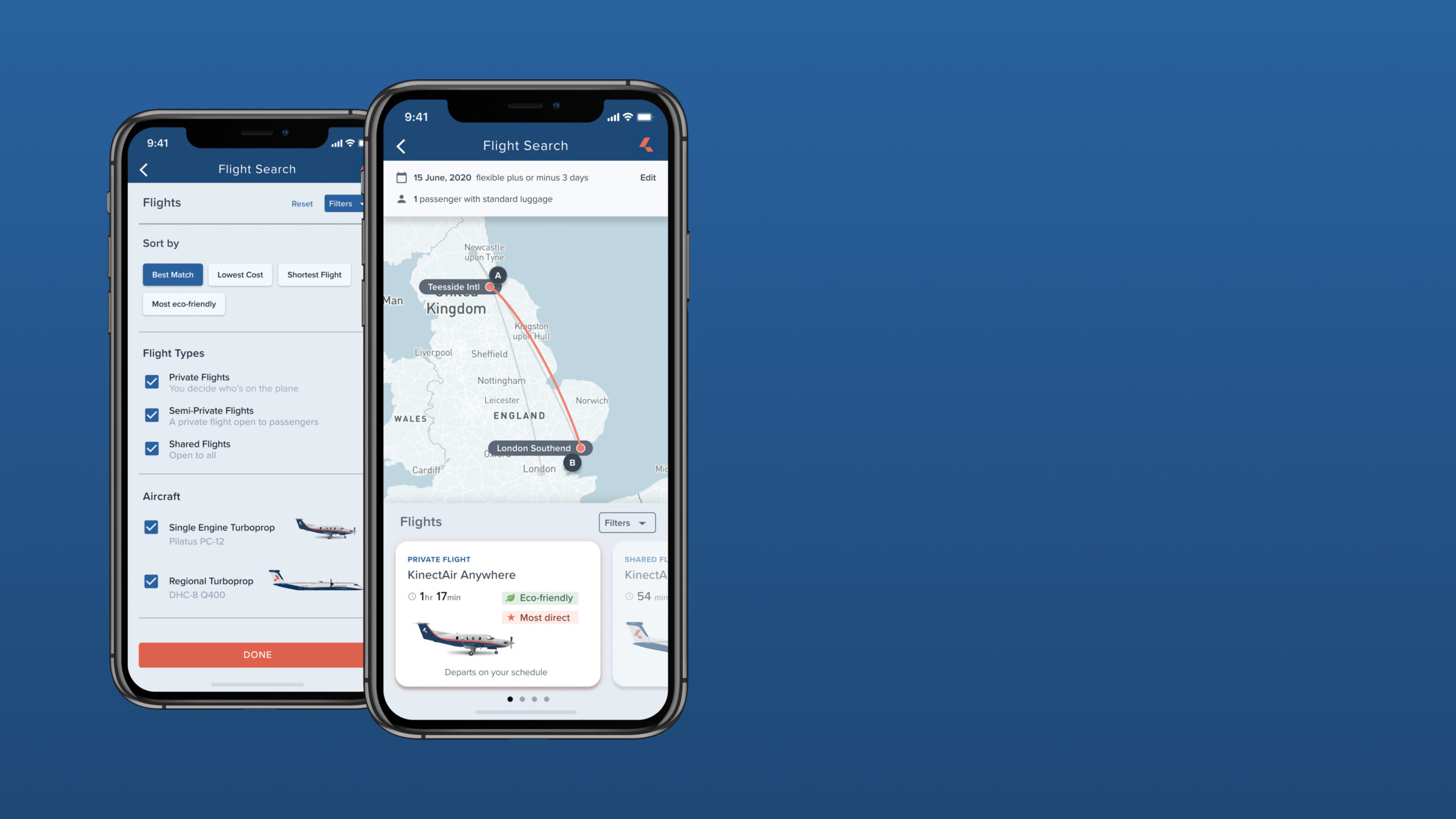 I tried Surf Air a couple of years ago between London Luton and Zurich and was impressed with the service. Here is how I described it in a piece I wrote for Mr Porter: "I rolled up at the gleaming glass Signature terminal in a taxi on a dark, wet morning, with half an hour to spare before my 7.10am departure (although, in fact, you can arrive as little as 10 minutes before).
"After an online background check completed in advance, all I had to do was show my passport and relax on a sofa in the lounge. There are no security checks. Within moments I was delivered a pot of tea – there was also free Moët champagne, in both full-size and mini bottles, but it was still a bit early for that.
"I was one of two passengers on my Surf Air flight (the other was a Swiss businessman), and the co-pilot personally welcomed us on board, telling us to help ourselves to snacks and drinks from the bar when airborne.
"My fellow traveller was a self-described 'serial entrepreneur', who said he booked with Surf Air the night before as an experiment. It was more expensive than business class on Swiss, he said, but decided the premium was worth it for the speed and ease of the journey."
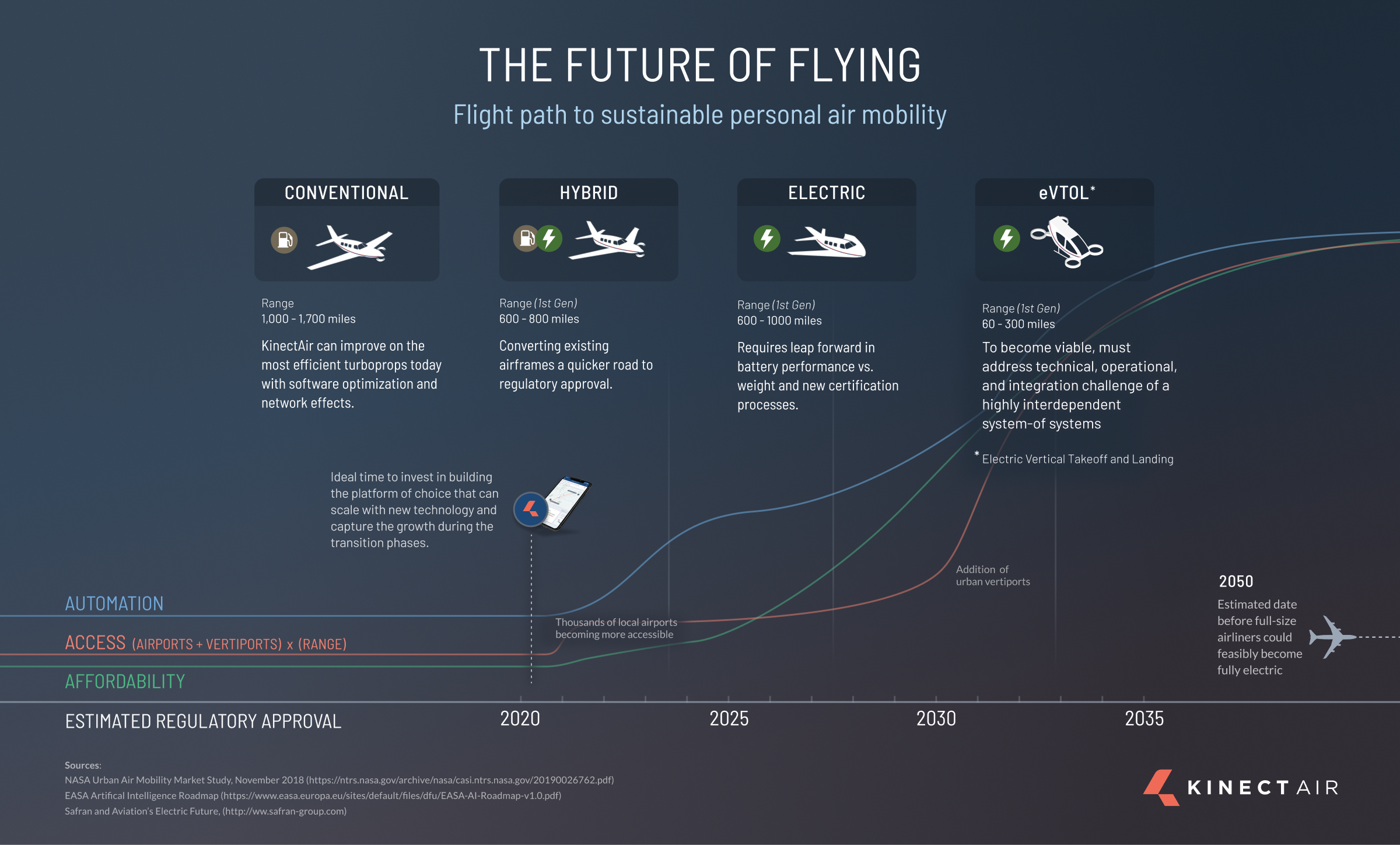 The company says it will be bringing the on-demand experience to aviation by using a combination of an AI enabled app and smaller format state-of-the-art aircraft that fly in and our of local airfields. It says that this "low infrastructure network will revolutionise where, when and how we fly to create a more sustainable ecosystem for regional flying based on actual demand".
Jonathan Evans, CEO of KinectAir, says: “The way people move is changing but flying has not evolved. People are tired of fixed airline schedules and crowded airport hubs. It will blow people's minds if they can control their flight path like this. That’s why we have reimagined air travel as a flexible on-demand flight network, to move people to where they need to be. And put the joy back into flying.”
Evans has been working on his dream of an air mobility solution for the last two years, ever since he sold his drone software company to Verizon in the USA. He says: “More than ever, we want to fly to see the people, places and communities we need in our lives – just more selectively.
"With KinectAir we avoid major airport hubs and waiting lines, cut out airport commutes and deliver a short, safe and hygienic boarding experience to get airborne in minutes. In bringing networked regional air connectivity, we’re building community around our vision.”
With the Covid-19 pandemic not only disrupting existing aviation infrastructure but altering people's perception of flying, now could be exactly the right time for KinectAir to launch.
The company says: "The airlines are broken, and the hub and spoke model is more unattractive to passengers than ever. Billions in government bailouts will likely end in failure. Worse, healthy demand for regional air travel is being ignored at the exact time people want the choice to live and work wherever they want and stay connected."
Although private jets are typically worse for the environment (they emit as much as 20 times more carbon dioxide per passenger mile than a commercial airliner), KinectAir it will use the most fuel-efficient aircraft available, and hopes to be able to offer hybrid and electric planes by 2023, years ahead of the competition.
Not only that, but KinectAir wants to be there for more than just the one per cent. It says: "For millions, the choice of smaller fuel-efficient aircraft will be more affordable and accessible than the current private jet charter prices. So flying direct will be an option for people who thought it was not. Saving them countless hours of driving or mixed travel using trains and hotel stays to go the same distances we can fly in under two hours."
KinectAir CEO Jonathan Evans tells Globetrender: "Typical jet aircraft, which dominate the air charter market today, operate at around US$15-US$20 per passenger-mile.
"We fly propellor driven aircraft, which are an order of magnitude more efficient to operate, and can fly guests for closer to US$0.60-US$1/passenger-mile. So a loaded 500 mile flight for each passenger in our four or eight seat aircraft, KinectAir Anywhere, would cost roughly US$500 each."
Its KinectAir Together product would be cheaper still. Evans says: "On our 80-seat aircraft where we aggregate demand to routes and times – think of crowdsourcing every flight in real time – we can bring that cost down much further and approach the prices you’d expect from regional airlines, but with a new and elegantly streamlined service that brings joy back to air travel."
In the US, and soon the UK and Europe, its fleet will include the Cirrus SR22, a four-seater aircraft perfect for quick trips under two hours or 300 miles; the Pilatus PC-12, a Swiss built and engineered eight-passenger aircraft for flights up to four hours or 1,000 miles; and the Dash-8, an 80-seater twin turboprop with a range of 1,500 miles.
The company says: "In our goal to democratise air travel and move from beta testing to an operational carrier, we are raising money through a crowdfunding campaign. Since we are bringing KinectAir first to regional air markets, we believe we should grow KinectAir with the very people we fly, and want to see the company blossom to become a truly global community."
Editor's note: On July 15, KinectAir announced a partnership with VoltAero, a leading French hybrid-electric manufacturer that could see KinectAir launching electric-powered flights over short distances by 2023.
The airline is part of Zed Aerospace, which was founded by Zander Futernick in 2016 when he was just 20 years old. The company also promises to develop innovative flying solutions for commercial and private aviation applications.
In launching Zed, a five-star start-up airline, Zed Aerospace says it will become an “American industry leader in crafting elegant passenger experience solutions”.
It will have a fleet of upgraded, Swiss-designed Bombardier CRJ700 aircraft, which have been modified to accommodate 29 passengers instead of 75, meaning those on board will have a private jet-style exprience. Seats will be 20 inches wide with 44 inches of legroom.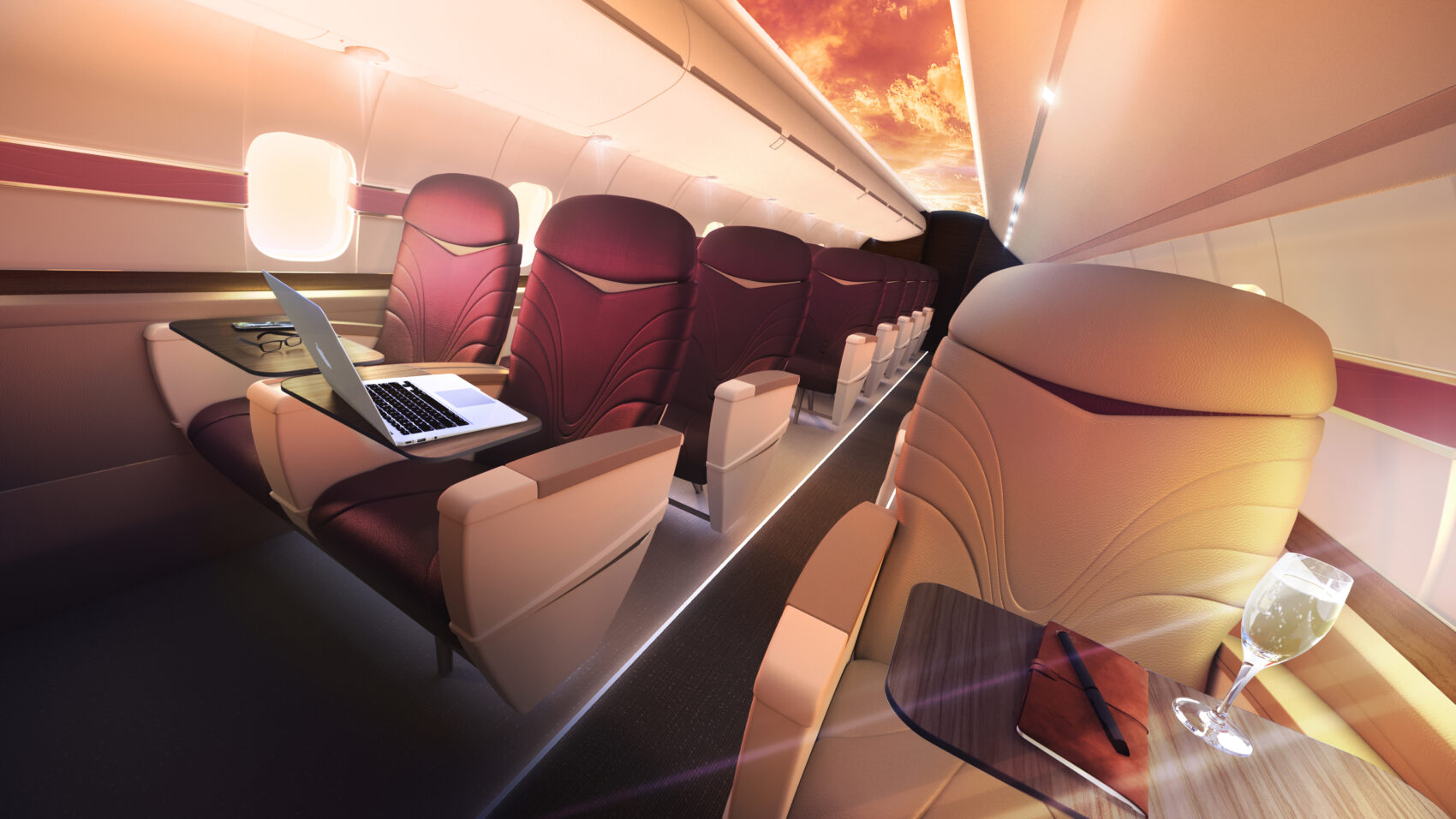 Zed says that all customers will receive private airport service, a rotating menu of fusion tapas, SushiBar selections, and a curated list of wine, liquor and cocktails. High-speed wifi, a free iPad Pro, and a SkyLights Virtual Reality headset will also be available.
Instead of watching films on an iPad or seat-back screen, the Allosky Cinematic VR headsets offer 3D, 2D and 180° on a full HD, IMAX-style display.
Entertainment options will include a catalogue by 20th Century Fox, DreamWorks, Warner Brothers and Lionsgate. The headset will also stream a live 360º view from a camera mounted on top of the plane.
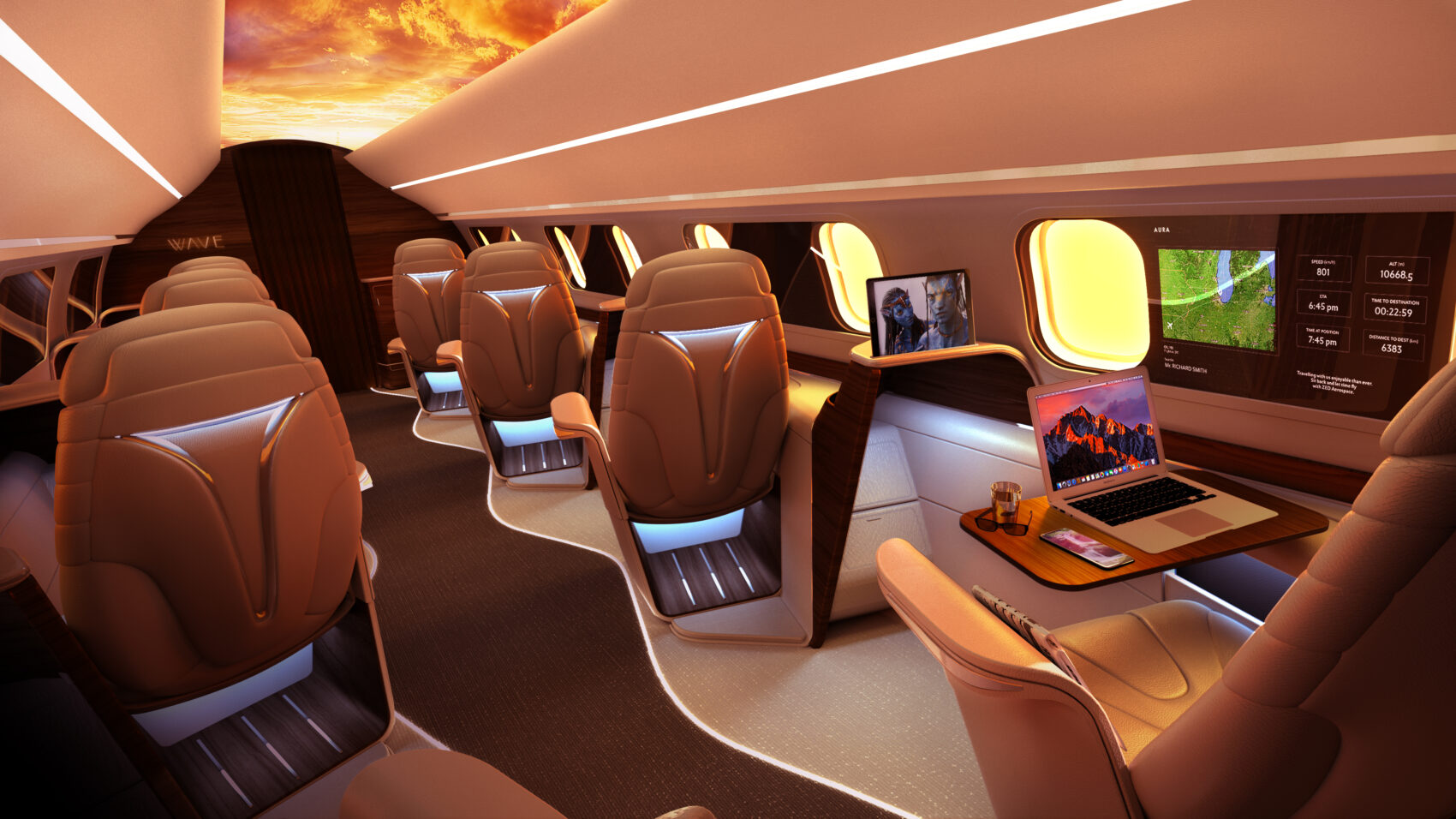
Those travelling in more expensive Wave class will enjoy a cabin with just eight seats, as well as a "Book the Cook" service whereby they can custom order a full five-course meal to be prepared on board. "WAVE offers a level of service exceeding that of a private jet," says Zed.
Even more impressive is the futuristic lie-flat design of the Wave seat, which has been designed by YASAVA Solutions. It features a thick mattress and "optimised reclines for multiple body positions that allow for better circulation, improved breathing and a reduction of the dangers of DVT". The use of "pioneering OLED display technology" will see the integration of a panel on the ceiling of the cabin that will give the impression that passengers are looking up through a window at the sky, when in actual fact, it is a screen. This will create a feeling of space and light.
 Unlike most plane interiors, which are very dirty, Zed is developing the "most hygienic aircraft in the sky". In addition to top-end air filtration units, toilets will self-clean after every use, and be exposed to ultraviolet light that kills 99 per cent of all germs.
Other innovations will include the ability to book flights with Siri, and carbon offsetting built into the price of every ticket, to make the airline sustainable.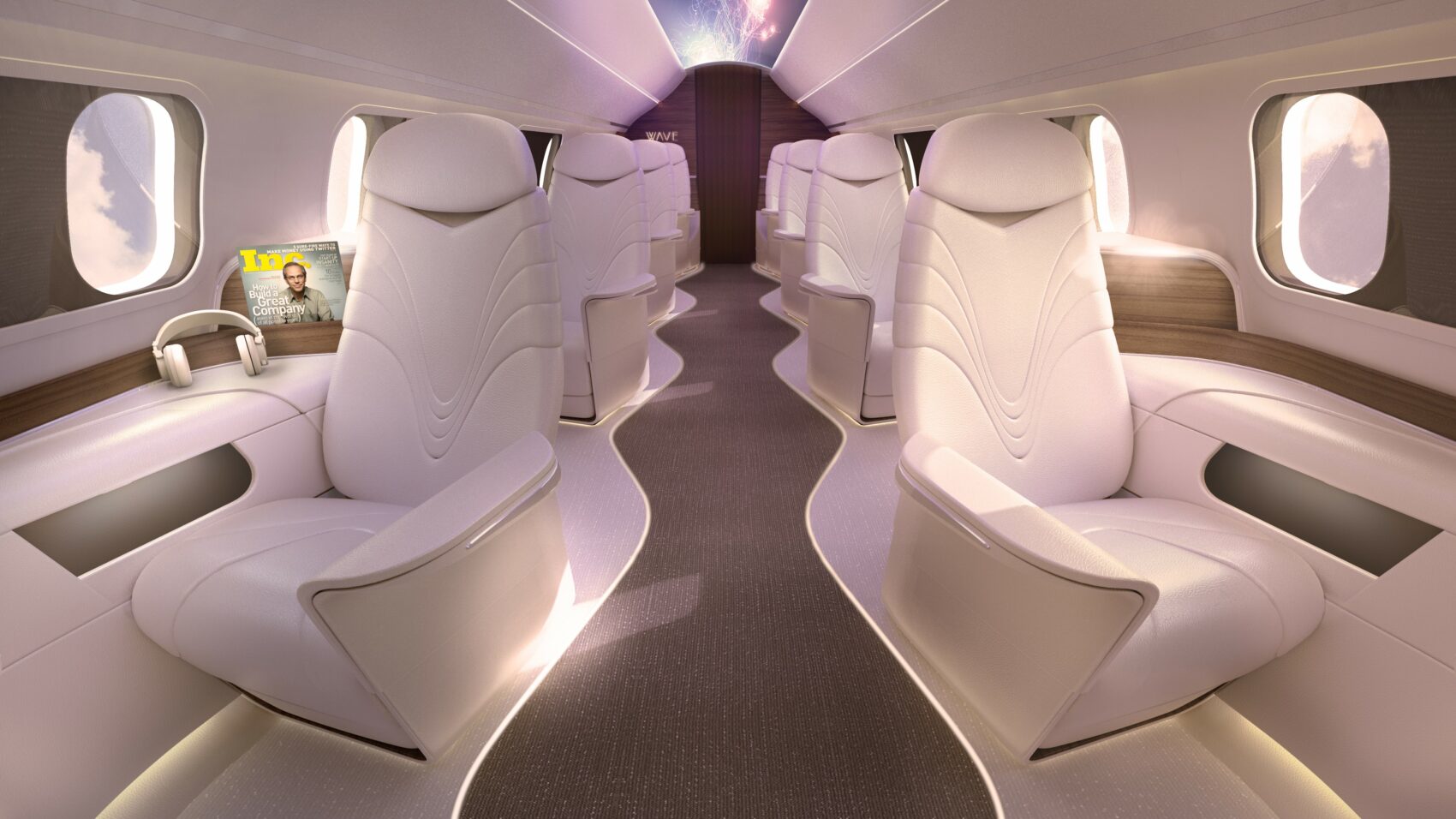
Zed Aerospace, which is headquarted in Miami, will connect North American metropolitan hubs with “reliable and frequent service,” according to the company.
To serve the needs of business travellers, no city pairing will be served less than twice daily, with increased frequency on busy routes. Zed will be operated by Presidential Aviation, an established FAA Part 135 private jet operator.
Seasonal routes will be launched throughout the year to popular ski, holiday and event destinations. Schedules will be released every 90 days and city routes will be served year-round.
According to Forbes, which described Futernick as the “CEO who is revolutionising luxury air travel,” Zed will depart from and arrive at private airports and terminals – initially Miami, New York, Chicago, Atlanta, Los Angeles and Denver. This means very little queuing (or none at all).
It will then be rolled out to Las Vegas, San Francisco, Seattle, Boston and Houston.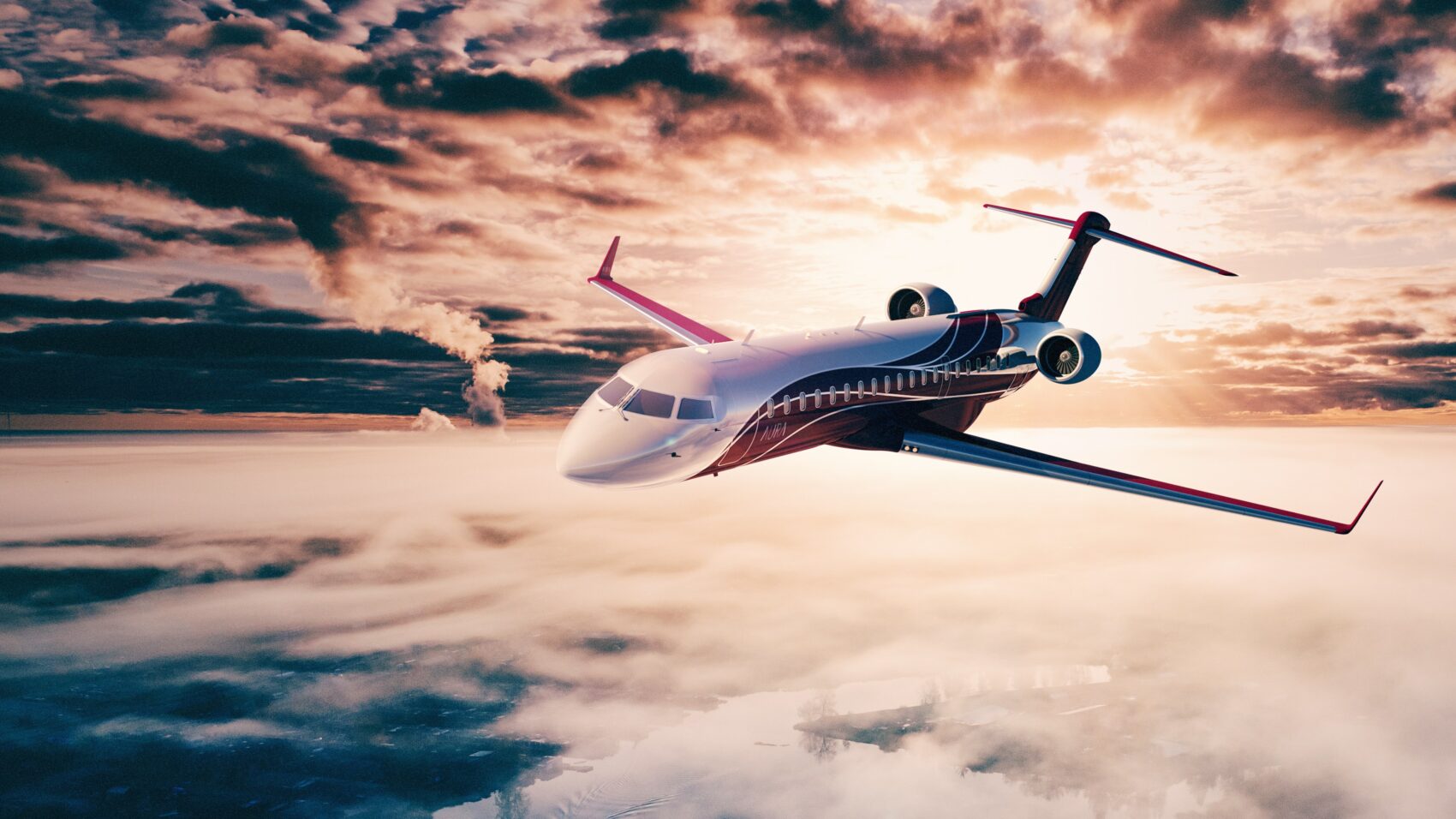 Writing on the Zed website, Futernick said: "I want you to love flying as much as I do. Zed is the vision of an aviation geek who wants you to reimagine what air travel can be. Zed is all about you. You can’t wait for your next flight, and I can’t wait to welcome you aboard.
“I founded Zed Aerospace in 2016 to create flying experiences yet unknown to the traveling public. The airlines of the United States had succeeded in their race to the bottom and I wasn’t going to let them strip away my passion.
“Zed is a deliberate effort to create a beautiful flying experience. No aircraft on the market today was designed for what we set out to accomplish, so we had to go design one ourselves. Zed Aerospace crafted Zed to be the most advanced fleet in the sky, unveiling the most modern technologies never before seen on aircraft.”
He added: “You can expect to see me every day, in the air, serving you a glass of champagne and putting the finishing touches on your steak. I am dedicated to you, our passengers.”
[dropcap size=big]A[/dropcap] collaboration between aircraft manufacturer Airbus and Italian supercar designer Pagani has given birth to the futuristic new Infinito cabin. Ready to be installed on ACJ319neo private jets, the highlight will be the innovative "Sky Ceiling" to create a feeling of "airiness and space".
Although it looks as if the roof of the jet slides back to reveal the clouds, or a glass ceiling has been installed for unimpeded views of the sky, neither of these scenarios is the case. In reality, the ceiling is a long screen that displays what's above in real-time by strategically placed cameras on the exterior of the plane. (It can also be used to broadcast other media.)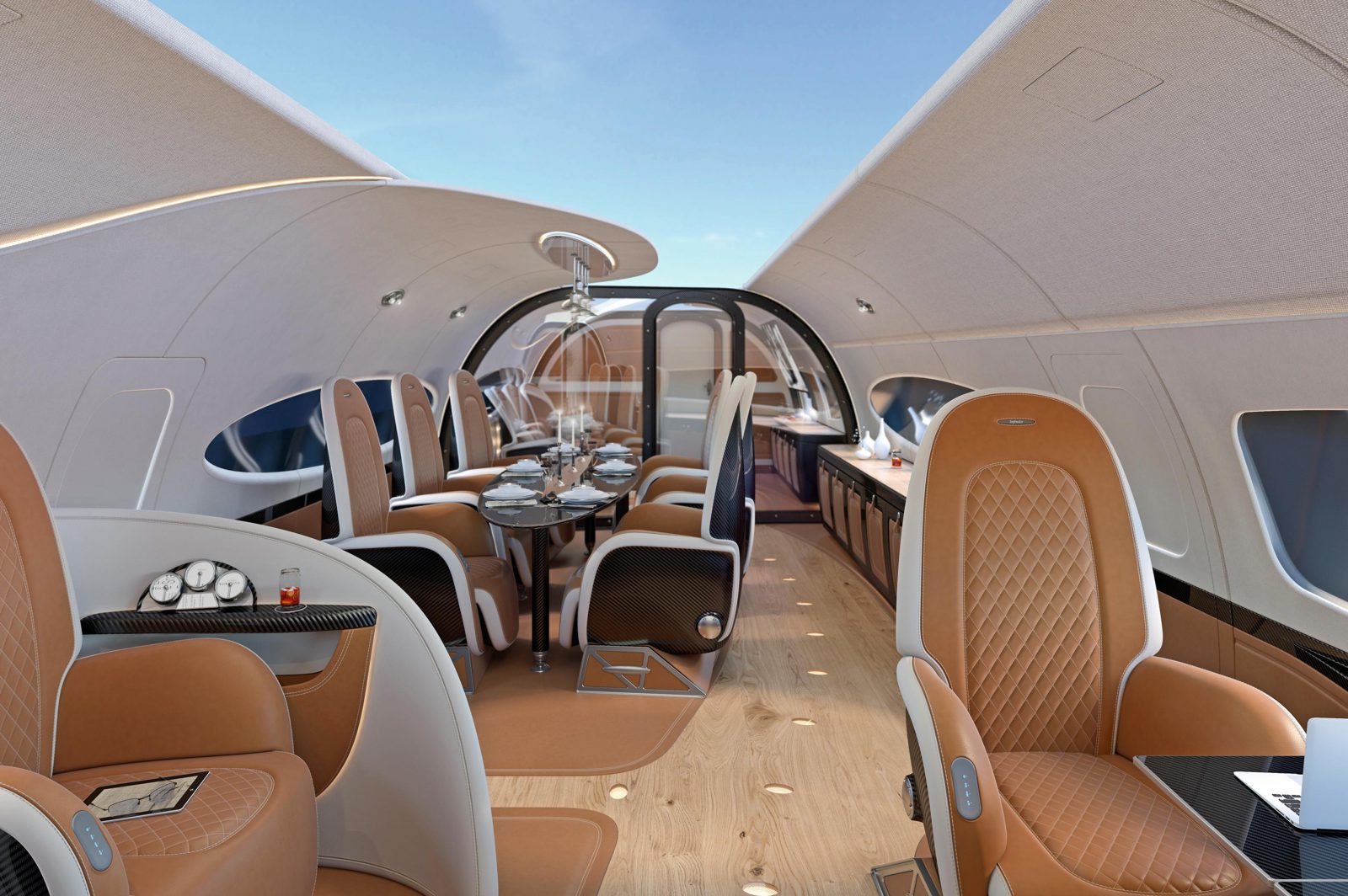 Horacio Pagani, founder and chief designer of Pagani Automobili SpA, says: “Art and science can walk together hand in hand: this is the Pagani philosophy. The combination of state-of-the-art composite materials never used before in an aircraft, such as CarboTitanium, with the typical design language of Pagani Automobili, has always represented our signature. Applying our Reinassance touch into the wider spaces of Airbus corporate jet cabins is the beginning of an exciting new venture for us."
With space for just eight (very rich) customers on board, the Infinito cabin also has a dining room and cinema, and a conference room and lounge, separated by a wall that can turn from opaque to transparent at the touch of a button.
Interiors are inspired by Pagani hypercars, with soft leather upholstery, carbon-fibre furniture, wooden flooring, sculpted metal, mirroring and LED mood lighting.
Airbus Corporate Jets managing director Benoit Defforge says: “In bringing together the best of the supercar and business jet worlds, we enable an elegant and seamless link for customers of both, while bringing a fresh approach to cabin design and satisfying very demanding standards."
Although it will be some years before regular flyers have the chance of experiencing a Sky Ceiling on commercial planes, it's exciting to see what the technology is capable of. Airbus has come up with an ambitious concept aircraft with a transparent membrane (among many other dazzling innovations), so sitting back in your seat with a view of the sky is something that could be on the horizon.



 For regular briefings on the future of travel, sign up to Globetrender’s free newsletter, here.
Stratajet is a private jet booking platform – available via stratajet.com or the Stratajet app – that is the first in the world to give fliers direct access to the private jet marketplace.
Where it’s innovative is in the incredible technology that allows this to be the case. We’ve removed the time-consuming, old-fashioned means of booking a jet via a broker and built an incredibly user-friendly interface that does millions of complicated calculations – that were previously done manually by aircraft operators, and still are in other companies – in mere seconds.
This makes it easier than ever before to get from A to B by allowing customers to search for a particular flight, without having to go through a broker, see accurate costs of as many as 50 aircraft available to charter for that flight – not just a select few – and book instantly.
That’s a very interesting question because the perception of private jet travel is one of a luxury toy for the rich and famous but our vision is to give everyone who wishes to fly by private jet the opportunity to do so.
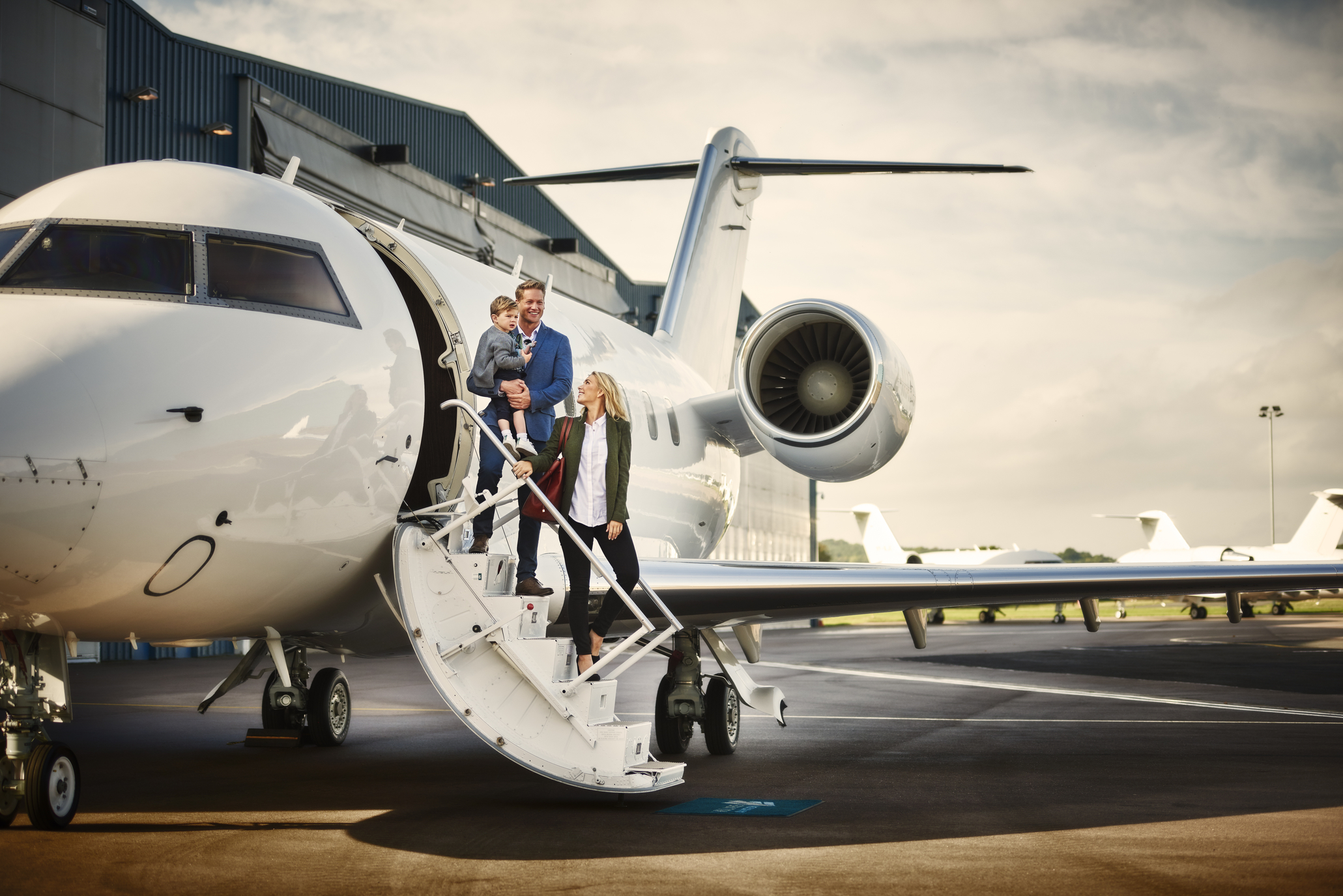
Typically, private jets have been employed by CEOs (and celebrities) but our bookings are a mix of business and leisure.
The 18-26 year old age bracket is the fastest growing and we estimate that around 30 to 40 per cent of our bookings are families travelling with children.
 What are you doing to attract younger travellers?
The fact is that we truly are doing something to attract a younger segment of travellers, when no other provider is. The trouble with the traditional booking process I mentioned is that operators can often be reticent to provide quotes to first-time flyers.
They see this as a risk since the booking is less likely to be finalised and paid for than with a regular private jetsetter. The result has been a slowly ageing customer base across private aviation, with the industry struggling to attract new and younger audiences.
However, the immediacy of Stratajet is paving the way for a new and younger audience of travellers to benefit from the perks of private jet travel. Because we can provide accurate costs of flights instantly – without any work being required from operators – we’re making private jet travel available to a new wave of flyers.
Other providers have different models but they are still based on the principle of a broker organising your flight requirements for you. Even platforms that claim to provide an online service don’t actually do what they say "on the tin".
Rather their websites collect flight requests and these are then pushed out to operators, who have to manually calculate the costs. Once quotes are delivered, you then have to finalise the booking with your broker.
It’s a terrible, long-winded, convoluted and inefficient process and, due to commissions taken by the broker, unnecessarily pricey.
In contrast, Stratajet is the only platform that has built, from scratch, its own technology that can make these calculations, meaning that aircraft are right at fliers’ fingertips.
It also has no hidden fees or membership costs.
 That’s an easy analogy and other companies are claiming a similar "tagline" but Stratajet is far more complex than that – it’s a remarkable piece of technology. On day one I asked myself why such a system had never been built before; and after five years of labouring to get the technology to work, it’s now obvious.
The reason is the vast complexities involved in calculating how much a private jet flight will cost. Whereas aggregators such as Skyscanner and Expedia make it easy to book seats on commercial aircraft, the nature of private jet travel – in that it offers a bespoke service – brings with it the need to calculate the cost of every potential flight from scratch.
There are 15 sets of fees involved, each with hundreds of variables, and the Stratajet search engine can make upwards of 2.5 million calculations every time a customer requests a flight.
 We’ve enjoyed some very strong growth since our launch and now have over 10,000 members. But "members" is a misleading word as we’re not an exclusive community. It’s important to note that – unlike other providers – our membership is free and doesn’t require a long-winded sign-up process.
You can get a flight costs without even registering and it only takes an email address to "sign-up" before going through to the booking page.
Not as much as you’d think. The average booking via the Stratajet app is around £6,000 but the platform comes into its own on trips where groups of friends are travelling together. We can often be priced better than the equivalent cost per person for business class seats on commercial flights.
Naturally there are always different ends of the spectrum and our dedicated customer service team is always on hand to help you customise your trip if you wish to add a little extra – perhaps a chauffeur pick-up or a particular bottle of champagne – to your flight.
Any destination they like. The beauty of private jet travel is that the flight will work around your travel requirements. Stratajet is particularly clever as you can enter the address you want to travel to and from, and the system will calculate the best airfields for you to use.
 There’s much more choice of airfields too. We’re live in 44 countries across Europe and there are over 2,100 airfields available to private jets, whereas only 500 are regularly used for commercial travel.
So there is huge scope to get to locations that are "off the beaten track". It invokes a sense of adventure in exploring new places. For example, someone from London wishing to visit the remote and beautiful island of Islay in the inner Hebrides would have to fly to Glasgow on a commercial flight before connecting on a smaller aircraft.
Naturally there would also be a lot of waiting around for flights and transfers. When flying privately, however, you can go direct and be salmon fishing or whisky tasting in no time.
Before Stratajet I would have advised to shop around. But now that the marketplace is available to all, I’d simply suggest visiting stratajet.com and seeing for yourself how easy it is to charter a jet. If you’ve got any questions, phone our charter team and they’ll be happy to help guide you through everything.
Our dream is to make private aviation available to the mainstream traveller and we’re already opening up the industry as shown by our customer base – 32 per cent of whom are first-time private jet fliers, which is a staggering statistic when compared to the industry average of less than one per cent. It shows just how much the industry has been struggling to attract new customers.
As more and more people use Stratajet, we believe there will be a watershed moment in the industry – private aviation "before Stratajet" and private aviation "after Stratajet". It’s a total game-changer.
[dropcap size=big]L[/dropcap]ondon-based catering company Absolute Taste has unveiled an app for made-to-order meal deliveries straight to your private jet.
Designed for both crews and passengers, the free app allows for gourmet food to be transported direct to the aircraft door before take-off or after landing, with a menu of "traditional and internationally inspired dishes for breakfast, lunch and dinner".
Users can browse a gallery of images before making a selection, paying online and sending off their order. According to a press release: "Customers also have the option to add individual menu preferences and compile a list of favourite dishes to make the ordering process even easier on their next trip."
Managing director for Absolute Taste, Lyndy Redding, said: “Absolute Taste Inflight was born following the demand from our clients wanting our food on their planes and, therefore, we have spent a huge amount of time working with our chefs to ensure each dish and menu works perfectly on board.
"With the launch of our new app, we want to make the in-flight dining experience even more comfortable and accessible for our customers. Technology advancement is vital for all businesses to develop and grow in order to keep pace with customer expectations and Inflight is no exception to this.
“We see this development as the latest step in enhancing our clients’ experience and keeping at the forefront of providing food to the private aviation sector.
“We are very excited to bring this to the market as we are forever trying to keep ahead of the times and in touch with what our clients are wanting, so watch this space for what we have planned next.”
UK catering company Bon Soirée also has an app for iOS and Android platforms, whereby you can choose anything from canapés, Iranian caviar and mezze platters, to sushi, lobster and Peking duck to be ready for your take-off.
If you are flying from London City, for example, your food will be with you in two hours, while at Luton it will arrive in just 30 minutes.
According to thisismoney.co.uk, since the financial crisis in 2007-8, the number of private jet flights has risen by 6 per cent, while in Britain the number is closer to 10 per cent.
“The growth in business jet traffic to the UK is being driven by the attraction of London as a residence for the super-rich, but also by business visitors looking to invest in the UK,” wrote Simon Watkins.
According to Privatefly, Luton is the fourth-busiest airport in Europe for private jet flights, with more than 27,000 take-offs and landings last year. (Paris le Bourget is number one, Geneva number two and Nice Cote D’Azure number three.)
[dropcap size=big]V[/dropcap]isit any international airport on any given day, and the perimeter fence will likely be surrounded by some of the world's most advanced photographic equipment, from telescopic lenses to high-tech tripods.
Many avgeeks are also lucky enough to work airside – as cabin crew or aircraft engineers, for example – allowing them unprecedented access to the runways, aprons and aircraft interiors, ripe for Instagramming.
Most would assume this realm of the plane-spotter is devoid of creativity, but the truth is, avgeeks have long had a flair for photography.
These days, many have now gained a huge following on social media, with Instagram the home of 1.4-million #avgeek hashtags, with #tailtuesday and #wingwednesday providing the weekly fixes of in-flight entertainment.
Aviation photography, or #avphtography, has always had the power to inspire and elevate, and now a new generation of photographers is changing this traditionally geeky pursuit into something much more glamorous.
Here are five of the best avgeek Instagrammers you need to follow…
Follow William Simpson on Instagram.
[dropcap size=big]D[/dropcap]esigned for wealthy “aviation geeks”, the itinerary begins with boarding a Gulfstream G650 private jet from London to the Caribbean island of Saint Martin, where you will experience its famous low approach over Maho beach.
Here you will have an exclusive private tour of St Martin’s Princess Juliana International airport (SXM), by the airport’s managing director, Regina la Bega.
There will then be a private charter flight to St Barts, where the aircraft will descend just feet above a steep slope to the runway.
Once on the tarmac, you will meet the president of St Barts, Bruno Magras, and have lunch with the managing director of St Barts airport, Fabrice Danet.
Next up there will be a landing on the shortest commercial runway in the world, on the tiny island of Saba. Once safely on the ground, you will have a meal with the pilots.
The package includes seven night’s accommodation in five-start hotels, meals with airport staff and crew, fine-dining in the evening and chauffeur-driven cars between all venues.
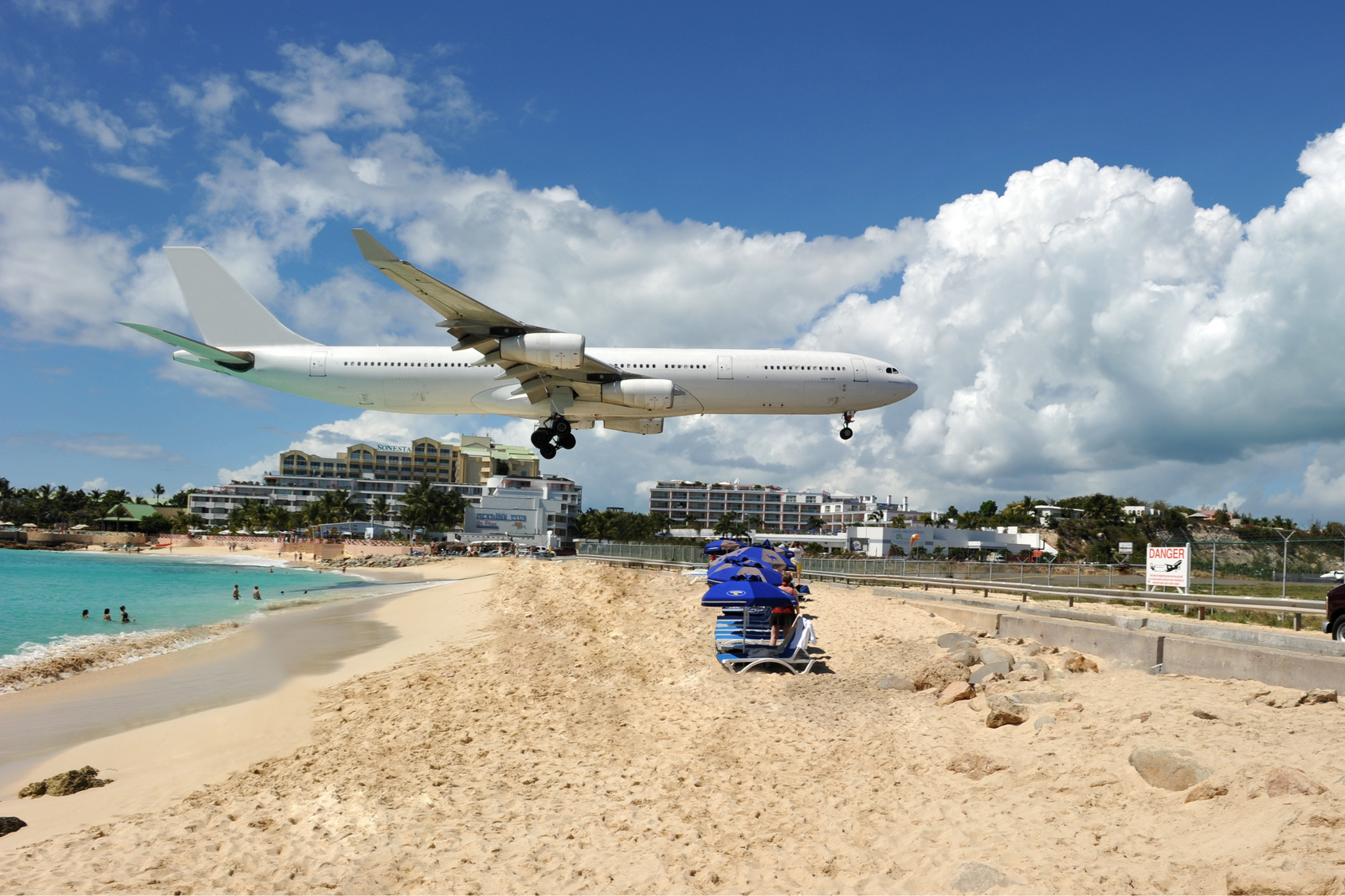
Maho bay in St Martin, West Indies
Adam Twidell, CEO of PrivateFly, said: “Aviation tourism is a growing trend amongst luxury travellers who seek out the world’s most extraordinary flying experiences.
“For an ‘Av Geek’ the joy is as much in the getting there, as it is in the destination. And the Caribbean offers an unbeatable collection of simply breathtaking landings.”
The trip costs from £190,000 for a group of four, or £48,000 per person. PrivateFly can also arrange the itinerary without the long-range G650 flight, at a cost of £12,000 per person.
Bespoke activities include flying lessons on St Barts and Saba, sightseeing tours, and flights the beaches of Anguilla.
Videos of the landings are available via PrivateFly’s You Tube channel .
[dropcap size=big]T[/dropcap]he 2015 Wealth Report from global property consultancy Knight Frank gives an in-depth look into who the super rich really are – and what they are spending their money on.
Last year, at the top of the wealth pyramid, 53 new dollar-billionaires were created, making 1,844 in total – a relatively tiny club compared with 17,808,831 dollar-millionaires across the planet.
About 15 people a day joined the ranks of the "ultra-high-net-worth individuals (UHNWIs worth over US$30 million), totalling 172,850. The number of "centa-millionaires" (those with assets worth more than US$100 million) was 38,280.
The number of super rich people adds up to just over 18 million – with a joint wealth of US$20.8 trillion. Out of a global population of more than seven billion, that's a handful of people with a serious amount of wealth.
The Wealth Report’s annual Attitudes Survey is based on insights from almost 500 private bankers and wealth advisors, and reflects the attitudes of their ultra-wealthy clients.
It revealed that 2014 was "a good year" for the wealthy. "The vast majority saw their net worth increase, and most of the respondents said this trend would continue in 2015".
However, 21 per cent of respondents expected their clients’ philanthropic activities to increase; in this year’s survey the figure was 22 per cent, with three-quarters predicting they would remain the same.
When asked if younger UHNWIs have a different attitude to wealth than their parents’ generation, 45 per cent said they were more philanthropic. Andrew Porter, director of research for Camden Wealth, said: "Millennials take seriously the notion of stewardship and social responsibility."
At the same time, two-thirds agreed they spent more on luxury goods. According to Ledbury Research, developing trends in the top-end goods sector show rising interest in wearable tech (Ralph Lauren, for example, is developing smart Polo Tech clothing that syncs with smartphones).
The second-hand luxury market is also booming, as are coloured diamonds and women's watches, while Scotch whisky (especially in Asia) and super-yachts are experiencing an uptick.
The report also noted what the most popular investments are: "Art is the luxury asset where interest is rising the most – perhaps unsurprising given its accessibility – followed by watches, wine and classic cars."
Saeed Patel, investment analyst for Schroders, said: "The scarcity of luxury assets and their historic ability to hedge against inflation make them an appealing investment proposition – it is always possible to commission a new yacht, but nobody can paint another Monet or build a classic Ferrari."
The use of private jets is "growing steadily", with demand rising most quickly in Asia – 38 per cent of respondents said their clients were increasingly using them for business and leisure. In 2013, the most popular private jet routes were Moscow-Nice, Miami-New York, and New York-LA.
Meanwhile, 37 per cent of respondents said their clients "increased their exposure to property as an investment" in 2014, and 35 per cent "expect that trend to continue in 2015".
When it comes to homes (often second, third or even fourth), demand from Asian UHNWIs for vineyards "remains keen". In Africa (29 per cent) and the Middle East (40 per cent in the UAE) equestrian residencies are more popular, while a ski chalet is most desirable to Europeans (35 per cent) and North Americans (50 per cent).
Globally, tax was highlighted as the main reason UHNWIs would consider moving to a different country, but in Russia, education and political issues were reported as two of the biggest drivers.
Over the next ten years, the number of ultra-high net-worth individuals (UHNWIs) will increase by 34 per cent to almost 231,000, particularly in Africa where the population will increase 59 per cent.
The number of ultra-wealthy people are set to grow 114 per cent in Kazakhstan over the next decade, but out of almost 100 countries, Vietnam's UHNWI population is forecast to increase by a whopping 159 per cent.
By 2024, China is predicted to be the largest economy in the world, boasting almost 15,700 UHNWIs and 338 billionaires.
The ten most important cities to UHNWIs in 2015 are:
However, by 2025, it's expected that New York will take the top spot. In the future, the cities that could rise in importance as places for the wealthy to live are Belgrade, Panama City, Addis Ababa and Yangon.
[dropcap size=big]A[/dropcap]ccording to a recent article in Business Traveller magazine, private jets are entering the mainstream thanks to apps enabling travellers to book seats on aircraft that would otherwise fly half-full or even empty on return trips.
Think of it as Uber for the skies...
PrivateFly, which launched in 2010, provides access to more than 7,000 jets around the world and claims it can get passengers from the ground to the air in 45 minutes.
JetSmarter, which entered the market in 2013, offers more than 2,500 empty legs a month at a cost of US$7,000 per year, plus 3,000 planes available for charter.
There’s also Blackjet, which sells seats on jets travelling between ten US cities (annual membership is US$2,500 and grants discounted empty-leg flights).
Meanwhile, Surf Air has a US$1,750 a month payment plan with 44 daily flights to eight US cities.
Fresh Jets doesn’t charge anything to sign up, has more than 1,200 aircraft and flights starting from US$799.
Subscribers can read the full feature on 21 Travel Trends in the April edition of Business Traveller.