

Travel execs remain hopeful in spite of war turbulence
Despite mounting geopolitical uncertainty, travel leaders remain confident in the industry’s ability to rebound. However, Globetrender’s latest Executive Travel Pulse survey reveals a gap between confidence and preparedness. Robbie Hodges reports.
Globetrender’s research in brief:
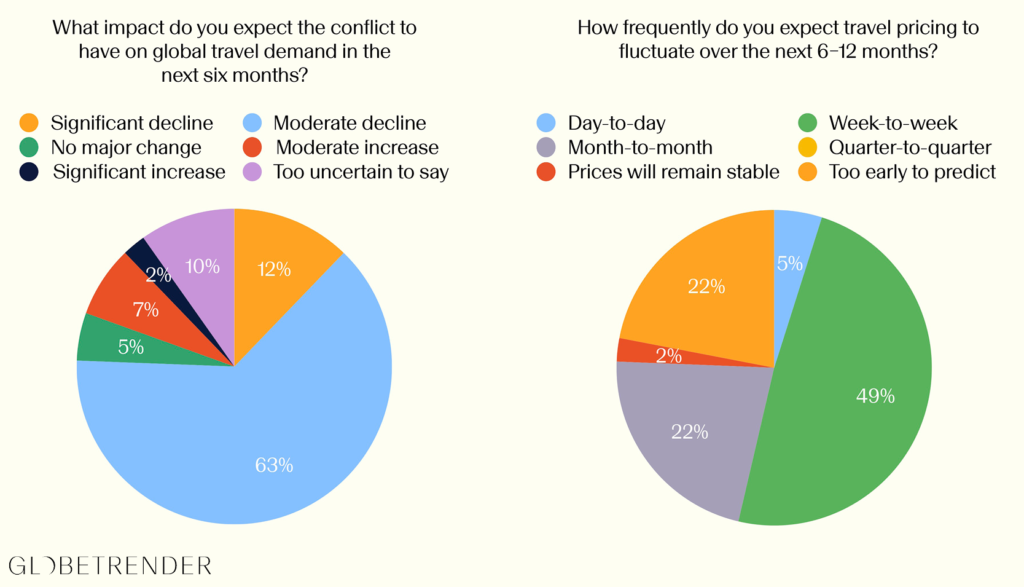
- 63% of executives expect a moderate decline in global travel demand over the next six months while 12% anticipate a significant downturn – mirroring those forecasting growth
- 49% expect week-to-week price fluctuations compared to 22% anticipating month-to-month volatility
- 12% have noticed shorter booking windows, reinforcing a shift towards more reactive, last-minute booking behaviour
- 61% believe the industry will remain volatile but resilient over the next 12 months
- 56% feel very confident in the sector’s ability to rebound
- 46% say Covid-19 significantly improved preparedness, with 24% describing the pandemic’s impact as “transformational”
- 88% believe geopolitical instability is becoming the “new normal” for travel, and yet, just 49% feel very well prepared for future shocks with the majority feeling only somewhat prepared, neutral or unprepared
With limited reliable data on travel industry sentiment towards the ongoing conflict in the Middle East, we turned to our network of C-suite and director-level travel leaders to understand how the ongoing conflict is shaping consumer behaviour and business strategy. This is one of three dispatches drawn from the findings, with the remaining two linked at the end of the article.
Looking ahead to the six months from March 2026, sentiment points to a softening rather than a collapse in demand. 63% of executives anticipate a moderate decline in global travel demand, while 12% expect a significant downturn – mirroring the proportion who are forecasting moderate or significant growth. The outlook, in other words, is finely balanced.
For travellers, however, the picture is more complex. Pricing is expected to become increasingly unpredictable, making forward planning more challenging. Half of executives (49%) anticipate week-to-week price fluctuations, while 22% expect month-to-month shifts. A further 22% say it is simply too early to call, underscoring the level of uncertainty still permeating the market.
This volatility is likely to further compress booking windows, a trend already accelerated by the pandemic. As travellers become more reactive – timing purchases to capture value or avoid price spikes – planning horizons appear to be shrinking. External data supports this shift: according to Criteo, the share of US travellers booking within two weeks of departure rose from 29% in Q3 2024 to 34% in Q3 2025. Globetrender’s survey echoes this trajectory, with 12% of executives reporting noticeably shorter booking windows.
And yet, despite these pressures, the prevailing mood is one of measured optimism. 61% of executives believe the industry will remain volatile but resilient over the next 12 months. Confidence in recovery is also high, with 56% feeling very confident in the sector’s ability to rebound from geopolitical disruption, rising to 15% who are extremely confident.
Much of this confidence appears to be rooted in lessons learned during Covid-19. Nearly half (46%) of respondents say the pandemic significantly improved their preparedness for future disruption, while 24% describe its impact as transformational in building long-term resilience.
However, geopolitical instability presents a different kind of challenge in that it’s less predictable, more fragmented and harder to model all the potential outcomes. This is reflected in a notable preparedness gap.
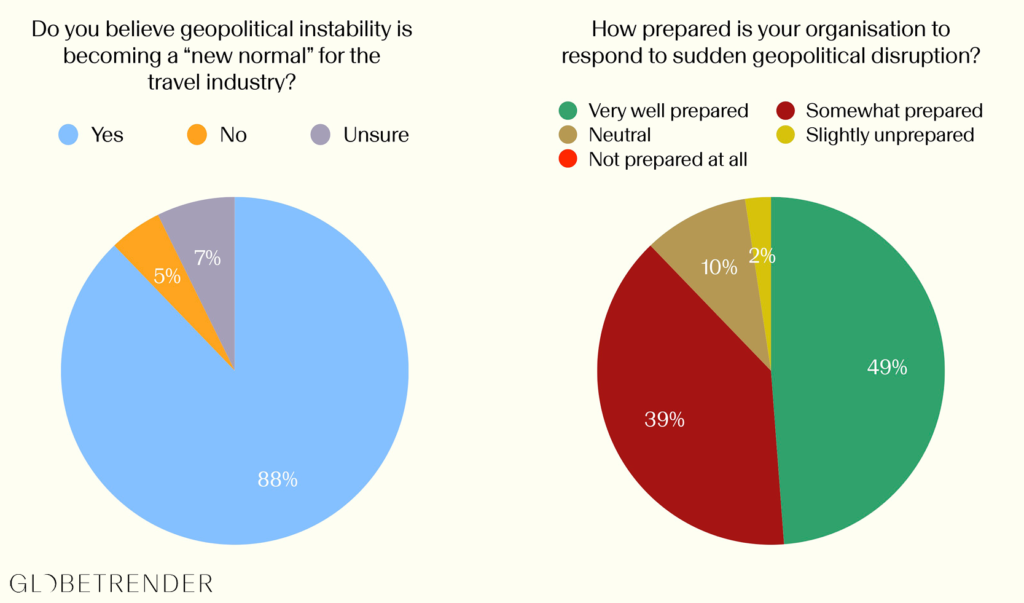
The overwhelming majority (88%) of executives agree that geopolitical instability is becoming the “new normal” for the travel sector. And yet, only 49% of executives feel very well prepared to respond to sudden geopolitical shocks. Meanwhile, the majority (51%) admit feeling only somewhat prepared, neutral or unprepared.
For an industry that has proven its resilience, the next phase will be defined not just by recovery but by readiness. Strategic foresight and scenario planning are fast becoming essential capabilities, rather than optional ones.
Globetrender has a suite of products and services designed to help travel leaders better anticipate and prepare for future disruption, from workshops to intelligence subscriptions. Reach out to discuss how we might be able to help.
Explore the full findings of Globetrender's Executive Travel Pulse
- Destination switching is redrawing global travel map
- Strategic foresight gains urgency amid Middle East conflict
Methodology
Globetrender surveyed 41 senior travel industry leaders from globally operating brands, with 63% of respondents at C-suite level (including CEOs and founders) and a further 32% at director level. The 20-question online survey was conducted in March 2026, capturing perspectives across sectors including hospitality, aviation, travel technology and tour operations.
Responses were anonymised and analysed to identify key quantitative trends and emerging qualitative insights, reflecting industry sentiment at a specific moment in time amid ongoing geopolitical uncertainty.