

A day on Snowdonia with Hypershell’s robotic exoskeleton
What happens when you climb a mountain with a robot strapped to your hips? In Snowdonia, Hypershell’s AI-powered exoskeleton offers a glimpse into a future where technology augments human endurance on the trail. Robbie Hodges reports.
Snowdon, the highest peak in Wales, rises 1,085 metres above sea level – almost 500 metres taller than the tallest skyscraper in Shenzhen, the Chinese megacity where robotics company Hypershell is based. Legend has it that gales once swept through these mountains on the wings of dragons stirred by Merlin’s sorcery. Several centuries later, a different kind of magic is taking hold.
Listen closely and, alongside the ancient bleating of sheep, you might hear it: a faint mechanical whirr carried on the wind. The whispered promise of science fiction made real.
Think “robot” and the mind usually drifts towards chrome limbs, factory floors and the fever dreams of Silicon Valley – Elon Musk prototypes stalking sterile laboratories. Yet here I was instead: wind-whipped on a slope of loose scree, Snowdonia’s peaks unfurling behind me like a silk parachute, the only sounds the plaintive bleating of mountain sheep and the faint, almost apologetic hum emanating from my hips.

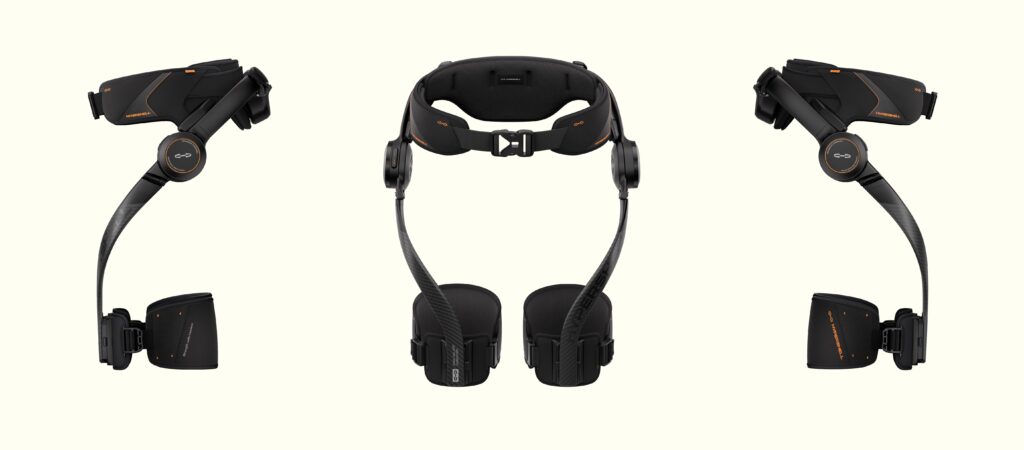
Or rather, from the robotic exoskeleton clamped there – a carbon-fibre crab, pincered to my thighs, tugging each leg uphill like a puppet on a string. She (heaven knows we don’t need more men in tech) had arrived from China’s so-called “City of Miracles”, Shenzhen, just days earlier. Fresh from Hypershell’s factory, the company’s latest model, the X Ultra, had only recently entered production.
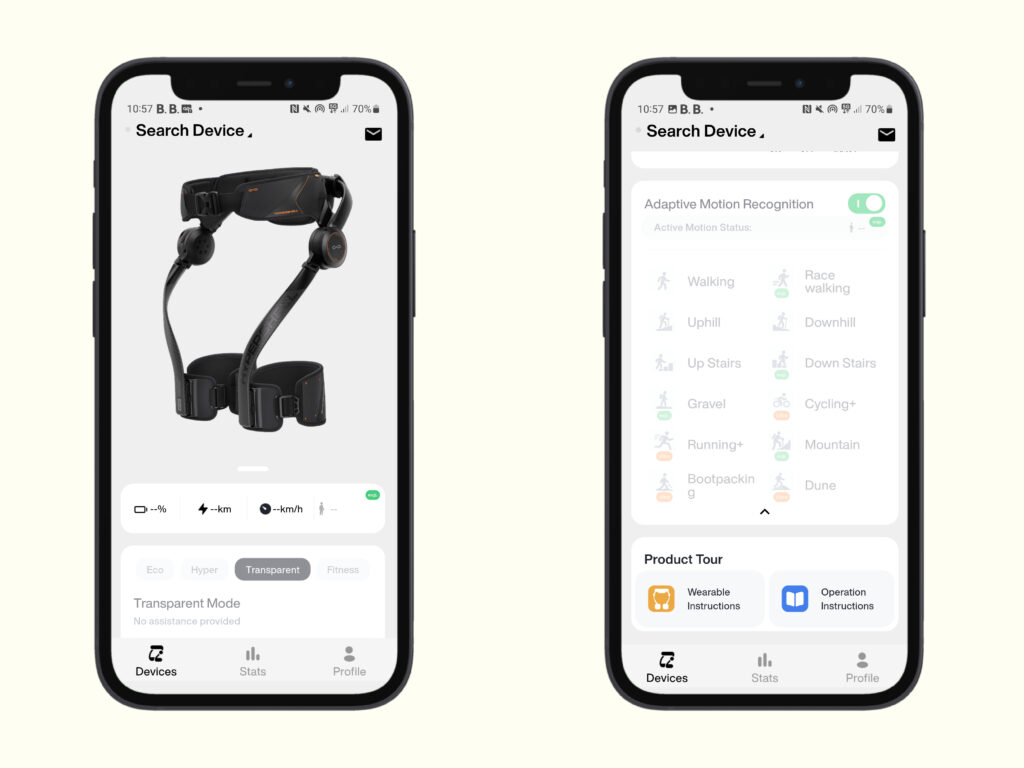
The evening before our expedition, the devices were handed over to us in the cosy snug of a small Snowdonia hotel. Initiation was swift. Each unit needed to be paired with a smartphone via Bluetooth, the companion app acting as a kind of mission control for the machine attached to your waist.
It functions much the same way as its antecedents: an app-based control panel that regulates the power delivered to each step. In theory, in the wrong hands it could send a wearer charging up a mountainside like a malfunctioning cartoon character – a real-world version of Wallace and Gromit’s The Wrong Trousers. After a brief shuffle around the hotel lobby, we called it a night. The next morning, in the long early shadows of a pale sun, we set off into the mountains.
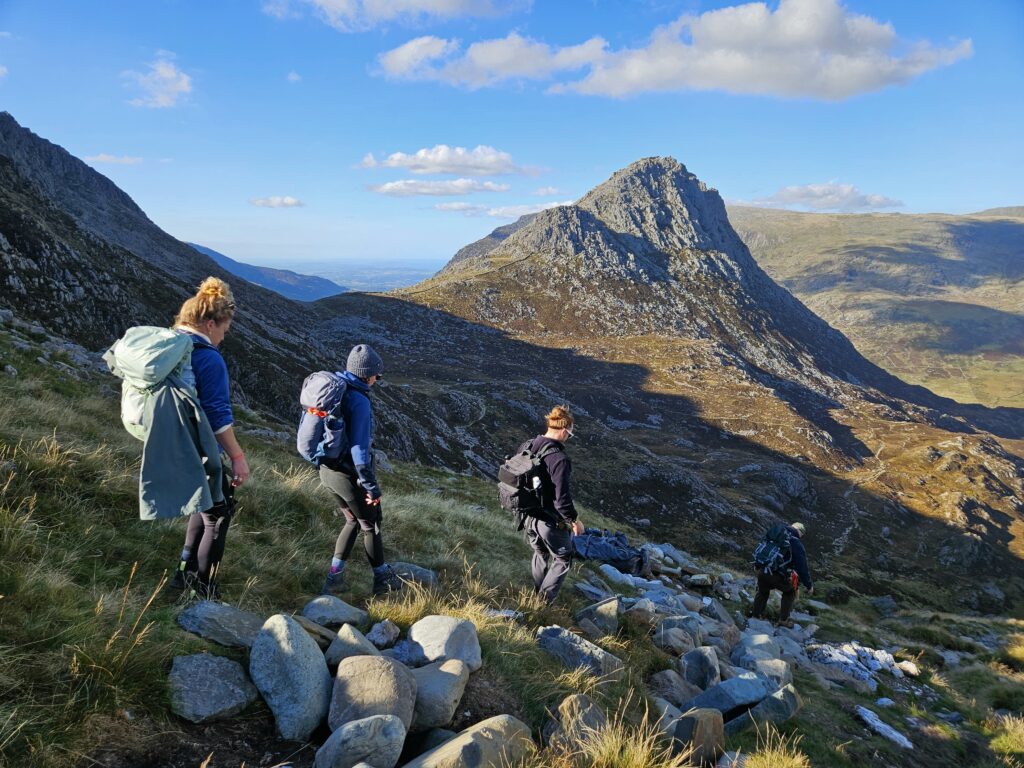
Clamped together, the exoskeleton and I began our ascent across Snowdonia’s scree-strewn slopes. As my body scrambled upward, my mind wandered into the strange territory of human-AI collaboration, a process we’ve all been muddling through in recent years. Whether proudly refusing to touch ChatGPT or happily outsourcing half your emails to it, most of us are renegotiating the relationship between effort and machine assistance. The exoskeleton was conducting its own experiment with my legs.
Inside each hip module sits a compact electric motor capable of delivering bursts of assistance as the gradient steepens. Sensors track cadence, resistance and terrain, adjusting the output accordingly. The entire system weighs just 1.8kg yet can generate up to 1,000 watts of peak motor power – an impressive output for something that resembles a pair of futuristic graphite love handles.
Those graphite appendages are constructed from aerospace-grade titanium alloy and carbon fibre, materials more commonly associated with aircraft components than hiking gear. But that fusion of high-performance engineering and outdoor recreation is precisely the point. Hypershell is attempting something rather unusual: to transform a technology historically confined to hospitals and warehouses into something sleek, wearable and desirable.
Like Peloton, Oculus Rift and many other culture-defining technologies of the past decade, Hypershell’s origin story begins with the power of the crowd. In 2023 the company launched a Kickstarter campaign that raised more than US$1.2 million in just one month, drawing thousands of early adopters intrigued by the idea of wearable robotics for outdoor adventure. Today, tens of thousands of its devices are already in circulation across more than 40 countries.
Scroll through the brand’s online community and a mosaic of motivations emerges. There are athletes chasing marginal gains, naturally. But there are also more poignant stories: hikers returning to trails after injuries, older travellers reclaiming long-abandoned walking holidays, people quietly rediscovering landscapes they thought their bodies had closed off to them.
Strip away the marketing gloss and the Ultra X reveals its deeper identity. At its core, it is a mobility aid – a distant cousin of the wheelchair, a sleeker descendant of the walking frame. And yet it feels nothing like those objects.
Getting buckled into the Ultra X feels closer to stepping into science fiction. And that’s not just some throw-away observation; many of today’s frontier technologies began as speculative fantasies. The idea of the metaverse is drawn from Neal Stephenson’s Snow Crash, Elon Musk’s rockets were inspired by the worlds imagined by Isaac Asimov and Arthur C. Clarke, and the exoskeleton sits comfortably within that lineage.
As we climbed higher into the mountains, the temptation to push harder became almost immediate. The device includes a dozen different movement modes – uphill, downhill, running, gravel, snow – adapting automatically to the cadence of your stride and the resistance beneath your feet.
In theory, the AI handles everything. In practice, I found myself frequently adjusting the assistance levels through the app as we negotiated Snowdonia’s unpredictable terrain. The mountains proved a stern testing ground: loose boulders, steep gradients, sudden scrambles across ancient dry-stone walls. Still, the effect was undeniable.

At certain moments the machine didn’t just nudge my knees forward, it lifted something else as well. The constant mental arithmetic of hiking softened slightly. My head lifted. My attention drifted outward. Across a valley below, two black horses galloped through the grasslands like brushstrokes on a green canvas.
Call me sentimental, but for a while I felt almost weightless, drifting further and further away from the small anxieties of the everyday world until we reached a plateau of jagged grey rockspindly jagged rocks that prodded at the sky while collapsing into themselves like the finger tents of a TV villain. Beyond it stood the summit: the Glyderau Cantilever, a precariously balanced slab of stone jutting above a thousand-foot drop.
Like thousands of hikers before us, we climbed onto the rock and struck a triumphant pose.
Yet standing there, looking out across the Welsh mountains, I couldn’t help thinking about the sepia photograph hanging back at the hotel – a group of hikers from decades past smiling proudly in the very same spot. Their accomplishment seemed uncomplicated: they climbed the mountain, and that was that. Our victory felt more ambiguous.

If theirs was an old Hollywood kiss of triumph, ours felt like a slightly awkward peck assisted by robotics. Somewhere between 25 and 75 per cent authentic.
Exoskeletons tug at the logic of sweat equity. Much like submitting a university essay partly written by AI, they blur the relationship between effort and reward. The brain expects hardship before satisfaction; the machine quietly short-circuits that equation. Synthetic sweat. Synthetic glory.
If the ascent had felt exhilarating, the descent offered a useful corrective. The Ultra X includes a downhill mode designed to reduce strain on the knees by anticipating the next placement of your foot and slightly retracting the leg before impact.
Unfortunately, Snowdonia’s chaotic boulder fields proved too unpredictable for the algorithm. For long stretches I found myself sliding down rocks on my backside, muttering complaints and gasping for water. Several hours later – somewhere between finishing a celebratory can of Tango and collapsing into bed – the true consequences arrived. Headache. Nausea. A deep and unsettling fatigue.

The robot hadn’t harmed me. If anything, it had simply encouraged me to push further than my body had realised. That, perhaps, is the most interesting side effect of wearable robotics. The exoskeleton might grant you superhuman endurance, but you still have to bring your human body along for the ride. And if that body hasn’t been properly fed, watered and rested, the mountain will eventually remind you who is in charge.
For the travel industry, the implications are intriguing. Technologies like Hypershell could quietly expand the boundaries of adventure tourism, opening up mountains, trails and wilderness experiences to travellers who might otherwise struggle with the physical demands – older explorers, those recovering from injury, or simply anyone curious to push a little further than their biology allows.
Electric bikes have already transformed cycling tourism over the past decade. Exoskeletons may yet do something similar for hiking.
Standing on a Welsh mountainside with a small motor humming gently at my hips, it was difficult not to feel that something subtle had shifted. The mountains were exactly the same as they had always been. It was the hikers who were evolving.